
BOOTS FOR ISRAEL CHARITY AUCTION
APRIL 2025 / BIDDING ENDS YOM HAZIKARON
DIRECTLY SUPPLYING ESSENTIAL
ARMY BOOTS TO IDF SOLDIERS

Bid today to support Israel's courageous defenders one pair at a time
Please bid generously on these 40 historic treasures connected to the soldiers and pioneers of Israel, all sourced by the curators at Curio Auctions. Use your charitable giving to acquire heirlooms that will inspire your family’s relationship with tzedaka and the Jewish People for generations, while supporting Boots For Israel mission giving 100% of their funds to soldiers.
The victories of the War of Independence of the State of Israel were full of completely open miracles. The blood, sweat, chutzpah and tears of our soldiers were also undeniable. For the first time in almost 2000 years, the Jewish People had sovereignty of their historic Homeland, but the cost was exceedingly great. Israel lost 10% of its population fighting against the seven Arab aggressor armies and international indifference. But God and a select few devout supporters around the globe were clearly on Israel's side (as is remains till this very day). While the Jews of Eretz Yisrael provided about two-thirds of the funding through taxes, government bonds and the National Loan Program, it was mainly American Jewish donors that donated approximately $150 million to the newly born nation. Prime Minister David Ben-Gurion had to create an entire army out of the handful of leftover WWII crumbs that was able to trickle onto the shores of Israel, typically smuggled via the Haganah's clandestine operations. Like these combat boots, much of Israel's war materiale was made by the the great European powers, and reused by the infant IDF out of sheer necessity. These exceedingly rare surviving relics from the birth of Israel tell an incredible, yet unspoken story. These are a pair of steel 'horseshoe' and stud soled black leather ankle 'ammunition' combat boots, stamped 41, and made by Britain's wartime industries. They ultimately were also stamped on the side with the IDF's 'צ' symbol, and found their way to the grateful feet of a Jewish soldier fighting for survival during the War of Independence. 11.25in; In Battle Worn condition
WAR OF INDEPENDENCE SOLDIER BOOTS
WWII BRITISH MADE, IDF STAMPED 'צ'
1940S, UNITED KINGDOM
RESERVE: $1000 (estimate $2600-$2900)


PARATROOPER COMBAT BOOTS
ISRAELI MADE, IDF STAMPED 'צ'
CIRCA SIX-DAY WAR, HAMEGAPER, ISRAEL
RESERVE: $670 (estimate $900-$1100)
These Six-Day War era IDF Paratrooper red combat boots are vintage icons. Produced by HaMegaper for the Israeli Army, they are size 42, and stamped with the IDF's 'צ' symbol for 'Tzahal'. We can imagine our soldiers liberating the Temple Mount, rushing to the summit while their boots glimmer in the sunlight, with a rifle in one hand, and a flag in the other. Like so much of IDF vintage gear, the history of the red combat boots goes back to the history of the British army. During the British Mandate which began in 1920, the British Paratroopers came to Israel to maintain security in the area. These soldiers came wearing red boots and red berets, which have become the symbol of the IDF Paratroopers. During the first years of the IDF, paratroopers wore special red shoes that were similar to the shoes that the British soldiers had. The reason they wore these was because they were lightweight and more comfortable, helping to soften the impact on the foot as they landed from jumps. The red color was apparently also chosen due to the fact that it easily catches the eye, which is helpful when the paratroopers jump. Despite the Paratroopers Brigade being known for wearing the red combat boots, there are several other brigades today who also wear the red combat boots. The Nahal and Kfir Brigades, as well as the Duvdevan and Oketz units, and the Border Protection Corps are all examples of other divisions in the IDF where they wear red combat boots. The reasoning behind it is because they were all once a part of the Paratroopers Brigade at one point in history and therefore they all have the honor of wearing red combat boots. HaMegaper, ( in-English 'The Vulcanizer') was an Israeli factory for the production of rubber products and shoes, which operated under this name from starting in the 1930s. The Vulcanizer was founded in Haifa as a cooperative factory for the production of rubber products, in particular tires. During World War II, its activities expanded to refurbish tires for the British army. In the 1940s, the Vulcanizer was purchased by the Histadrut and began to focus on shoe production. By the 1950s, the factory produced about 50 different shoe models. The shoes were manufactured according to a patent, which combined the soft leather and rubber, without a seam or tape. 11.25in; In Battle Worn condition


CHALITZAH SHOE
USED BY RABBINIC COURTS
19TH CENTURY, EASTERN EUROPE
RESERVE: $900 (estimate $1600-$1900)
_edited.png)
Chalitzah in traditional Judaism is the process by which a childless widow and a brother of her deceased husband may avoid the duty to marry under the Torah's system 'yibbum', known as 'levirate marriage'. The process involves the widow making a declaration in front of the town elders, scorning the brother for not building his brother's household, loosening and taking off a shoe of her brother-in-law, and spitting on the floor. Through this ceremony, the brother and any other brothers are released from the obligation of marrying the woman to conceive a child that would be considered the progeny of the deceased brother. The ceremony of chalitzah makes the widow free to marry whomever she desires, except for a Kohen. The shoe, which is usually the property of the community, is brought forth and examined as to cleanliness and construction, in accordance with the precepts of the law. The chalitzah shoe is made entirely of leather, usually from the hide of a kosher animal. It is made of two pieces, the upper part and the sole, sewn together with leather threads. Three small straps are attached to the front of the shoe, each of which has a knot at the top to fit a hole made on the other side of the shoe. Two white leather straps attach to either side of the shoe and fasten it to the leg. In the Talmudic period, this tendency was intensified by the apprehension that the brother-in-law might desire to marry his brother's widow for motives other than that of "establishing a name unto his brother." Therefore, many Talmudic and later rabbis preferred chalitzah to marriage. As a result, yibbum fell into disuse; now chalitzah is the general rule and marriage is the rare exception. However, the yibbum law is still presumed to be in force, thus making a childless widow who remarries someone other than her brother-in-law without performing the chalitzah ceremony an adulterer. 10in; In Worn Condition
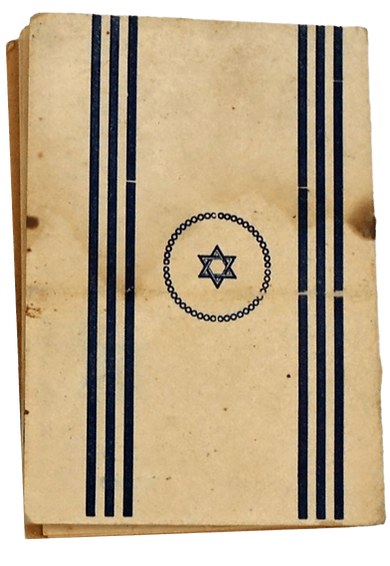
WAR OF INDEPENDENCE BOOKLET FOR SOLDIERS
KABBALISTIC TEXT DEFEATING ISRAEL'S ENEMIES
1948, PUBLISHED IN JERUSALEM, ISRAEL
RESERVE: $1800 (estimate $2400-$2700)

_edited.png)
This miniature booklet was printed in Jerusalem during the War of Independence, published by the Emet v’Shalom Kabbalist Yeshiva as “a segula from an old kabbalah manuscript, and passed from person to person, from Moshe Rabbeinu to fight one’s enemies and defeat them…”. The cover depicts a modified flag of Israel. On the back of the title page is an illustration of Rachel’s Tomb with verses and holy names of God. This small treasured book was given to Haganah soldiers around Jerusalem in 1948 at the height of intense fighting to create a free State of Israel. The National Library of Israel maintains an identical copy in their historic archives. 3.3 x 2in; 8 Pages, In Good Condition with minor discoloration
ISRAEL DEFENSE FORCES PERISCOPE
FOR ARMORED FIGHTING VEHICLES
LATE 20TH CENTURY, UNI-SCOPE SYSTEMS, ISRAEL
RESERVE: $1200 (estimate $1500-$1800)


This functioning periscope was made by Uni-Scope Optical Systems in Karmiel Israel for the IDF Armament Corps. Stamped for use in battle with the IDF's 'צ' symbol, the raised Hebrew lettering denotes its use for the military vehicle's commander complete with laser shielding. The Israeli Armored Corps was first assembled during the War of Independence. The corps started from the Palmach's armored unit, that was established on February 24, 1948. Yitzhak Sade was appointed as its first head, with personnel recruited from various places such as the British army and other allied countries' militaries, members of the Haganah, the Palmach, and other resistance movements. Tanks and armored fighting vehicles use periscopes: they enable drivers, tank commanders, and other vehicle occupants to inspect their situation through the vehicle roof. Prior to periscopes, direct vision slits were cut in the armor for occupants to see out. Periscopes permit view outside of the vehicle without needing to cut these weaker vision openings in the front and side armor, better protecting the vehicle and occupants. A protectoscope is a related periscopic vision device designed to provide a window in armored plate, similar to a direct vision slit. A compact periscope inside the protectoscope allows the vision slit to be blanked off with spaced armored plate. This prevents a potential ingress point for small arms fire, with only a small difference in vision height, but still requires the armor to be cut. In the context of armored fighting vehicles, such as tanks, a periscopic vision device may also be referred to as an episcope. In this context a periscope refers to a device that can rotate to provide a wider field of view (or is fixed into an assembly that can), while an episcope is fixed into position. 12.25 x 6in; In Battle Worn but Good Condition with some wear
ISRAEL DEFENSE FORCES PASSOVER HAGADAH
SOLDIER BLESSING 'ON THE NILE BANKS' BY
CHIEF MILITARY RABBI GENERAL SHLOMO GOREN
1970, PUBLISHED IN TEL AVIV, ISRAEL
RESERVE: $500 (estimate $900-$1200)
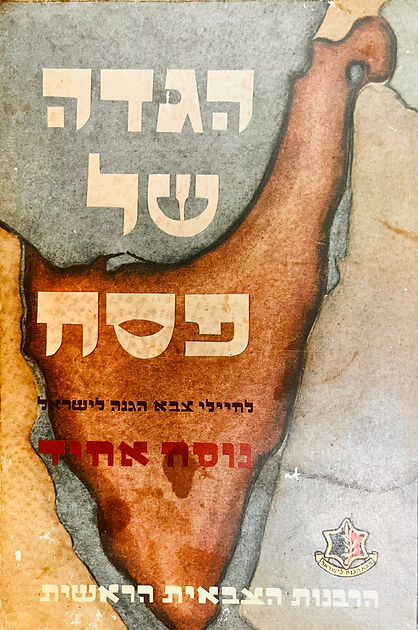

This Pesach Hagadah was created shortly after Israel's miraculous victory of the Six-Day War. It displays a beautifully designed cover with the newly created map of the State of Israel including the newly acquired Sinai Peninsula, conquered from the Egyptians. The back cover highlights the recently won Temple Mount, and logo of the IDF Chief Rabbinate. Chief Military Rabbi General Shlomo Goren begins the text with a blessing to our soldiers. Goren's military career as an Orthodox Jew was characterized by a commitment to the Religious Zionist values of his youth. He volunteered for the Haganah in 1936, and served as a chaplain for the Jerusalem area following the outbreak of the 1948 Arab–Israeli War, during which he tested for and qualified as an IDF paratrooper. 'Since our departure from Egypt from the slave trade to eternal freedom, the Pesach lamb symbolizes the continuous heroic struggle of the Jewish People for national salvation, and for the right to exist as an independent people in their own land. It serves as a source of inspiration, security and hope for its third redemption, which is about to come. And now the days of expectation and vision have come, the chapters of the Hagadah have taken shape, and have become a reality in our national life. We are now celebrating the holiday of Pesach on the banks of the Nile of Egypt, in the Sinai Desert, on the Jordan River, and on the Golan Heights and Hermon, on the mountain of the Lord and in holy Jerusalem. And on the day we left the land of Egypt, the Lord showed us wonders. At the same time, biblical prehistory repeats itself. The Egyptian enemy has once again stood at the head of Israel's adversaries, he is hardening his heart and strengthening his spirit against us, and he is putting the blood of war in peace, despite the miraculous signs and renewed plagues that were inflicted on him in heaven and on earth. May this holiday of redemption be a spiritual resource to strengthen our confidence and to root our faith in the eternity of Israel and confidence in the fulfillment of the vision of peace and redemption as stated: And now thus says the Lord, your Creator, Jacob, and your Redeemer, Israel: Fear not, for I have called you by your name, I have redeemed you; for I will pass through the waters with you, and through the rivers they shall not overflow you; for you shall walk through the fire, you shall not be burned, nor shall the flame kindle in you, for I am the Lord, your God, the Holy One of Israel, your Savior.' 9.25 x 6.5in; 84 Pages, In Good Condition
IDF'S FIRST PASSOVER HAGADAH
BLESSING TO WAR OF INDEPENDENCE SOLDIERS BY
CHIEF MILITARY RABBI GENERAL SHLOMO GORONCZIK
1949, PUBLISHED IN JERUSALEM, ISRAEL
RESERVE: $1500 (estimate $2200-$2400)


The unit of the Military Rabbinate was created at the same time as the Israel Defense Forces in 1948. The Chief Military Rabbi, appointed by the Chief of Staff, is the highest religious authority in the IDF and advises the Chief of Staff on matters relating to religion. According to the law, a representative of the rabbinate must be present in each IDF unit. These representatives are in charge of all religious aspects according to the needs and traditions of the soldiers. This is the IDF"s first Hagadah printed after the creation of the Jewish State by the first Chief Rabbi of the army, who was then still known by his original family name, Rabbi Shlomo Goronczik, a year later changed to 'Goren'. Then also a Brigadier General, the Chief Rabbi opens the Hagadah with a heartfelt blessing to both the soldiers who recently finished the grueling battles of the War of Independence, and an added blessing to the IDF's top commanders. "To the soldiers of the Israel Defense Forces wherever you are! After two thousand years of both physical and spiritual slavery, this is the first time that we celebrate the holiday of Passover - the holiday of freedom, from real freedom, national freedom, political freedom, and spiritual freedom. The light of redemption and redemption that appeared in the skies of Israel in the darkness of Egypt has shone upon us anew. And as when we left Egypt, we saw the wonders of God, in the heroics of the war of liberation that we waged in our holy land. Carry high the banner of freedom and splendor that was purchased by you with supreme courage and great devotion, until we are worthy to witness the vision of complete redemption, and to celebrate the holiday of Passover in the Temple of God in Jerusalem, the capital, built on a mound. B"H To the Chief of Staff, the General Staff, commanders and soldiers of the Israel Defense Forces! On the eve of the first Independence Day in the State of Israel, I extend a holiday blessing. This holiday served as a ray of light and encouragement to our people throughout the dark days of exile. It reminded us of the wonders of our exodus from Egypt to freedom and freedom. It strengthened the faith in the Rock of Israel and its Redeemer, who will bring us out of slavery to redemption. This faith is what filled the defenders and liberators of the homeland with the strength and the power to stand bravely, adorned with majesty and glory, in all the difficult campaigns. We honor this holiday today as a symbol of the fulfillment of the vision of our prophets and a great lever for the gathering of our scattered people in a homeland built from freedom and preserving our eternal values." 8 x 5.5in; 30 Pages, In Good Condition with appropriate Seder used wine stains
RABBI GOREN SHOFAR BLOWING AT THE KOTEL
ICONIC PHOTO WITH SIX-DAY WAR PARATROOPERS
FAMED PHOTOGRAPHER DAVID RUBINGER
JUNE 7 1967, JERUSALEM, ISRAEL
RESERVE: $1200 (estimate $1800-$2200)
When at the height of the 1967 Six-Day War, brigade commander Motta Gur was given the order to take the Old City, IDF Military Chief Rabbi General Shlomo Goren sprinted straight toward the Lions’ Gate. Paratroopers were spread out along both sides of the road, with heavy artillery raining down incessantly. At the gate, a bus was on fire, and a tank had stalled. “Rabbi Goren, you’ll get yourself killed,” a battalion commander shouted. “Come with us and stick close to the wall.” “I’m the highest-ranking officer here,” the Chief Rabbi, replied. “You can’t make me do anything.” Goren had in mind the Biblical practice of blowing a horn in the heat of battle. In the Book of Numbers, God instructs the Israelites: “and if you go to war in your land, against the enemy that oppresses you, then you shall blow an alarm with the trumpets; and you shall be remembered before the Lord your God and you shall be saved from your enemies.” Drawing closer to the Lions’ Gate, Rav Goren began blowing the shofar. The Israeli troops reached the tank that had been stuck, blocking the entrance to the Temple Mount. So Goren climbed it and slid down the other side. Making his way to the site of the Temple, in between blasting the shofar, he prayed-shouted to the soldiers, “In the name of God, take action and succeed. In the name of God, liberate Jerusalem, go up and be successful.” The Old City was recaptured by the IDF. Jerusalem was reunified. When the dust had settled, Goren headed from the Temple Mount down to the Kotel. A minyan was gathered. There the rabbi recited Kaddish for the soldiers who had fallen in battle. Someone made an audio recording. Paratroopers can be heard crying as the prayer ends. Rav Goren then blew the shofar, while famed photographer David Rubinger was able to capture this historic moment for us all. David Rubinger was one of the important photographers who worked in the State of Israel in the first decades of its existence. Born in Vienna, Austria, in 1924, he made Aliyah in 1939. In the years 1942-1945 he served in the British Army, as part of the Jewish Brigade. Between the years 1954-2001 he was an official photographer for TIME and also photographed independently for newspapers in Israel and around the world. In 1997 Rubinger won the Israel Prize. This period print from his studio is as iconic today as it was when the Temple Mount & Kotel came back into our hands. 7.25x 4.52in; In Very Good condition

ART NOUVEAU PASSOVER SEDER PLATE
CZECH PORCELAIN WITH FINE GILT
1920S, KARLSBAD, CZECHOSLOVAKIA
RESERVE: $1600 (estimate $1900-$2200)

The Art Nouveau movement began in 1890 with the goal of modernizing design and abandoning the classical, historical styles that had previously been popular. Art Nouveau artists drew inspiration from natural elements, such as flowers or insects. Curves, asymmetrical forms, and intense colors were other common motifs of the movement. The Art Nouveau aesthetic also appeared in various media, including decorative art, paintings, architecture, and even advertisements. Art Nouveau’s origins can be traced back to the Arts and Crafts movement, a reaction to the academic art styles of the 19th century. An influx of Japanese woodblock prints that contained floral motifs and strong curves also influenced the style. Art Nouveau remained popular until 1905 but today is considered an important predecessor to Modernism. This stunningly beautiful seder plate is made of white porcelain with a spectacular pearly glaze and gilt decorations. Identical examples feature in Jewish museums worldwide. In the center, an inscription of Karlsbad, the famed spa city also known as Karlovy Vary. Manufacturer's stamp on the reverse reads 'TK Thun Czechoslovakia'. 9.5in Diameter; In Good Condition with minor wear to gilt.
EXTRAORDINARY MOSSAD SPY
ERETZ-YISRAELIT PASSOVER HAGADAH
1953, PUBLISHED IN TEL AVIV, ISRAEL
RESERVE: $1500 (estimate $1900-$2200)


French-German artist Charles Duvall was a darling of Cairo’s high society, a bohemian character who styled himself as 'Charduval'. He was a tall young man with a cigarette dangling permanently from his lips. He relocated from Paris to Cairo in 1950 after declaring his love for the land of the Nile. Local Egyptian art critics gushed about his work, which they felt was strongly influenced by Picasso, displaying a modern abstract style with Oriental themes. Charduval was honored with a November exhibition of his work at the national Cairo Museum of Modern Art, which even caught the attention of art lover and the King of Egypt, Farouk I. The Egyptian Minister of Culture was such a fan of his artistry that he bought two Charduval paintings for his personal collection. It was an impressive debut for a young artist, made even more remarkable by Charduval’s real identity: the ‘artist’ was Mossad spymaster Shlomo Cohen-Abravanel, posing as a painter while running an Egyptian spy network for the Zionist State. Cohen-Abravanel operated networks of agents in Egypt and recruited new assets throughout the Arab world. He collected information about Nazi war criminals who had taken refuge in the Middle East, and he reported to his Mossad superiors on the initial attempts of German rocket scientists to sell their services to Arab armies. Shlomo Cohen-Abravanel was born in Hamburg, Germany in 1921, one of four sons. With the rise of the Nazi party his family moved to France and later Palestine in 1935 where he worked as a graphic artist and served in the Haganah. WWII’s end allowed Cohen-Abravanel to return to France in 1947 to study art, but the Haganah recruited him for Operation Aliyah B, based out of Marseilles. His first job for the covert secret services was to use his artistic talents forging passports and travel visa documents used by Jewish refugees smuggled into Palestine in violation of anti-Jewish British Mandate immigration limitations. When Cohen-Abravanel returned to Israel after his stint as an undercover artist in Egypt in 1952, he established the Mossad unit to find and kill escaped Nazis. He was reportedly involved in the search and capture of Nazi war criminal Adolf Eichmann, a German SS officer and the focus of Operation Finale. Shlomo Cohen-Abravanel had obtained a crucial lead in the operation: the Eichmann family's address in Buenos Aires Argentina. Years later, Eichmann was hanged by Israel for his part in the Holocaust and extermination of Jews. In 1960, he was appointed the first commander of the "Amal" unit in the Mossad, a special unit established to combat manifestations of anti-Semitism and neo-Nazism around the world. He was said to be a major figure in the Middle East, Europe, and South America, ultimately serving as Mossad’s deputy chief. After taking a command role in Mossad, Cohen-Abravanel also designed the agency’s emblem. At its center is a seven-branch menorah and a seal that bore a legend: "For by subterfuge you will make war." This was later changed to: "Where there is no subterfuge - the nation falls, but in the multitude of counselors there is safety. Shlomo Cohen-Abravanel died on July 4th 1981 at age 60. His cause of death wasn't publicly revealed. However, his name and talent lives on. Cohen-Abravanel apparently spent his spare time in the 1948 War of Independence between his undercover work for the Haganah, illustrating this beautiful edition of the Hagadah. This rare Hebrew/English edition titled 'Hagadah Eretz-Yisraelit l'Pesach' was published by Sinai in Tel Aviv, at the beginning of the State of Israel. This treasure contains some of Cohen-Abravanel's illustrations highlighting his Zionist pioneering ethos of Jewish self-defense, including photographs of the building of the Yishuv. 7.25 x 4in; 50 Pages, In Excellent Condition

BERLIN JEWISH COMMUNITY WINTER RESCUE
PASSOVER HAGADAH PRINTED IN NAZI GERMANY
1938, PUBLISHED IN FRANKFURT, GERMANY
RESERVE: $700 (estimate $900-$1200)


This beautifully illustrated Passover Haggadah published in Hebrew and German was printed during the Nazi regime's height of power, just before its invasion of Poland. The Hagadah was distributed by the Jewish Winter Rescue Organization of the Berlin Jewish community as touchingly described on the original book plate label of the inner hard cover. The "Winter Rescue" nonprofit was founded in the early 1930s to assist Jews in-need by supplying food, medicine, and heaters. In 1938, the persecution of the Jews in Germany escalated tremendously with increased ferocity. Throughout that year, registration of Jewish property and its forced expropriation grew, including the brutal eviction of Polish Jews and invalidation of many Jewish passports. In November of 1938 the devastation of the Kristallnacht pogrom took place. 8.5 x 5.5in; 64 Pages, In Good Condition

WWII JEWISH BRIGADE SOLDIER GIFT
AFIKOMEN MATZAH POUCH
1943, ERETZ YISRAEL
RESERVE: $850 (estimate $1100-$1500)
Created for soldiers in Eretz Yisrael that joined WWII's Jewish Brigade, The National Committee for the Jewish Soldier, established at the initiative of Yosef Baratz, worked to meet all the needs of Jewish soldiers serving in the British Army. The committee contacted the British military authorities to raise awareness of the needs of Jewish soldiers. Its members saw to cultural matters first, sending newspapers in Hebrew, organizing Hebrew theater events, and even arranging Hebrew and English lessons in the various army units. Alongside all this, the committee provided the soldiers with religious items such as bibles, tefillin and prayer books, as well as kiddush cups and candlesticks, so that they could observe the Sabbath. In addition, the committee naturally also sought to provide the soldiers, especially those who had been wounded, with financial assistance. The Hebrew on this linen pouch notes it was a gift for Passover 5704/1943 and displays the Committee's emblem of a male and female soldier in profile sporting the British military uniform of the time. 8.5 x 9.25in; In Good Condition with aged discoloration

BAR KOCHVA REVOLT
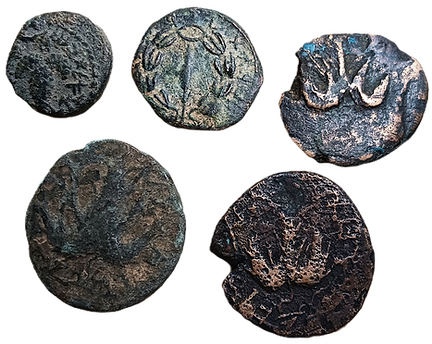
FIVE ANCIENT BRONZE COINS
'FOR THE FREEDOM OF ZION'
132-135 C.E., ERETZ YISRAEL
RESERVE: $3000 (estimate $3600-$4000)
The Bar Kochva Revolt (132–136 CE) was the third and final war between the Jewish People and the Roman Empire. It followed a long period of tension and violence, marked by the first Jewish uprising of 66-70 CE, which ended with the destruction of the Second Temple. The Bar Kochva Revolt differed markedly from its predecessors. For the first time, the Jewish soldiers presented a united front against Roman forces and fought underneath a single charismatic leader, known as Shimon Bar Kochva. It was marked as well by strong religious passions, with man believing that Bar Kochva was the Mosiach who would lead the Jewish People to final victory against their enemies. The war shattered Judean society and led to far-reaching demographic and political changes, with the majority of the Jewish population of the province killed, enslaved, or exiled, and their national hopes definitively crushed. The Jewish People would not regain their political independence until the Zionist era and the establishment of the State of Israel in 1948. During the revolt, large quantities of coins were issued in silver and copper with rebellious nationalistic inscriptions, all being overstruck on foreign Roman coinage. The coins feature symbols of Judea such as the date palm tree, King David's harp, grape clusters, and the names 'Shimon' or 'Eleazar the Priest' written in Paleo-Hebrew. Some also show symbols connected to Sukkot, such as the lulav and etrog, and the words 'For the Freedom of Zion' or 'Year One of the Redemption of Israel'. (coins come with an added certificate of authenticity plus export license from the Israel Department of Antiquities) Coins of various sizes; Obverse and Reverse in Good Condition
_edited.png)
_edited.png)
RAV AVRAHAM YITZCHAK HAKOHEN KOOK
INSPIRATIONAL PRESENTATION FOR JEWS WORLDWIDE TO REBUILD 'THE GREAT HOUSE OF ISRAEL' WITH PHOTOGRAPHS
1925, JERUSALEM, ERETZ YISRAEL
RESERVE: $700 (estimate $900-$1200)


Rabbi Avraham Yitzchak HaKohen Kook, born in 1865 Latvia, spent his life giving to Israel and is considered one of the fathers of Religious Zionism. Rav Kook made Aliyah in 1904 to serve as the Chief Rabbi of Yafo. He later established the Chief Rabbinate and was elected to serve as the first Ashkenazi Chief Rabbi of Israel until his passing in 1935. Rav Kook was a genius of the Torah world, a halachic authority, and one of the most important luminary spiritual leaders of his generation. He was also an expert in Jewish and non-Jewish literature and well versed in modern philosophy. In his various works he demonstrates his unique and graceful writing style. The subject of Knesset Yisrael, which is central to Rav Kook’s thought, develops the idea that individual nationhood is an ideal. Each nation has a particular purpose in the world, a specific quality which it emphasizes. Each nation is a unique integral part in the family of nations that make up the human race. Nevertheless, writes Rav Kook, the world will reach a stage when all nations have imparted their unique contribution, and then the nations will be disbanded. The nation of Israel, however, will still remain. In his Orot, Rav Kook writes that the essence of Israel is its connection to God on a national level. The focal point around which Israel was created and continues to draw its existence is its relationship with God. It is impossible to relate to Israel outside the context of God. This is reflected by the fact that Judaism is ideally structured at the national level, embodying laws governing kings, taxes, the army and detailed civil laws. It follows from this that according to Rav Kook, the nation and religion are inseparable. The religious outlook and our understanding of God derive from the relationship between God and Israel. Torah is meaningless without Israel. Conversely, there is no significance to the Jewish People without the religious element. The relationship with God forms the character of the people and its history. There is no other people whose national structure is so dependent on God; and this is Knesset Yisrael. This rare English/Hebrew beautiful art-nouveau designed presentation edition with gilt embossed cover was printed in 1925 by the Rav Kook associated Central Committee Knesseth-Israel Jerusalem. In it he asks Jews worldwide to become a "Ceaseless helper in the practical building work for all endless times...Your share will continue to build again, and again, and never cease to build in Eretz-Israel...Lift up your hands in holiness to the Lord and help to get the great House of Israel built.' 7.25 x 5.25in; 56 Pages, In Good Condition
WWII JEWISH BRIGADE TRENCH ART
BRASS ARTILLERY SHELL ENGRAVED WITH
JERUSALEM OLD CITY & LAND OF ISRAEL MAPS
1944, SHELL MADE IN QUEBEC, CANADA
RESERVE: $3600 (estimate $4000-$4500)
.png)

This beautiful trench art hand-engraved heavy artillery brass shell was likely created by a WWII soldier while serving in the Jewish Brigade under the British army. One side of the polished shell is a map of the Land of Israel with cities and landmarks noted in Hebrew, including Hevron, Yafo, Acco, Yerushalayim, Shechem, Beer Sheva, Aza, Ashdod, Ashkelon, and most interestingly 'Etzion Geber' the Biblical name for what would become the region of Eilat after 1948. The shell's other side depicts a fascinating map of the walls and gates of Jerusalem's Old City, including the Temple Mount. The Hebrew lettering marks locations such as the Kings' Graves, Gihon Spring, Rachamim Gate, Tzion Gate, Yafo Gate, New Gate etc.., including a crescent, cross and star placed accordingly to denote the various quarters of each religion's control within the city. The shell was used in an Ordnance QF 25-pounder heavy artillery gun, with a caliber of 3.45 inches. This piece of field artillery was commonly used by British and Commonwealth forces in the Second World War. Durable, easy to operate and versatile, it was the most produced and used British field gun and gun-howitzer during the war. The shell was produced in 1944 by the Robert Mitchell Company in Quebec, Canada. The 25-pounder gun fired two-part ammunition – the projectile was loaded separately from the propelling charge in its brass cartridge case with its integral primer. Trench art can be defined as any item made by soldiers, prisoners of war, and civilians, from war matériel, as long as it and they are connected in time and space with armed conflict or its consequences. Trench art is war art, but in its sensuous and tactile qualities, and its memory-evoking power, it is far more than that, because it can simultaneously embody the experiences of its makers and transform their pre-war selves. The maker of this item, clearly had a heart and vision for Zion. 11.5 x 4in; In Good Condition
LARGE MAP OF THE STATE OF ISRAEL
WAR OF INDEPENDENCE ARMISTICE LINES
JULY 1955, PUBLISHED IN ISRAEL
RESERVE: $500 (estimate $900-$1200)
On April 3rd 1949 in Rhodes Greece, with UN mediation, Israel concluded armistice agreements with Jordan, Egypt, Syria, and Lebanon, thus reaching an official cessation of hostilities of the first Arab-Israeli war that had started in May 1948. Iraq and Saudi Arabia, whose forces took part in the war, never signed any agreements with Israel. The parties agreed that the armistice agreements would serve only as interim arrangements until replaced by permanent peace treaties. Israel's territory according to the agreed 1949 Armistice Demarcation Line encompassed about 78% of the Mandate area, while the other parts, namely the West Bank and the Gaza Strip, were occupied by Jordan and Egypt respectively. The 1949 Armistice Lines between Israel and its Arab neighbors came to be known as The Green Line (and is shown in green on this map). The line also bisected the city of Jerusalem. Around Latrun, west of Jerusalem, as well as in small areas inside the city, a no man’s land was established. The rest of the armistice line followed the 1922 border between Palestine and Transjordan. The total length of the armistice line was 637km, of which 330km constitute the border between Israel and the West Bank. Jordan officially annexed the West Bank in 1950, a move that was only recognized by Britain and Pakistan. Israel took control of the West Bank as a result of the 1967 Six Day War. This large colorful map highlighting the 1949 War of Independence Armistice Lines, also details the cities of Haifa, Tel Aviv, and a bitterly divided Jerusalem. The topography of the map is based on the British Mandate authority geological survey of 1924. 38.75 x 15.75in; In Good Condition with minor wear


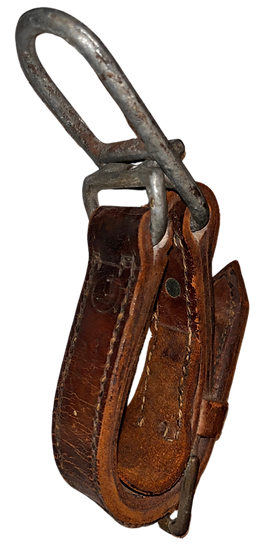
WAR OF INDEPENDENCE IDF CAVALRY
ARTIFACTS, WWII BRITISH MADE
1940S, UNITED KINGDOM
RESERVE: $7500 (estimate $8500-$9500)
_edited.png)
_edited.png)

Before us is among the rarest of all possible relics of IDF equipment from our 1948 War of Independence. Did you even know the Israeli army had a cavalry unit? The First Cavalry Battalion of the IDF was a unit established in January 1948, using horses for patrol, as well as, operating pack animals, for transportation. The unit took inspiration from the Jewish soldiers of the Zion Mule Corps that took part in World War I. The Zion Mule Corps was initiated by Ze'ev Jabotinsky and commanded by Joseph Trumpeldor, taking part in the Battle of Gallipoli. The IDF calvary battalion was established as a transportation service, used for mountainous and desert areas, utilizing horses, mules, donkeys, and even camels. Its first commander was veterinarian Chaim Applebaum. On August 11, 1948, the battalion commander, Appelbaum, distributed a document to his soldiers regarding the marking of IDF animals. "All pack and riding animals belonging to the Israeli army units must be marked with the letter C on the left hind thigh. The serial number of the animal is determined on the hoof of the left hand. The hooves in the service of the battalion are marked from number 1 to 500." During the War of Independence, the unit participated in many operations on all fronts, including the Ten Days' Battles and convoys through the Burma Road to Jerusalem. Sometimes battalion soldiers had to put rubber hooves on their animals to silence their footsteps during secret operations. At its peak, it numbered about 300 soldiers and 200 animals. The battalion was disbanded in 1949. Our leather items here are all British-made for their own military needs in WWII, later appropriated by the Israel Defense Forces and twice stamped with the 'צ' for 'Tzahal'. The buckle and straps are also embossed with the IDF symbol adjacent to the British military original markings. The leather saddle bag horseshoe satchel (complete with period iron horseshoe), has a built-in scabbard holder, and was made by 'Butler Brothers Makers of Walsall & London', which itself was established in 1812, famed for their military saddles and harnesses. Click here for more information in Hebrew plus photographs about this unique story in Israeli military history, and here for a rare video of the IDF calvary horses in action. (see adjacent photo of IDF cavalry soldiers from 1948) 6.5x 6in Leather Horseshoe Satchel; In Very Good Condition
IDF TEFILLIN & BAG FOR SOLDIERS
FROM IDF MILITARY CHIEF RABBINATE
CIRCA SIX-DAY WAR, ISRAEL
RESERVE: $500 (estimate $900-$1200)
.png)
And it shall be for a sign upon your hand and Tefillin between your eyes' -Shemot 13:16 This cloth bag from the 1960's in military green displays the symbol of the IDF, line from Shemot, and recited during the Shema, and labeled as coming from the IDF Military Chief Rabbinate. The small Tefillin themselves are quite special and old, of an indeterminate age, but most likely European in origin. Traditional rabbinic tradition is that Tefillin in particular protects the wearer, and is known for providing Divine protection and casting fear on Israel's enemies. Many rabbis explain that just as a soldier has to be properly equipped (with boots, helmet, vests, etc.) for protection, so it is in the case of the Jew who has special 'equipment' ordered by God, of which Tefillin is one of the most important, and necessary not only for his own safety but also for the benefit of his fellow soldiers. 7 x 6in; In Good Condition
CHANUKAH GELT AND BLESSING FOR IDF SOLDIERS
'SOLDIERS ARE THE RANK OF COMPLETE TZADIKIM'
FROM THE REBBE MENACHEM MENDEL SCHNEERSON
CIRCA YOM KIPPUR WAR, KFAR CHABAD, ISRAEL
RESERVE: $1770 (estimate $2770-$3770)


Rabbi Menachem Mendel Schneerson, known as the Lubavitcher Rebbe, was a passionate supporter of the State of Israel, and had a deep love for the soldiers of the IDF. For example, the Rebbe hosted a group of wounded IDF veteran soldiers visiting New York in 1976. The Rebbe spoke to the group in Hebrew, and afterwards went over to each one of them and shook their hands. The Rebbe, as a leader who was exemplary in his care and sensitivity for every individual, utilized the opportunity to encourage and guide these disabled veterans how to cope with their challenges with a positive frame of mind. He explained that when someone has a physical weakness or lacking, it is proof that the Creator has endowed him or her with special spiritual powers which enable him to overcome and succeed where the ordinary person cannot. He went on to say that injured soldiers should not be called “handicapped,” indicating inferiority. To the contrary, they are “exceptional.” They have the ability to be a living example of joy and self-confidence, and express how every Jewish man and woman—regardless of their physical or bodily state—possesses a Divine soul which enables them to overcome any limitations. This lot honoring the Rebbe has a small booklet given to IDF soldiers as a blessing for their success and protection, and a recommendation that the tzedakah given to them be used half for their tzedakah giving and half for their needs of the army. In this booklet, 'The Rebbe explained that all the soldiers who were called up and went out to the Yom Kippur War were of the rank of complete righteous men. After all, the war began on Yom Kippur, about which the Sages said, "The Day of Atonement." Even after Yom Kippur, it is a great and wonderful privilege for those who give their lives to defend our holy land and the people of Israel.' The packet of Chanukah gelt, has an Israeli 1 Lira coin. The Rebbe was famous for standing for hours handing out money with the intention that they recipient would give tzedakah themselves and use the funds to help them study Torah. 4.75 x 3.25in; 14 Pages, In Good Condition
STATE OF ISRAEL VICTORY MAP PUZZLE
LAND CONQUERED DURING THE SIX-DAY WAR
CIRCA SIX-DAY WAR, PUBLISHED IN ISRAEL
RESERVE: $180 (estimate $300-$360)

Israel miraculously defeated the Arab armies and captured the Sinai Peninsula and the Gaza Strip from Egypt, the Golan Heights from Syria and the West Bank from Jordan. The new ceasefire lines were easier for Israel to defend as most of them stretched along geographical barriers such as the Jordan River and the Suez Canal and because they provided strategic depth. Following the war, Israel's pre-war economic slow-down changed into economic growth. While Israelis and the Jewish People as a whole acquired a new sense of pride in their state's achievements, the consequences of the war gave birth to a new public discourse and controversy over the future of the captured territories. On the Arab side, in spite of the militant Arab Summit of 1967 in Khartum (no peace, no recognition, no negotiation), the sweeping defeat created long-term and deep shock-waves, which, on the one hand, brought most of the Arab states to realize that Israel can not be wiped out easily, and on the other hand, created a surge of Palestinian nationalistic and terrorist activities. 12.75 x 8.75in; In Good Condition
WAR OF INDEPENDENCE HISTORIC PHOTO
BORIS CARMI SIGNED 'GIRL WITH A PISTOL'
A FEMININE ZIONIST SABRA ICON
JULY 1948, BEN SHEMEN, ISRAEL
RESERVE: $1200 (estimate $1800-$2000)
In the center of this historic photograph, appears Palmach fighter Ziva Arbel armed with a pistol, head covered with a keffiyeh, forehead bandaged, khaki shorts and bare legs, lost in thought, while leaning on a pine tree. This photograph has become a long-standing icon of Israeli Sabra femininity. Ziva Arbel (born 1927 in Edirne, Turkey) participated in War of Independence battles for Tzfat, Lod, including invasions into Syria and Lebanon, and Operation Yoav. She was the only woman participating in the Yiftah Brigade's battle to occupy Lod side by side with 136 Palmach soldiers. After the battle she was photographed by famed photographer Boris Carmi while attending a gathering of soldiers in the Ben Shemen forest, after the fighting ended in July 1948. Ziva is considered the first female IDF battalion liaison officer. Interesting to note, that Ziva only learned about the existence of this famous photograph after her children saw it hanging in the Haganah Museum. Ziva, a symbol of Israeli determination and feminine Zionism, passed away in 2012. Another dimension to this treasure, almost hidden from view, is a young soldier sitting in the lower left corner, with the end of a number tattooed on his hand, evidence of his being a Holocaust survivor. Born in Moscow in 1914, more than any other photographer Carmi succeeded in capturing the essence of Israeli society from its very beginning. He was one of the founding fathers of photojournalism in the new-born country, with his camera focusing on scenes of everyday life and the country's cultural elite. In the midst of conflicts, however, it was the ordinary people who interested Carmi most, and it is this talent that led to him becoming acknowledged as Israel’s finest military photojournalist, becoming the first photographer hired by BaMahaneh, the official newspaper of the Israeli Army. Carmi’s contribution to the documentation of the early years of the State was recognized with lifetime achievement awards from the Tel Aviv Museum of Art and the Israel Museum in Jerusalem. His works reside in numerous institutional and private collections in Israel and abroad. This historic photo is both signed and dated 1948 by Boris Carmi. 16 x 12in, In Very Good Condition

ETZEL PROCLAMATION FOR JEWS TO JOIN IN BATTLE
'A WAR AGAINST THE ARAB WORLD, THE YOUTH OF ISRAEL WILL FIGHT, CONQUER THE HOMELAND'
1940S, ERETZ YISRAEL
RESERVE: $2600 (estimate $3000-$3500)


"Jews! In this time of trial, when Jewish blood is abandoned to Arab rioters in Zion, in this time of trial when the entire world has become a prison camp and a graveyard for countless of our brethren in exile… Do not believe in the conscience of the world or in the mercy of foreigners. Only an independent Hebrew force, fighting with Hebrew weapons, under the command of Hebrew officers, will conquer the Homeland for our People…". The in-Hebrew proclamation continues, stating that the British army did nothing to prevent the Jewish Yishuv from being handed over to Arab gangs. It declares that "the enemy will not be destroyed by standing guard, but through face-to-face combat. We have war against the Arab enemy, a war to the end, a war that we shall not cease even with the establishment of an Arab state…". This call to arms ends with a rallying cry to join the ranks of the Irgun and take part in the battle; '"The youth of Israel will fight with us for our freedom and together we will conquer the Homeland." The Irgun, also known by its acronym Etzel 'National Military Organization in the Land of Israel', was a Jewish underground organization, founded in 1931. The Irgun rejected the more restrained policies of the Haganah and carried out armed reprisals against Arabs and British officers. The Etzel's policy was based on Ze'ev Jabotinsky's Revisionist Zionism. This bold proclamation comes with an Etzel cover sheet, complete with the military organization's 'Rak Kach' slogan and emblem depicting a raised rifle over the full map of British Mandate Palestine on both sides of the Jordan River. 13 x 8.52in; In Excellent Condition
PRIME MINISTER MENACHEM BEGIN'S 'THE REVOLT'
SIGNED MEMOIRS AS THE IRGUN COMMANDER
1978, PUBLISHED IN JERUSALEM, ISRAEL
RESERVE: $1500 (estimate $1900-$2200)
.png)


Menachem Begin was a participant in the major events in modern Jewish history: the evolution of Zionism, resistance to the Nazi genocide, Soviet conquest of Eastern Europe, struggle against British rule in Palestine, founding of the State of Israel and the peace treaty with Egypt, which won him a Nobel Prize. He was run out of Poland by the Nazis, imprisoned by the Soviets, hunted by the British and nearly murdered by the Jews. To have survived would have been impressive enough. Begin was a controversial figure, commander of the Irgun, an underground Army which fought against the British Mandatory regime in Palestine. He was lionized by some, demonized by others, but his love of the Jewish People and his heroism in the service of their national homeland were never questioned. The Revolt, 'HaMered' in Hebrew, is Begin’s account of the Irgun’s campaign against the British Mandatory Regime and its role in in the 1948 War of Independence. Told without partisan shading and buttressed by official photographs (including a photo of Rabbi Yisrael Sassover, aka Menachem Begin's alias while hiding from the British authorities), maps, documents and correspondence it offers a truthful historical record of that momentous period. Our fine copy Hebrew edition with gilt lettering was published by Ahiasaf in Jerusalem and is hand-signed by the then Israeli Prime Minister. 9.5 x 6.5in; 514 Pages, In Good Condition
* AUCTION HIGHLIGHT *
THE SONG OF SONGS OF KING SOLOMON
PORTFOLIO OF 12 DRY-POINT ETCHINGS
SALVADOR DALI HAND-SIGNED
1971, PARIS, FRANCE
RESERVE: $15,500 (estimate $19,000-$22,000)
אני לדודי ודודי לי
“I am my beloved's,
and my beloved is mine”
- Song of Songs 6:3
Famed Spanish artist and Surrealist icon Salvador Dalí (1904-1989) was enamored with the creation of Israel and inspired by the Bible's vision. Before us is Dali's acclaimed 'Song of Songs of King Solomon' portfolio, containing twelve etchings in stencil colors with gold dust gilding. Published by Leon Amiel of Paris and New York in 1971 and printed by Jacques David of Paris, this set is numbered 40 out of an edition of 250 on Arches paper. The folded and loose (as issued) etchings are contained in the original blue, linen-covered portfolio case decorated with a cast bronze medallion, accompanied by a title page, colophon and text pages. Each of the etchings is hand-signed by Dali in the lower right corner. The Song of Songs is a book included in the Writings, which is the last section of the Old Testament. It is unique within the Bible in that it shows no interest in law or historical accounts. Instead, it celebrates love, presenting the voices of two lovers, praising each other, yearning for each other, proffering invitations to enjoy. The two lovers are in harmony, each desiring the other and rejoicing in intimacy. Jewish tradition interprets the Song of Songs as an allegory of the relationship between God and the People of Israel. It is read on Passover's Shabbat, which commemorates God redeeming the Jews during the Exodus. When portraying and transforming the didactic and allegorical message of this ancient love song for the ages, Dali reinterpreted it in a contemporary manner with modern tastes, drawing inspiration from his love for Gala, his wife, lifelong muse, and spiritual companion. The 12 etchings included in the portfolio are titled as follows: King Solomon; The Kiss; The Shepherd; The King's Train; The Dovelike Eyes of the Bride; The Bridegroom Leaps upon the Mountains; The Beloved Looks Forth Like a Roe; The Beloved is as Fair as a Company of Horses; Thou art Fair, My Love, and Thy Breasts...; The Beloved Feeds Among the Lilies; The Fruits of the Valley; Return, O Shulamite. 23 x 16 x 1.5in; In Excellent Condition


EXTREMELY RARE ARCHIVE
WAR OF INDEPENDENCE IDF SOLDIER
DOG TAGS, INSIGNIA & DOCUMENTS
1948, ISRAEL
RESERVE: $5500 (estimate $6300-$6600)
.png)
_edited.png)
Elieser Liss was 19 years old living in Haifa at the beginning of Israel's War of Independence. He joined the Carmeli Brigade, which had its soldiers in action for the entirety of the war. The brigade was formed as the 2nd Brigade during the 1948 Arab-Israeli war when it was split off from the Levanoni Brigade. Named the Carmeli Brigade because it was led by Moshe Carmel, the brigade was an infantry formation operating in northern Israel. It played an important part in Operation Hiram. Operation Hiram was conducted by the Israel Defense Forces, led by General Moshe Carmel, and aimed at capturing the Upper Galilee region from the Arab Liberation Army forces, led by Fawzi al-Qawuqji and a Syrian battalion. The operation, which lasted 60 hours, October 29–31, was marked by heavy fighting between Arabs and Jews, and ended just before the ceasefire with the neighboring Arab countries went into effect. The name given by the IDF to the operation to save the Galilee was a reference to Hiram I, the Biblical king of Tyre. He was instrumental in the construction of the First Temple in Jerusalem with King Solomon. As a result of the our courageous soldiers from the Carmeli Brigade, including Elieser Liss, Operation Hiram intending to free the Upper Galilee, which was originally slated by the United Nations partition plan to be part of an Arab state, stayed in the vital control of the newly formed State of Israel. This historic museum worthy archive from one soldier's incredible adventure to help create the State of Israel includes: an original photograph of Carmeli Brigade snipers, bus load of soldiers in a camouflaged bus leaving Haifa, Elieser's war time security pass dated February 25th 1948, his British Mandate ID card dated November 19th 1945, a War of Independence booklet and battle map detailing the mission to free the Galilee, a two-year anniversary booklet honoring the 21st Battalion that on March 14th 1948 blew up the railway tunnels at Rosh Hanikra to prevent the passage of Lebanese troops into Israel via the railway and took part in Operation Dekel that repelled the Iraqi Army near Jenin. Rarest amongst this treasured archive are Elieser's personal War of Independence Dog Tags, stamped in Hebrew with his name and army ID #5319, along with his Carmeli Brigade shoulder insignia patch. Documents and Artifacts of various sizes; In Good Condition
IDF POSTER TO THE SOLDIERS
'GUARD YOUR UNIFORM'
1950S, MINISTRY OF DEFENSE, ISRAEL
RESERVE: $1500 (estimate $1900-$2200)
This strikingly designed mid-century poster in the retro-modern style of its time was published by the Ministry of Defense. The poster's message is a call to action for IDF soldiers to take the initiative to care for, repair and protect their uniforms. With the early state encouraging its soldiers to also be self-reliant, is it any wonder that only half a century later, Israel would be globally recognized as the 'Startup Nation'. Considered one of Israel's most influential graphic designers from the early years of the State, Asher Calderon truly left his mark on Israeli culture. Born in Bulgaria in 1929, he made Aliyah and studied at the famed Bezalel Art School in Jerusalem. Calderon was a prolific and passionate creator, known for his affinity for Judaism and the Bible, which was reflected in many of his works, including stained glass windows, the Passover Haggadah, wall hangings and postage stamps. He may be most remembered for having designed the Ten Shekel banknote featuring Prime Minister Golda Meir. His works have been exhibited all over Israel and around the globe. 27 x 19.25in; In Very Good Condition

WWII HIGH HOLIDAYS SIDUR
FOR U.S. JEWISH SOLDIERS
1943, PUBLISHED IN PHILADELPHIA, U.S.A
RESERVE: $500 (estimate $900-$1200)
Printed during WWII by the National Jewish Welfare Board, this abridged prayer book for the 'New Year and Day of Atonement" was given to Jewish soldiers in the U.S. armed forces. While the Second World War is infamous for the death and destruction of the Jewish People that we now call the Holocaust, a lesser known Jewish story is that of the large number of Jewish fighters in uniform that took on the Nazis and won. Approximately 1.5 million Jews served in the regular Allied militaries during World War II, and which 550,000 American Jews served in the various branches of the United States Armed Forces. Roughly 52,000 received U.S. military awards. Another 500,000 served in the Red Army, and more than 160,000 earned citations, with over 150 receiving the Hero of the Soviet Union award. Some 100,000 Jews served in the Polish Army during the German invasion, and thousands served in the Free Polish Forces, including about 10,000 in Anders' Army. Over 60,000 Jews served in the British Armed Forces, including 14,000 in the Royal Air Force and 15,000 in the Royal Navy. About 30,000 Jews from Mandatory Palestine also served in the British military, including 5,500 who served in the Jewish Brigade, a military formation composed of Jewish soldiers from Palestine led by British-Jewish officers. About 17,000 Canadian Jews served in the Canadian Armed Forces. 5 x 3.25in; 191 Pages, In Good Condition with some wear

WWII SIDUR FOR U.K. JEWISH SAILORS & SOLDIERS
JEWISH BRIGADE SOLDIER PERSONAL COPY
HANDWRITTEN HISTORIC DATES & BATTLES
1941, PUBLISHED IN BRITAIN
RESERVE: $1800 (estimate $2400-$2800)

.png)

The Jewish Brigade Group was the only military unit to serve in World War II in all the Allied forces, as an independent Jewish military formation. It was comprised mainly of Jews from Eretz Yisrael and had its own emblem. The establishment of the Brigade was the final outcome of prolonged efforts by the Zionist Movement to achieve recognized participation and representation of the Jewish People in the war against Nazi Germany. In 1940, the Jews of Palestine were permitted to enlist in Jewish companies attached to the British military's East Kent Regiment. These companies were formed into three infantry battalions of a newly-established “Palestine Regiment.” The battalions were moved to Cyrenaica and Egypt, but as in Palestine, they continued to be engaged primarily in guard duties. Chaim Weizmann and Moshe Sharett, head of the Jewish Agency Political Department, lobbied the British government to allow the Jewish soldiers to participate in the fighting and the right to display the Jewish flag. This artifact is far more than a simple daily and Shabbat prayer book issued for Jewish members of His Majesty's forces by the U.K.'s Chief Rabbi. It is a Jewish soldier's treasured personal diary of his time in the Jewish Brigade during WWII, constantly cherished throughout his many adventures. Edgar 'Shlomo' Frigyes was born 1924 in Frankfurt am Main, Germany. After making Aliyah to Haifa, he enlisted in the British Army as part of the newly formed Jewish Brigade. As his list of noteworthy diary entries begins, his draft date into history was July 7th 1942. By August of 1942 he took part in the Battle of Madagascar, a many month Allied campaign to capture the Vichy French-controlled island. Possibly due to injuries in the former battle ('pass out'?), by September 1942 he was in Borg El Arab and El Alamein, Egypt just after the famed battle of the Western Desert campaign of World War II, fought between Axis German and Italian forces of the Panzer Army Africa—which included the Afrika Korps under Field Marshal Erwin Rommel—and Allied British forces of the Eighth Army under General Claude Auchinleck. Edgar was given leave at the beginning of 1943, and by February that year he was stationed in Beirut, Lebanon, continuing on to Aleppo, Syria, returning to Egypt, then Tobruk, Libya and Gambut, a military airbase for the Royal Air Force. The diary list ends at the Royal Air Force Station in El Adem Libya on May 6th 1943. 6.25 x 4.25in; 76 Pages, In Good Condition with some wear
BRITISH ARMY WWI ENFIELD RIFLE BAYONET
USED BY IDF IN WAR OF INDEPENDENCE
EARLY 20TH CENTURY, UNITED KINGDOM
RESERVE: $1600 (estimate $2100-$2500)
_edited.png)
_edited.png)
Like so much of the Haganah and early IDF's military gear, this bayonet was a relic of early 20th Century European trench warfare. The nascent State of Israel had virtually no production capacity of its own, and our IDF soldiers relied on whatever arms and equipment could be smuggled past British Mandate authority's watchful eyes leading up to the War of Independence. This bayonet is a survivor of two world wars, and Israel's victory over seven Arab armies in 1948. Its various stamps, markings, nicks and scratches, including the pointed star, reflect a storied battle-tested past. The Pattern 1907 bayonet, officially called the Sword bayonet, pattern 1907 (Mark I), was a production British/Australian bayonet designed to be used with the Short Magazine Lee Enfield (SMLE) rifle. The Pattern 1907 bayonet saw broad front-line service by the British and Commonwealth forces until 1945, seeing service in both World War I and World War II. The introduction of the Pattern 1907 bayonet was approved on January 30th 1908. The inspiration for the bayonet came from the 1906/07 Trials Japanese Pattern Type 30 Arisaka bayonet. The hilt has a straight cross guard with a muzzle ring and the grips are plain wood held to the tang with two screw bolts. The pommel has a push button locking bolt and mortice slot. Take note of the image we have included from a 1948 IDF arms training manual, showing a Lee Enfield rifle and bayonet attachment. 21.5in; In Good Condition with battle worn wear

BRITISH WWII AMMUNITION BANDOLIER
USED BY IDF CAVALRY IN WAR OF INDEPENDENCE
1940S, UNITED KINGDOM
RESERVE: $6500 (estimate $7900-$8200)

.png)
This exceedingly rare '1903 Pattern' leather bandolier features nine rifle ammunition pouches, each of 10 rounds capacity, and having rivets and a fitted buckle for size adjustment, with second buckled strap arrangement for securing the lower end to a soldier's waist belt. Originally made for use by the British military mounted cavalry regiments, it was later appropriated by the nascent Israel Defense Forces and stamped twice with 'צ' for 'Tzahal'. (see adjacent photo of IDF cavalry soldier wearing a bandolier in the War of Independence) 59in; In Good Condition
IDF WARRANT OFFICER RANK BADGE
LEATHER WRIST BAND WITH INSIGNIA
CIRCA YOM KIPPUR WAR, ISRAEL
RESERVE: $500 (estimate $900-$1200)
Although no longer in use in today's IDF, this vintage leather band with watch-like clasps is certainly one of the coolest items of a uniform that a soldier could proudly wear. Israeli military history is complete with holdover customs from the British, and this WWII style warrant officer band with insignia, is evocative of that time period. Warrant officer is a rank or category of ranks in the armed forces of many countries. Depending on the country, service, or historical context, warrant officers are sometimes classified as the most junior of the commissioned officer ranks, or the most senior of the non-commissioned officer ranks. Warrant officer ranks are especially prominent in the militaries of British Commonwealth nations, hence the IDF's adoption of such, known in Hebrew, as Rav Samal. 10.75 x 2in; In Very Good Condition

RIFLE BUTT HANUKKAH MENORAH
WITH 'LION OF SHEMA' LIROT COINS
MID-20TH CENTURY, ISRAEL
RESERVE: $650 (estimate $900-$1200)

The design elements on our wooden rifle butt 'trench art' style Hannukah menorah prominently feature classic Israeli 'lirot' coins displaying the lion from the 'Seal of Shema.' In 1904, a small jasper seal was discovered by archaeologists in an excavation dump in Megiddo. The seal depicts a majestic roaring lion with the inscription: “Belonging to Shema, the servant of Jeroboam.” American-born archaeologist Gottlieb Schumacher led his team in a three-year excavation of Megiddo from 1903 to 1905. The seal was dated around the mid-eighth century B.C.E.; thus, the Jeroboam mentioned must have been none other than King Jeroboam II of Israel. The roaring lion motif was common in ancient Israel. The lion was most famously associated with the Tribe of Judah, but the northern tribes also used the lion as a metaphorical symbol of destruction, power and ferocity. No wild lions remain in Israel today, but in biblical times they were common. No other wild animal is mentioned more in the Bible than the lion; they are referred to by six Hebrew words, occurring 135 times in the Torah. 11 x 6.5in; In Good Condition
LEGENDARY MOSSAD SPY ELI COHEN
UNDERCOVER WATCH MODEL
GOLD ETERNA-MATIC
1961, SWITZERLAND
RESERVE: $1600 (estimate $1800-$2200)

In 1948, the Swiss based Eterna Watch Company advanced self-winding watch technology with the development of the Eterna-matic automatic movement. The use of five strategically placed ball bearings made the movement very efficient and significantly reduced friction and resistance on the oscillating weight that wound the mainspring. This reduced the wear and tear on internal parts, increasing the watch’s accuracy and useful life. The new watch became popular, and by 1961 the company released its Centenaire version with a date window, not realizing how truly useful it would become. The announcement in July 2018 of a successful special Mossad operation to recover a watch came more than 53 years after its owner had been publicly hanged in Damascus, Syria. An Eterna-Matic Centenaire 61 had been purchased in Geneva in 1961 by a Syrian national called Kamel Amin Thaabet, who would wear the timepiece for almost four years. But Thaabet was a fiction. In fact, he was a Mossad undercover officer named Eli Cohen, an Egyptian-born Jew who became Israel’s most legendary spy. The Centenaire 61, then marketed by Eterna as a thin elegant new timepiece at a glance, originally retailed at $135, and it was a finishing touch to Eli's cover. It seemed to befit his identity as Thaabet, a wealthy, flamboyant businessman bound for Buenos Aires. The watch was part of Eli Cohen's operational image and part of his fabricated Arab identity. The Mossad is believed to have kept documentation of the purchase of the Centenaire—perhaps connecting a serial number—that confirmed Cohen purchased it in Switzerland when his cover as Thaabet was being established. When Israel was able to capture the Golan Heights during the Six-Day War of 1967, credit was given to Cohen’s exemplary espionage. Eli Cohen was hanged on May 19, 1965, at Marja Square at the center of Damascus, his body left swaying on the rope for hours. Yet to this day, the bodily remains of Eli Cohen, who operated in Damascus for three years until his capture in January 1965, have never been recovered. His watch was ultimately returned by the Mossad to his wife Nadia in Israel. The lengths to which Mossad went to locate the Centenaire and the simmering national anger over the failure by an Arab enemy to return his body, speaks to the centrality of espionage and enduring enmities in the psyche of the Jewish State. Of course this is not Eli's personal watch, but it is the exact same vintage year, make and model. The Mossad used forensics expert, and photo experts who examined pictures of Eli Cohen with his watch, as well as diving into Swiss archival records. Our gold-filled case is still as elegant and alluring as when Eli wore his at the lavish parties where he hosted the glitterati of 1960's Damascus high-society. As far as Zionist warrior equipment goes, this is the tops. 35mm Case Diameter, 42mm Lug to Lug; In Good Condition

PRIME MINISTER YITZHAK SHAMIR
SIGNED AUTOBIOGRAPHY 'SUMMING-UP'
1994, PUBLISHED BY EDANIM, JERUSALEM
RESERVE: $500 (estimate $900-$1200)
.png)
Yitzhak Shamir spent his life giving to Israel. Shamir, an underground leader, spymaster, parliamentarian and the seventh Prime Minister of the State of Israel - was born Yizhak Yzernitzky in Ruzinoy, Poland in 1915. In 1935 he left Warsaw, where he was studying law, made Aliyah and enrolled at the Hebrew University. In 1937, opposing the mainstream Zionist policy of restraint vis-à-vis the British Mandatory administration, Shamir joined the Irgun Tzeva'i Le'umi (Etzel) - and in 1940 became a member of the small, but more militant, faction led by Avraham Stern, the Lehi (Lohamei Herut Israel - Fighters for the Freedom of Israel). Twice arrested by the British - during and after World War II - Shamir escaped both times, the second time in 1947 from the British prison camp in Eritrea to neighboring French Djibouti. Granted political asylum in France, he returned to Eretz Yisrael in 1948 and resumed command of the Lehi until it was disbanded following the establishment of the State of Israel. After several years during which he managed commercial enterprises, Shamir joined Israel's security services in the mid-1950s and held senior positions in the Mossad. He returned to private commercial activity in the mid-1960s and became involved in the struggle to free Soviet Jewry. In 1970 he joined Menachem Begin's opposition Herut party and became a member of its Executive. In 1973 he was elected a Member of Knesset for the Likud party - a position he held for the next 23 years. During his first decade as a parliamentarian, Shamir was a member of the Foreign Affairs and Defense Committee and, in 1977, became Speaker of the Knesset. Yitzhak Shamir served as Minister of Foreign Affairs between 1980 and 1983. Following the resignation of Menachem Begin in October 1983, Yitzhak Shamir became Prime Minister. Two momentous events overshadowed other issues on his public agenda. The first, beginning in 1989, was the victory in the long struggle for Jewish emigration from the USSR, which brought 450,000 immigrants to Israel in the next two years; the second was "Operation Solomon," in May 1991, in which 15,000 Ethiopian Jews were rescued and brought to Israel in a massive airlift. Yitzhak Shamir's second term as Prime Minister was marked by two major events: the 1991 Gulf War, in which Shamir - despite Iraqi missile attacks on Israel's civilian population - chose a policy of restraint; and the October 1991 Middle East Peace Conference in Madrid that inaugurated direct talks between Israel and the neighboring Arab states. This is Shamir's autobiography of his incredible life journey, devoted to the story of the Jewish people, written in Hebrew, autographed and dedicated. 9 x 6in; 319 Pages, In Excellent Condition with dust jacket

VLADIMIR ZE'EV JABOTINSKY
'THE JEWISH LEGION IN WORLD WAR' 1ST EDITION
1930, PUBLISHED BY JUDISCHER VERLAG, BERLIN, GERMANY
RESERVE: $360 (estimate $500-$700)
Founded by Ze'ev Jabotinsky and Yosef Trumpeldor, the Jewish Legion was the first modern Jewish-only military unit and first wholly-Jewish fighting force since the times of Bar Kochba. This historic battalion was disbanded by the British authorities in May 1921, temporarily thwarting Jabotinsky's vision of establishing an official Jewish army. This led the Yishuv to establish a clandestine armed force - the Haganah, which ultimately became the foundation of the Israel Defense Forces in the 1948 War of Independence. When Turkey entered the war on the side of the Central Powers in 1914, two different concepts of the Jewish role in the world conflict emerged among Zionists. In November, David Ben-Gurion and Yizhak Ben-Zvi submitted to the Turkish commander in Jerusalem a proposal to raise a Jewish Legion attached to the Turkish army. The project was approved by the Turkish military council in Jerusalem, and the first 40 Jewish volunteers began their training. Authorization, however, was soon canceled by Jamal Pasha, the supreme commander of the Turkish army in Palestine and Syria, who instigated severe persecutions of Zionists. Many were imprisoned; others, among them Ben-Zvi and Ben-Gurion, were deported. Of the 18,000 Jewish deportees and refugees, some 12,000 landed in Alexandria, Egypt. Vladimir Jabotinsky advanced a diametrically opposite concept. In December 1914, while a roving correspondent of a Moscow daily, he arrived in Alexandria and expounded to the Palestine deportees the idea of raising a Jewish Legion to fight with the Allies in order to liberate Palestine from the Turks. Joseph Trumpeldor, one of the deportees, fully embraced Jabotinsky's idea. It was also endorsed by the majority of the Palestine Refugees' Committee. On March 22, 1915, about half of the 200 people present signed a seven-line resolution in Hebrew "to form a Jewish Legion and propose to England its utilization in Palestine." Within a few days about 500 enlisted, and training started immediately. Nonetheless, General Maxwell, commander of the British force in Egypt, told a delegation of the volunteers that an offensive on the Palestine front was doubtful and that regulations prohibited the admission of foreign nationals into the British army. He suggested that the volunteers serve as a detachment for military mule-transport on some other sector of the Turkish front. His proposal was rejected by most members of the Legion Committee, including Jabotinsky, but Trumpeldor's position was that any anti-Turkish front would "lead to Zion." This is a rare first German edition detailing the storied history of what would become the IDF, was printed with photographs in 1930 Berlin by Jabotinsky himself. 7.5 x 5.25in; 260 Pages, In Good Condition with some wear
.jpg)
PRIME MINISTER BEN-GURION PHOTO WITH SOLDIERS ON GAZA BORDER
+ YOM HAZIKARON AUTOGRAPH
1950S, ISRAEL
RESERVE: $1650 (estimate $2100-$2500)
David Ben-Gurion spent his life giving to Israel. He was the nation's founder and first Prime Minister, he was also Israel's first Minister of Defense. During the War of Independence, Ben-Gurion was in charge of the battlefield and was responsible for shaping the strength and character of the IDF. His military decisions set the course of the the IDF's early development. He regularly visited Israel's front lines to formulate military strategy and give encouragement to the troops. This historic archival photograph from 1957 shows the PM in his army garb engaging with soldiers stationed on the Gaza border at a time of heightened tension with Egyptian forces. Ben-Gurion signed this 1954 Yom HaZikaron commemoration solemnly printed by the Ministry of Defense in honor of fallen IDF soldiers. Yom HaZikaron is the Israeli day of national remembrance to commemorate all the soldiers and citizens who lost their lives during the struggle to defend the State of Israel. Yom HaZikaron, which follows the Jewish calendar cycle, begins with a siren at 8pm in the evening. As soon as the siren is heard, Israelis stop whatever they are doing, wherever they are, and stand firm to honor those they have lost. People driving on highways even stop their cars in the middle of the road to get out and stand in solemn remembrance. 9.75 x 7in; Both in Very Good Condition


EARLY IDF MEGILLAT ESTHER
PURIM LAWS FOR SOLDIERS
'REDEMPTION & SALVATION'
1951, ISRAEL
RESERVE: $500 (estimate $800-$1000)
Published by the Israel Defense Forces Chief Military Rabbinate, this Megliat Esther for Purim was supplied for the soldiers. Like so many of Rabbi Goren's works as Chief Rabbi of the IDF, he begins this text with inspirational teaching, blessings and special holiday halacha for the soldiers. His opening words titled, 'Redemption & Salvation', resonate as beautifully then as they do for today's generation. 'The miracle of Purim is a clear illustration of the constant danger of general and individual, physical and spiritual destruction that hangs over the enslaved nation and is scattered among peoples and states. The miraculous sequence of events of Purim is typical of the path of salvation in exile...' 'The State of Israel will henceforth celebrate the miracle of Purim in the fortress of the strength of its state, protected as in the days of Joshua ben Nun by the army of God with its warriors..."That not one alone stood against us to destroy us"... and the Holy One, blessed be He, saves us from their hands. This holiday will be established in the liberated State of Israel as a holiday of redemption and salvation at the same time. The memory of the days of Purim will harden our hearts to trust in God, to unite our hearts and to love our enemies, to purify the eternal war of Israel, which fights for its soul and enslaves its heart and hands to heaven, and in this they did not put their hand." 'And we will know how to keep the will of the people of the Great Knesset in the days of Mordechai and Esther to share honor with the Land of Israel.' 'And it will be that the Jews will rule over their enemies, "and these days of Purim will not pass away from among the Jews and their memory will not perish from their descendants.' 6.5 x 4.75in; 64 Pages, In Good Condition


PRIME MINISTER SHIMON PERES
SIGNED & DEDICATED, 'FROM THESE MEN'
1979, PUBLISHED BY WYNDHAM, NEW YORK
RESERVE: $500 (estimate $800-$1000)
.png)
Shimon Peres spent his life giving to Israel. Peres served as the ninth President of Israel, and the twice Prime Minister of Israel. As Israel's Minister of Defense he was responsible for the mission to rescue hostages in the 1976 famed "Operation Entebbe". At the time of his retirement in 2014, he was the world's oldest head of state and was considered the last link to Israel's founding generation. Peres engineered the 1994 Israel–Jordan peace treaty, and won the 1994 Nobel Peace Prize. In 1996, he founded the Peres Center for Peace & Innovation, which has the aim of promoting lasting peace and advancement in the Middle East. This in-English first edition signed and dedicated in 1980 by Shimon Peres, is a a snapshot into the lives of seven founders of the State of Israel whom he most respected. David Ben-Gurion, whom he considered the greatest Jew of his generation, PM Levi Eshkol, Zionist visionary Berl Katznelson, poet Nathan Alterman, Atomic scientist Ernst David Bergmann, politician Moshe Haviv, and finally Yoni Netanyahu, the heroic commando soldier who was killed leading the daring Entebbe raid to free Israeli hostages in Uganda. 8.75 x 6in; 254 Pages, In Good Condition with some wear to dust jacket

GENERAL MOSHE DAYAN
SIGNED 'STORY OF MY LIFE'
1976, PUBLISHED BY EDANIN, JERUSALEM
RESERVE: $500 (estimate $900-$1100)
.png)
Moshe Dayan spent his life giving to Israel. Born in 1915 at Kibbutz Degania, the first kibbutz established by Jewish Zionist pioneers in the land of Israel, from the age of 18, Moshe Dayan was involved in the defense of the Jews in Eretz Yisrael. In 1933, he joined the Haganah as a member of the Jewish Auxiliary Police. When the former general of the British Army Orde Wingate established the Special Night Squads, (the joint British-Jewish counterinsurgency unit), Moshe Dayan was one of the first five people to volunteer. He served as deputy to Wingate in several daring operations. In 1939, Dayan was arrested by the British with other members of the Haganah. Dayan was then imprisoned in Acre for two years. Once released, he volunteered to join an Australian infantry division, with whom he fought the Vichy army in Syria, 1941. It was during this period that he lost his left eye; he was looking through binoculars that were struck by a sniper. After the victory of the Allies in Syria, he joined the Paratroopers training course in the British Army. At the end of his training, Dayan returned to the Haganah as a permanent member. He participated in intelligence operations in the service of the British Army, and was sent on missions by the Haganah in neighboring Arab countries. When the War of Independence broke out, Dayan was sent to the Jordan Valley region and participated in the conquest of Lod and Ramleh during the “Battles of the Ten Days”, as commander of the 89th Battalion of the 8th Armored Brigade. He later became commander of the Jerusalem area, and negotiated with the Jordanian commander to restore order in the area. He also played a role in the negotiations of the Arab-Israeli armistice on the Greek island of Rhodes. He was involved in planning the Sinai campaign in 1956, and personally commanded the IDF forces during the operation. He directed the withdrawal from the Sinai, to which he was personally opposed. During this period, his eye patch became the symbol of his boldness, his pride, and his victories. On June 1, 1967, shortly before the Six-Day War broke out, he was appointed Minister of Defense by then-Prime Minister Levi Eshkol, and enjoyed unprecedented popular support for his charismatic personality. His dazzling victory during the Six-Day War allowed him to fight for the signing of an agreement with Egypt, which included a unilateral Israeli withdrawal from the Gidi and Mitla strategic passes in Sinai. After the setbacks of the Yom Kippur War, Moshe Dayan presented his resignation, which then-Prime Minister Golda Meir refused. In 1977, he joined the Likud government headed by Begin, and held the post of Minister of Foreign Affairs. Dayan was a major contributor to the Camp David Accords, and to the signing of peace agreements with Egypt. He died on October 16, 1981. 9.25 x 6.25in; 768 Pages, In Good Condition with some wear to dust jacket

EARLY HAND-CRAFTED FLAG
STATE OF ISRAEL
MID-20TH CENTURY
RESERVE: $360 (estimate $600-$800)
We love seeing these retired old flags honored in style when framed prominently on the wall. Nothing compares to the pride one feels when knowing that the star and stripes of Israel’s blue and white flag had a long life fluttering in the breeze. More than a state, Israel is a people, a faith and a light unto the nations. In less than a century, Israel’s flag has become an iconic representation of the painful past, prodigious present and fantastic future of the Jewish People - at home and abroad. This hand-crafted flag in linen, sewn during the earliest days of the creation of the state, pays homage to the sacrifices of Israel’s founding Zionists. These pioneers secured the miracle of modern statehood for generations to come. This flag reminds us all that the Jewish People, wherever they may be, are united by the idea and ideals for which Israel so staunchly stands. 40 x 30in; In Good Condition with minor wear


