

COMBAT ANTISEMITISM MOVEMENT
UNITED FRONT AGAINST JEW HATRED
CHARITY AUCTION JULY 2026
Tzedaka bidding to forge an unbreakable shield safeguarding Jewish communities
Please bid generously on these historic treasures connected to warriors defending the Jewish People, all sourced by the curators at Curio Auctions. Use your charitable giving to acquire authentic heirlooms that will inspire your family’s relationship with tzedaka for generations to come, while supporting the Combat Antisemitism Movement creating, a world where Jews can live without fear.
SUPERMAN COMBATS ANTISEMITISM
DURING DC COMICS GOLDEN AGE
'FIGHTING FOR FREEDOM & TOLERANCE'
1950, NEW YORK, UNITED STATES OF AMERICA
RESERVE: $1800 (estimate $2500-$3000)
It is no surprise that the most famous and beloved superhero of all time, Superman, is equally adept at fighting super villains as he is combating human hatred. This rare public service one-sheet, titled "Superman's Code for Buddies," was issued in 1950 during the Golden Age of American comics, as part of a civic tolerance campaign tied to Brotherhood Week. The color folio presents Superman intervening when a boy named Sam Levy is shunned for being Jewish, taking the group to the Star of David–marked grave of a fictional World War II soldier, Joe Rubin, who "died fighting for freedom and against intolerance." The piece was produced in cooperation with national civic organizations that promoted interfaith understanding in the postwar United States, and it belongs to a short but powerful corpus of mid-century comic-book public service art that retooled superhero iconography for social education. The historical context of this sheet deepens its significance. Superman’s creators, Jerry Siegel and Joe Shuster, were sons of Jewish immigrants whose experiences and awareness of European antisemitism informed much of early Superman mythmaking. To quote Siegel: "What led me to create Superman in the 1930s? Hearing of the oppression and slaughter of helpless, oppressed Jews in Nazi Germany... seeing movies depicting the horrors of privation suffered by the downtrodden." During the 1940s Superman stories explicitly opposed Nazism and Axis ideology in wartime narratives. By 1950 the threat to the Jewish People also included domestic prejudice and exclusion. Brotherhood Week, inaugurated by civic and interfaith groups in the late 1940s, aimed to combat intolerance at home through schools, churches, synagogues and mass media. This page is the first clearly documented instance in which the Superman character was used to address American antisemitism directly, translating superhero moral authority into a lesson about inclusion and civic duty. For collectors and philanthropists committed to combating antisemitism, this lot offers both cultural resonance and pedagogical power. It is a tangible example of how popular culture served as a civic tool to teach tolerance at a critical moment in American and Jewish life. Bidding on this lot preserves a moment when mass-produced comics entered public discourse on prejudice and supports the broader mission of educating future generations about the stakes of discrimination against the Jewish People. 6x9in; In Very Good Condition

'THE BATTLE OF THE WARSAW GHETTO'
FIRST ENGLISH PUBLICATION DURING SHOAH ABOUT
MORDECHAI ANIELEWICZ'S 'JEWISH COMBAT ORG.'
AND THE LEGENDARY UPRISING AGAINST THE NAZIS
INCLUDES UNDERGROUND REPORTS & BATTLE MAPS
1944, NEW YORK, USA
RESERVE: $3600 (estimate $4500-$5000)
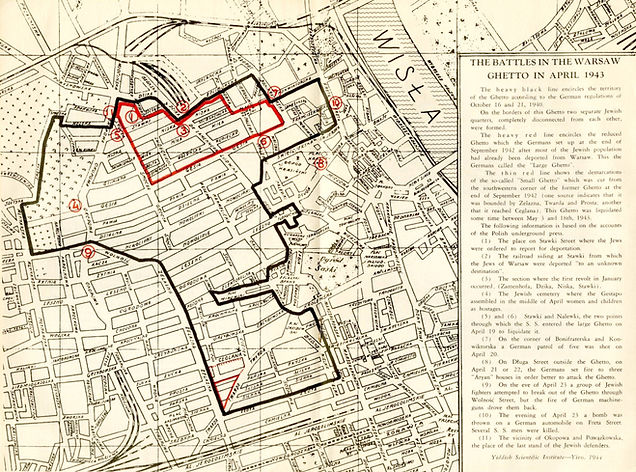
One of the earliest English-language efforts to record armed resistance during the Shoah, this 1944 YIVO edition of The Battle of the Warsaw Ghetto brings a contemporaneous map and eyewitness synthesis of the April 1943 uprising to an English-speaking public while the war was still ongoing. An identical copy is housed in the United States Holocaust Museum. Published in New York by the Yiddish Scientific Institute YIVO, the booklet presents Shloyme Mendelsohn’s January 9, 1944 report translated for the first time into English. Mendelsohn compiled material from four principal sources: underground dispatches from the ghetto, the clandestine ghetto press, official reports from the representative of the Polish government, and testimony from escapees and witnesses. At the heart of the volume is a detailed operational map that identifies the Large Ghetto and Small Ghetto perimeters, marks Stawki Street where Jews were ordered to assemble for deportation, locates rail sidings used for deportations "to an unknown destination," and pinpoints sites of guerrilla engagements, barricades, fires set by the occupiers, and the attempted breakouts on Wolność Street. The text of 'The Battle of the Warsaw Ghetto' exemplifies the contemporaneous limits and the urgent moral undertaking of wartime documentation. Mendelsohn writes with visible shock at Nazi brutality while explicitly acknowledging the fragmentary nature of the record, noting that precise chronologies and casualty totals were often impossible to verify at the time. That candid uncertainty is itself historically important because it shows how the Jewish People and allied researchers sought to preserve fact and memory even as annihilation continued, producing a primary account that later historians would use to triangulate events and testimony. The text never mentions Mordechai Anielewicz by name, as his personal leadership story was only revealed later on by the Ringelbaum archives unearthed in 1946. Historian Emanuel Ringelblum and his underground group, Oyneg Shabes, secretly buried thousands of documents in milk cans and metal boxes beneath the Warsaw ghetto. This archive contains writings about Anielewicz's early leadership. For any individual moved by the story of resistance and remembrance, this booklet is both a stark primary source and a call to memory. It preserves an early effort to map courage under siege and to translate clandestine reports into an English-language record that could inform and mobilize public conscience. Acquiring this lot connects personal stewardship to the living duty of safeguarding testimony about the uprising so that future generations understand what the Jewish People endured and how acts of resistance shaped both memory and moral witness. 9x5.75in; 28 Pages; In Very Good Condition

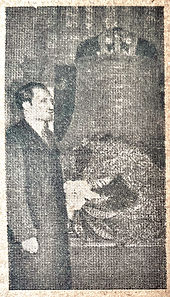
'THE WARRIOR'S SPEECH' FOR 'FIGHTERS OF THE FREEDOM MOVEMENT' HONORING
WAR OF INDEPENDENCE SOLDIERS &
'MORAL IMAGE OF THE ISRAELI ARMY'
SEPTEMBER 1949, TEL AVIV, ISRAEL
RESERVE: $1500 (estimate $1800-$2500)
This graphically striking September 1949 Tel Aviv publication issue titled "The Warrior's Speech" frames the War of Independence fighters as moral exemplars and records American accolades for Menachem Begin and the Etzel during the fragile first year of statehood. A dramatic two-tone blue cover shows a resolute soldier planting a Star of David flag before a swelling crowd while a radiant outline map of the Land of Israel hovers above, the bold Hebrew title declaring the magazine’s call to moral service; the lithograph’s stark contrasts and heroic composition powerfully convey postwar pride, communal mobilization, and the nascent moral image of Israel’s army in 1949. Printed months after the 1948 fighting and formal armistices, the publication channels the urgent task of nation-building by celebrating the combatants who made independence possible. The internal pages, translated from Hebrew, include a prominent headline reading "America Honors Begin" and an extended feature that recounts receptions and commendations given to Begin during visits with diaspora communities, and a quick visit to the Liberty Bell. The internal reportage describes public ceremonies, presentations of honorary tokens, and laudatory speeches that cast Begin as a symbol of uncompromising resistance, with translated lines such as "To Begin, whose name stands for struggle and hope" and "the honored guest of American Jewry, whose deeds testified to the determination of our people." Photographic captions and article copy also highlight specific Etzel operations and the network of underground reports that shaped public knowledge of late war events. The magazine’s text situates those honors within a contested but evolving memory of armed struggle. It treats the Etzel’s campaigns not as isolated militancy but as part of a longer narrative of Jewish self-defense that traces back through prewar self-help organizations and wartime partisan resistance. Several pages translate and summarize first-person accounts and operational summaries that emphasize guerrilla tactics, breakout attempts, and raids intended to protect Jews and pressure hostile forces in critical moments. The editorial voice frames fighters as ethical agents whose tactical choices were driven by the imperative to secure life and continuity for the Jewish People in the Land of Israel, and it connects diaspora recognition to the moral effort of legitimating the new state in the court of world opinion. For any individual with a heart for the Jewish People and the State of Israel, this magazine is a vivid primary witness to how memory, politics, and commemoration were forged in public during 1949. It preserves contemporary Hebrew reportage that elevated underground veterans into national heroes and records the diaspora’s reciprocal role in celebrating those fighters, including Menachem Begin, at a moment when Israel was consolidating its armed forces and defining the moral image of service. Bidding on this lot links personal stewardship to the living duty of preserving testimony about the sacrifices and debates that shaped Eretz Yisrael’s founding narrative. 12x9in; 19 Pages, In Good Condition with minor edge wear


'MARCH FOR SOVIET JEWRY' POSTER
HAND-SIGNED BY NATAN SHARANSKY
1982, NEW YORK, USA
RESERVE: $2800 (estimate $3500-$3800)
A powerful and historic 1982 New York poster for the March for Soviet Jewry captures the urgency of a global movement for Soviet Jewry and is hand-signed years later in Israel by Natan Sharansky, the movement’s most resonant emblem of refusenik courage. Printed for the May 2, 1982 demonstration in Manhattan and designed by artist Paul Davis, the poster’s bold portrait of a Jewish Soviet heroine and hand-lettered typographic call-to-action embodied public efforts to mobilize mass pressure on the Soviet authorities to allow Jewish emigration and to end discrimination. The March for Soviet Jewry was part of a broad transnational campaign that included grassroots demonstrations, synagogue vigils, congressional advocacy, and media work to spotlight the plight of Soviet Jews who were denied exit visas, subject to state antisemitism, and forced to abandon religious and communal life. New York’s 1982 rally was one of many high-profile protests that sustained public attention and built political leverage in the United States and worldwide. Natan Sharansky’s life story gives this poster added moral weight. Arrested in 1977 on fabricated charges by Soviet authorities and held until his release in 1986, Sharansky became an international symbol of the refusenik struggle, monitored by human-rights groups and frequently cited in diplomatic advocacy. The signature on this example was added later in Israel after Sharansky’s emigration and political career, linking the poster’s original civic moment to the personal arc from prisoner to public statesman. That provenance transforms the sheet from a contemporary rally artifact into a layered testament of endurance, witness, and eventual vindication. For any individual moved by the history of modern Jewish liberation and human-rights activism, this poster is a vivid emblem of solidarity that also bears the autograph of one of the Soviet Jewry movement’s most consequential figures. It preserves the visual rhetoric of protest and the later personal imprimatur of a man whose freedom symbolized the movement’s aims, and it invites the buyer to carry forward the story of advocacy that helped secure the rights and dignity of the Jewish People. 11x7in; In very Good Condition with archival stamp on reverse

THEODOR HERZL'S 'THE JEWISH STATE'
'SOLUTION TO THE JEWISH PROBLEM' 1ST ITALIAN EDITION CALLING FOR ZIONISM TO COMBAT EUROPEAN ANTISEMITISM
1918, LANCIANO, ITALY
RESERVE: $1100 (estimate $1600-$1900)
A rare and beautiful 1918 Italian edition of Theodor Herzl’s seminal tract presents Zionism’s political argument to a European readership at a moment when Europe’s map and the fate of the Jewish People were being violently remade. First articulated in German in 1896 as Der Judenstaat, Herzl’s argument transformed Jewish survival from a private sorrow into a public political project and crystallized the program that led to the First Zionist Congress in 1897. This 1918 Lanciano edition, issued by Carabba Editore and presented here as an early Italian translation, carries that urgent message into the aftermath of World War I when debates over national self-determination, minority rights, and refugees dominated European politics. The book’s decorative title page and period stamps attest to its circulation among Italian readers and immigrant communities seeking intellectual tools to understand and respond to virulent European antisemitism. Reading Herzl in Italian in 1918 meant encountering a proposal that reframed the “Jewish problem” as solvable by national revival in the Land of Israel. Herzl urged the establishment of modern political institutions, international diplomacy, organized colonization, and cultural renewal as mechanisms to secure safety and dignity for the Jewish People. Placing this edition in the postwar moment illuminates how his ideas traveled beyond Central Europe into Mediterranean and Latin-language spheres, where new audiences were wrestling with displacement and the collapse of empires. The book thus documents both the spread of Zionist argumentation and the transnational conversation about minority survival that prefaced later waves of Aliyah to Eretz Yisrael. For any individual who cherishes the intellectual roots of modern Jewish statehood, this edition is a tactile link to a doctrine that reshaped Jewish self-understanding and political strategy. It invites reflection on how literary pamphlets became instruments of mass mobilization and how translated ideas seeded movements that would alter the course of Jewish history. Acquiring this lot connects private stewardship with the ongoing responsibility to remember the debates, hopes, and practical projects that sought to secure a future for the Jewish People in their ancestral Homeland. 7x4.25in; 163 Pages, In Very Good Condition, collection label & stamped


NILI JEWISH SPY UNDERGROUND IN WWI
'THE ETERNITY OF ISRAEL WILL NOT DECEIVE'
RARE VOLUMES PRINTED DURING WWII
+ SPY AVSHALOM FEINBERG'S PORTRAIT
1940, TEL AVIV, ERETZ ISRAEL
RESERVE: $800 (estimate $1200-$1500)
One of the most ambitious Mandate‑era literary memorials to clandestine courage, this rare four‑volume NILI masterpiece by J. Yaari‑Poleskin in Hebrew dramatizes the underground network’s missions, sacrifices, and the human cost of intelligence work during World War I. These four volumes are grounded in the real-life enterprise led by agronomist Aaron Aaronsohn, whose scientific expeditions and regional knowledge became the tactical backbone of NILI’s operations. Formed in 1915, the network funneled detailed reports on Ottoman troop dispositions, supply lines, and telegraph nodes to British commanders, materially assisting the Sinai and Palestine campaign. Central figures who move from the pages into national memory include Avshalom Feinberg, the young courier captured and murdered in 1917 while attempting the perilous Sinai crossing, and Sarah Aaronsohn, whose arrest, brutal interrogation, and death that same year sealed the moral drama of the enterprise. NILI’s intelligence was invaluable to Allied planning, yet the group’s overt cooperation with a foreign power and its clandestine methods provoked heated debate within the Yishuv about tactics, loyalty, and the limits of secrecy during wartime. Printed in Tel Aviv by Masada between 1937 and 1940, the set fuses fictionalized narrative with detailed operational texture that preserves routes, code practices, and the rhythms of underground life in Eretz Yisrael under Ottoman rule. The books illuminate how small cell networks used local geography, agricultural cover stories, and diaspora contacts to transmit reports that influenced military operations and postwar political claims. Yaari‑Poleskin also captures the bitter afterlife of NILI’s fame: the contested reputations, the heroic martyrdom ascribed to figures like Feinberg and Sarah Aaronsohn, and the enduring ethical questions about irregular warfare and national survival for the Jewish People. For any individual who values first‑hand memory and the moral complexity of resistance, this complete four‑volume NILI set is both a literary monument and a documentary archive. It preserves the narrative scaffolding by which the Yishuv transformed clandestine action into collective memory and invites personal stewardship of testimony about the spies, couriers, and scholars whose courage helped shape the modern story of the Jewish return to the Land of Israel. Four Volumes in Good Condition, minor edge wear to the dust jacket


'BALLAD OF JOSEPH TRUMPELDOR'
MUSIC HONORING THE ZIONIST HERO & CHAMPION OF JEWISH SELF-DEFENSE
POSTER DESIGNED BY OTTE WALLISH
OCTOBER 19 1930, PRAGUE, CZECHOSLOVAKIA
RESERVE: $700 (estimate $1000-$1200)
A bold 1930 poster art cover by Zionist artist Otte Wallish and its inner music folio present the Ballad of Joseph Trumpeldor as an inspirational heroic tribute that turned battlefield legend into public pedagogy about courage and Jewish self‑defense. The interior music page identifies the work as Die Ballade vom Leutnant Trumpeldor by Georg Mannheimer with music by Walter Kohn and performance rights reserved. The score opens with the rhetorical question, "Kennt Ihr die Geschichte von Trumpeldor, der bei Port Arthur seinen Arm verlor?" translated as "Do you know the story of Trumpeldor, who lost his arm at Port Arthur?" The printed text that follows situates Trumpeldor’s early service in the Russian army with the line "Da hat ihn der Zar zum Leutnant gemacht" meaning "There the Tsar made him a lieutenant." The folio also bears the Prague imprint and copyright notice, Copyright 1931 by Dr Josef Flesch, Prague, confirming Central European publication and distribution of the lyrics and music that popularized Trumpeldor’s legend beyond Hebrew‑language audiences. Musically and rhetorically the ballad frames Trumpeldor as both veteran and exemplar, moving listeners from martial motifs to communal song. Notations such as Tempo di Marcia and ff feroce underline the piece’s march-like, exhortatory character designed for public performance and patriotic assembly. The work’s German-language presentation and theatrical scoring made the Trumpeldor story accessible to German‑speaking Jewish and allied audiences in Czechoslovakia and across Europe, translating the Yishuv’s formative memory of sacrifice into concert halls and community stages. The combination of Wallish’s modernist poster design and the folio’s evocative text and musical cues creates a complete media package that taught new generations how to feel the link between personal valor and national revival in the Land of Israel. Wallish is most famed as the artist who Ben-Gurion tasked with creating the Declaration of Independence. For any individual who cherishes the material culture of Zionist memory, this poster and internal music folio constitute a rare, integrated artifact: a visual manifesto by Otte Wallish coupled with an authoritative musical setting that memorialized a hero of self‑defense and helped transmit the moral vocabulary of national renewal. Owning this sheet preserves the memory of Joseph Trumpeldor as part of the larger project of securing the future of the Jewish People in Eretz Yisrael. 10.5x13in; 13 Pages, In Excellent Condition

WAR OF INDEPENDENCE ETZEL MANUAL
'GOALS & METHODS' FOR FRENCH OLIM
''RETURN TO ZION & LIBERATE THE NATION'
1948, ERETZ YISRAEL
RESERVE: $2100 (estimate $2600-$3000)
A concise clandestine field manual issued in 1948 for French olim outlines Etzel’s practical doctrine of organization, sabotage, intelligence, and the moral imperative to "Return to Zion and Liberate the Nation." Produced amid the convulsive months of Israel’s War of Independence, this manual translates tactical doctrine into readable guidance for newly arrived French speakers preparing to join local units. Etzel, the Irgun Tsvai Leumi, had evolved through the 1930s and 1940s from a self‑defense association into a disciplined underground with a repertoire of urban guerrilla methods that included intelligence gathering, demolition of strategic infrastructure, small‑unit ambushes, clandestine arms handling, and civil defense preparation. Manuals for specific language groups were part of a larger effort to absorb Diaspora volunteers rapidly, to teach unit cohesion, radio and courier practice, code procedures, and basic fieldcraft while aligning recruits to the movement’s political purpose of national reclamation in Eretz Yisrael. Contextually the booklet sits at a fraught hinge in modern Jewish history. Published during open war with neighboring armies, Etzel’s doctrine was shaped by decades of confrontation with Ottoman, Mandate, and hostile local forces and by the existential urgency felt by the Jewish People returning from exile. The same year saw the formal process by which irregular militias were integrated into the newly formed Israel Defense Forces, a transition that included both organizational absorption and painful political conflicts. A manual like this therefore captures the dual character of the moment: practical field instruction for immediate survival and action, and testimony to a diasporic mobilization that aimed to convert individual Aliyah into collective defense and the realization of national sovereignty. For any individual drawn to the lived mechanics of national rebirth, this manual is a rare operational record of how ideology became practice on the ground. It preserves the language, priorities, and training habits taught to French‑speaking volunteers who stepped off ships or trains into a nascent polity under fire, and it invites reflection on the complex moral and historical choices that accompanied the struggle to secure the Jewish People and the Land of Israel. 8x6.5in; 12 Pages, In Good Condition


MENASHE KADISHMAN MASTERPIECE
'HERZL'S VISION ON THE BALCONY'
HAND COLORED & SIGNED SERIGRAPH
LATE 20TH CENTURY, TEL AVIV, ISRAEL
RESERVE: $4800 (estimate $5600-$6000)
This hand‑signed and hand‑colored serigraph, Herzl’s Vision on the Balcony by Menashe Kadishman, frames the founder of modern Zionism as a contemplative progenitor whose political dream became the creative and civic labor of the Jewish People in the Land of Israel. Kadishman, is internationally celebrated for his artwork that fuses minimalist form with deep national feeling. Here he renders Herzl with iconic clarity that balances monumentality and intimacy, playing of the iconic photograph taking December 1901 by Ephraim Mooshe Lillien in Basel Switzerland at the Three Kings Hotel over the Rhine River during the Zionist Congress. Executed as a serigraph and enhanced with hand coloring, the large sheet bears the artist’s hand in both pigment and signature, making each impression a unique act of commemoration. The composition invites reflection on Herzl’s 1896 pamphlet Der Judenstaat and its revolutionary claim that organized political action and national renewal were necessary responses to European antisemitism, while Kadishman’s late twentieth century idiom translates that argument into a visual meditation on memory, responsibility, and continuity in Eretz Yisrael, especially with doodles of modern Israel's Tel Aviv & Jerusalem in the background. Above, seven stars float in the sky, a direct reference to Herzl’s proposed Zionist flag. Historically the image belongs to a lineage of Israeli art that sought to make public heroes part of private devotion and civic education. Kadishman’s work often explored themes of sacrifice, pastoral life, and national defense, and here he places the founding thinker on a metaphorical balcony that overlooks a destiny the Jewish People set out to secure. The serigraph therefore functions as both aesthetic masterpiece and moral prompt, encouraging the owner to consider the link between intellectual origin and practical nation building, and to remember that statehood emerged from argument, organization, and enduring communal sacrifice. For the individual who wishes to anchor personal philanthropy in tangible culture, this signed and hand‑colored Kadishman (of which we have three unique versions each slightly different for you to chose from) serigraph offers a brilliant opportunity. It is a work to display and to reflect beside, a visible testament to the ideas that guided the creative energies which continue to shape life in the Land of Israel. 39x31in; In Excellent Condition

EXCEPTIONALLY RARE MOSSAD MEDAL
ELITE KIDON ASSASSINATION SPY UNIT
MID 20TH CENTURY, ISRAEL
RESERVE: $900 (estimate $1600-$2200)
This exceptionally rare bronze medal awarded by Mossad’s clandestine Kidon unit presents a stark emblem of covert service and the moral complexities of state survival. The obverse depicts a pistol barrel seen head on before a flaming torch, the tip of a spear, and a Hebrew inscription quoting Joshua 8:18, "Stretch out the spear that is in thy hand toward Ai; for I will give it into thine hand," linking biblical language of decisive action to modern covert duty. The blank reverse indicates this piece was intended as a conferment object to be engraved with a recipient’s name and operation details, a form of discreet recognition consistent with the secrecy surrounding elite operational units. As a physical artifact, the medal condenses iconography of force, illumination, and sacramental mission into a portable token that would travel with an operative’s private history. Placed in historical context, the object evokes the Mossad’s post‑1948 mandate to secure the Jewish People and the State of Israel through intelligence, covert operations, and targeted counterterrorism. The Kidon unit, literally the tip of the spear, is widely described in open sources as a small, highly specialized detachment responsible for assassinations and protective operations that have had outsize geopolitical effect, most notably during the retaliatory campaigns of the 1970s following the Munich massacre. Whether awarded for a single clandestine action or as a unit emblem, this medal captures the tension between clandestine necessity and public memory in a nation for which survival and sovereignty in Eretz Yisrael have often required painful, secret choices. For the individual moved by the gravity of Jewish self-defense and the private sacrifices that secure public life, this medal is a rare, evocative object of witness. It invites reflection on the burdens borne by those who operate in the shadows to protect communal safety and stands as a personal heirloom that connects its steward to the fraught history of intelligence, courage, and consequence in the service of the Jewish People. 2.34in Diameter; In Excellent Condition

'JEWISH PALESTINE FIGHTS BACK'
HONORING WWII JEWISH SOLDIERS
WHO ENLISTED TO FIGHT THE NAZIS
FEBRUARY 1946, LONDON, UK
RESERVE: $1250 (estimate $1500-$1800)
“More than a million Jews fought in the UN armies. Six million were killed by Hitler and his satellites. The survivors are still waiting for justice and for a course of action that will guarantee them a place as a free people in the family of nations. At the forefront of the struggle for this settlement is the Jewish community in Palestine, small but vigorous, divided by the pioneering effort of three generations." A powerful 1946 Jewish Agency London booklet, Jewish Palestine Fights Back, documents the service and sacrifice of Hebrew soldiers who joined British and Allied forces in World War II and insists that military contribution must translate into national justice for the Jewish People. "This book is by no means a complete account of the military contribution of Jewish Palestine to this war, but it tells something of the way in which Jewish men and women from the Land of Israel sought to do their part in the forces. It may teach something of the special spirit of the Jews when they unite with the land of their fathers and give them strength in the struggle for a large-scale Jewish immigration to the Land of Israel and a Jewish state." Published in London by the Jewish Agency soon after hostilities ended, the booklet assembles photographs, frontline vignettes, and a campaign map that traces the varied theaters in which volunteers from the Land of Israel served under British command. The pages record service in North Africa, the Mediterranean and Italian campaigns, and in support roles across the Middle East, and they echo the booklet’s urgent claim that “more than a million Jews fought in the UN armies” while six million perished in the Holocaust. Interwoven with portraiture and unit shots, the text presents personal testimony of soldiers’ experiences and frames military enlistment as part of a larger effort to secure a place for the Jewish People as a free nation in the family of nations. The booklet should be read in the context of immediate postwar politics and the crystallizing demands for statehood. By 1944 the Jewish Brigade had been formed as a distinct Jewish unit within the British Army and Eretz Yisrael volunteers had already demonstrated substantial participation across Allied forces. Jewish Palestine’s wartime service became a moral and political claim in the struggle over immigration, displaced persons, and the future of Eretz Yisrael, feeding public campaigns, rescue networks, and diplomatic appeals that pressed for legal avenues to resettle survivors. The pages therefore document not only battlefield contribution but also how combat service became evidence of readiness for sovereignty and of the Jewish People’s capacity for organized self-defense. For any individual who honors the living memory of those who fought and those who were lost, this booklet is a poignant primary record linking wartime bravery to the postwar fight for justice and return. It preserves photographs, maps, and language that taught contemporaries to see military sacrifice as integral to national revival and invites the buyer to steward a rare voice from the moment when the Jewish People’s war experience reshaped international sympathy, policy debates, and the practical campaigns that led to the founding of the State of Israel. 7x9.5in; 32 Pages, In Good Condition with minor edge wear

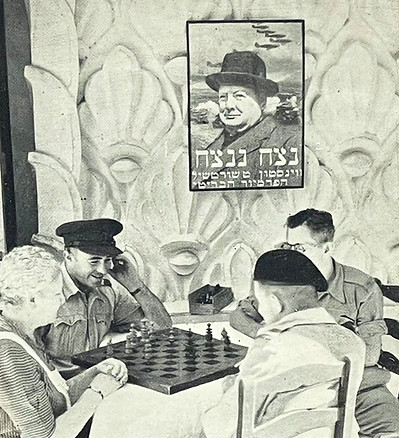

SPECIAL EDITION OF DVAR NEWSPAPER
YISHUV CELEBRATING WWII VICTORY &
HONORS JEWISH BRIGADE SOLDIERS
DEMANDS CREATION OF HEBREW STATE
MAY 10 1945, TEL AVIV, ERETZ YISRAEL
RESERVE: $1600 (estimate $2200-$2500)
The Jewish Brigade emblem, a Magen David set above blue and white Zionist banners, asserts Jewish identity as a source of collective service and honor. As a visual foil to the Nazi yellow star, it converts a symbol of enforced stigma into one of dignity, sacrifice, and national renewal. One of the most electrifying Eretz Yisrael front pages from the final days of World War II, this special May 10, 1945 edition of Davar celebrates Allied victory while urgently demanding rescue, Aliyah, and the founding of a Hebrew state. Printed in Tel Aviv two days after Germany’s surrender, the issue records mass public jubilation with headlines describing triumphant processions that quickly became unified demands for salvation, Aliyah, and statehood. The paper carries emphatic calls translated from the masthead and lead pages: "The Yishuv celebrated in its multitudes the Victory" and "Processions of the multitudes became mighty, unified demonstrations demanding rescue, immigration and the establishment of the Hebrew State." Prominent coverage honors the Jewish Brigade with emblematic imagery and reports on Jewish volunteers who served in British and Allied formations, while local mayors, National Council leaders, and diasporic receptions in England are cited as the Yishuv mobilized public grief, hope, and political claim-making. Placed in immediate historical context, this Davar issue crystallizes the paradox of May 1945: elation at Nazi defeat coexisted with an anguished insistence that victory must translate into concrete rescue for survivors and legal routes of return to the Land of Israel. Headlines and dispatches voice the Yishuv’s plea that military victory become a diplomatic and humanitarian turning point, and the paper frames the Jewish Brigade’s service as moral leverage in international negotiations over displaced persons and immigration quotas. The coverage also reflects the urgent domestic politics of the moment as the Yishuv moved from wartime endurance toward the final push for sovereignty, insisting that the Jewish People’s demonstrated loyalty and sacrifice warranted a permanent national home. For any individual who honors living memory and civic responsibility, this special Davar is a vivid primary witness to the moment when triumph became a summons to action. It preserves the rhetoric, images, and moral claims that linked wartime sacrifice to the campaign for rescue and statehood, and it invites the buyer to steward a document that helped shape contemporary public opinion about the fate of survivors and the course of Eretz Yisrael’s rebirth. 23x17in, 10 Pages, In Good Condition with minor edge wear and fold lines that will frame beautifully


HAND-SIGNED BY THREE PRIME MINISTERS
MENACHEM BEGIN, YITZHAK RABIN & GOLDA MEIR
SIX-DAY WAR MONUMENT ARCHITECT'S DRAFT DESIGN
1978, ISRAEL
RESERVE: $8700 (estimate $9500-$9800)
This is a museum-worthy epic piece of art. It is a powerful rendering of architect Israel Gudovich’s Ugdat HaPlada monument which commemorates fallen IDF soldiers of the Six-Day War and incredibly bears the rare hand signatures of three Israeli prime ministers: Menachem Begin, Yitzhak Rabin, and Golda Meir, matted along with photographs of them each doing the signing. Gudovich’s original Ugdat HaPlada memorial was conceived to honor the casualties of the 84th Armored Division, which under General Yisrael Tal broke into North Sinai and reached the Suez Canal during the Six‑Day War. The architect’s composition centers on a 25‑meter tower and a field of concrete columns, some inset with authentic tank and weapons fragments, symbolizing both sacrifice and the material reality of battle. Erected in Yamit on June 5, 1977 for the war’s tenth anniversary and later reassembled near Highway 232 after the Sinai withdrawal, the monument became a public locus of memory for the division’s armored brigades, paratroopers, engineers, and artillery who served the Jewish People in a decisive campaign for the nation’s survival. This signed and numbered (only 125 were ever created) draft print translates Gudovich’s powerful three‑dimensional design into a graphic commemoration that carries additional historical gravity through its signatures. The presence of Golda Meir, Yitzhak Rabin, and Menachem Begin unites different eras and political currents in Israel’s leadership and underscores the cross‑partisan public veneration of those who fell defending Eretz Yisrael. Each signature converts the print from a reproduction into a document of national remembrance linking civic authority, battlefield sacrifice, and personal pledge to memory. For an individual honoring the cost of national defense, this artwork is both a visual memorial and a personal reliquary of stewardship. It preserves Gudovich’s solemn aesthetic and the layered postwar history of commemoration that followed the Six‑Day War, inviting the buyer to carry forward a tangible connection to the men and women whose service shaped the security and future of the Jewish People in the Land of Israel. 31.5x28in matted; In Very Good Condition


WWI POSTER HONORS JEWISH SOLDIERS
CALL TO ACTION TO SUPPORT FIGHTERS
JEWISH DESIGNER 'BEST ARTIST OF WWI'
NOVEMBER 11 1918, NEW YORK, USA
RESERVE: $1300 (estimate $2000-$2500)
A stirring 1918 National Jewish Welfare Board poster by Sidney H. Riesenberg calls Americans to support Jewish soldiers and civilians in the closing days of World War I. Sidney Riesenberg was a prominent Jewish artist, best remembered for his iconic World War I propaganda posters. A classically trained artist who studied at the School of the Art Institute of Chicago, he contributed heavily to Jewish community support efforts and military recruitment. He has been described by historians as "one of the greatest illustrators of the World War I era." Printed for the United War Work Campaign on November 11, 1918, the image places the Star of David prominently as a symbol of communal solidarity and sacrifice. Riesenberg’s impressionist style lithographic skill blends heroic composition with intimate appeal, pairing martial urgency and compassionate appeal in a visual program designed to mobilize relief, comfort, and moral support for Jewish service members and war‑torn Jewish communities in Europe. The poster’s wording, "Through this we need all the help and comfort you can give," translates broad patriotic rhetoric into a direct plea rooted in particular communal need. The piece belongs to a decisive moment when American Jewish agencies and volunteers sought to translate wartime service into humanitarian relief and public recognition. The Jewish Welfare Board had organized chaplaincy, recreation, and support programs for Jewish troops while coordinating relief for displaced civilians abroad; this poster functioned both as propaganda for the allied fundraising drive and as a claim that Jewish contribution to the war effort warranted attention and assistance. Riesenberg, celebrated for his wartime imagery and sensitive draftsmanship, renders that claim with dignity and urgency, using figural placement and the emblematic Star of David to center Jewish sacrifice within American wartime solidarity. For the individual who prizes visual testimony to Jewish patriotism and humanitarian mobilization, this original 1918 poster is a rare emblem of civic commitment and communal care. It preserves a moment when graphic art converted public sentiment into tangible support for the Jewish People confronting war, loss, and displacement, and it offers a compelling reminder of the power of public appeal to translate empathy into relief. 35x24in; In Good Condition with minor edge wear and paper aging that will frame beautifully

'ANNE FRANK'S DIARY OF A YOUNG GIRL'
1ST ISRAELI PRINTING + FRANK HOUSE CARD SIGNED & DATED BY HER FATHER, HOLOCAUST SURVIVOR OTTO FRANK
1962, JERUSALEM, ISRAEL
RESERVE: $3100 (estimate $3700-$4400)
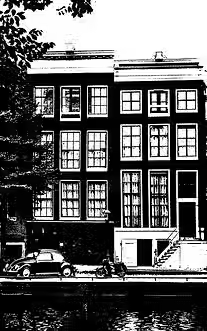
"A few weeks ago, I started writing a story, something I made up from beginning to end, and I’ve enjoyed it so much that my pen-and-inklings are piling up." - Anne Frank's Diary dated August 7th 1943 "The nicest part is being able to write down all my thoughts and feelings; otherwise, I'd absolutely suffocate. - Anne Frank's Diary dated March 16th 1944. Anne hoped one day to become a famous writer or journalist. Although she doubted from time to time whether she was talented enough, Anne wanted to write anyway... Few names in Jewish and world history resonate with such poignancy as Anne Frank. Her diary, written while in hiding during the Holocaust, has become perhaps the single most recognized testimony of the Jewish experience under Nazi tyranny, capturing the imagination of generations with its raw humanity, unbroken hope, and tragic silence. The present lot from 1968 brings together rare and deeply moving artifacts directly connected to Anne Frank’s life and legacy. Tel Aviv's Yavneh Press edition of Stories from the Secret Annex— a posthumous collection of Anne’s lesser-known writings—and, most significantly, a rare original Anne Frank House postcard boldly signed and dated by her father, Otto Frank, the sole survivor of the Frank family and the man who dedicated his life to ensuring his daughter’s voice would never be silenced. Anne Frank, born Anneliese Marie Frank in Frankfurt am Main in 1929, was only four years old when her family fled Nazi Germany for Amsterdam in 1933, seeking refuge from the escalating antisemitic persecution unleashed by Hitler’s rise to power. Yet safety proved temporary: by May 1940, the German army had invaded and occupied the Netherlands, and by July 1942, with deportations of Dutch Jews underway, Otto Frank moved his wife Edith, daughters Margot and Anne, into a concealed annex above his spice and pectin business on Prinsengracht 263. For over two years, the family—together with the van Pels family and later Fritz Pfeffer—lived in secrecy, sustained by the courage of Dutch helpers such as Miep Gies. During those years in the “Achterhuis” (Secret Annex), Anne filled her now-famous diary with intimate reflections, dreams, and observations, but she also composed short stories, fairy tales, and an unfinished novel. These works, later collected under the title Verhalen rondom het Achterhuis (Stories from the Secret Annex), reveal another dimension of her extraordinary talent: a precocious writer experimenting with fiction, allegory, and humor even in the darkest of times. Unlike her diary—intended as a private confessional—Anne shared these stories with her family and even dreamed of publication. On March 28, 1944, after hearing an exiled Dutch minister on the BBC urge citizens to preserve wartime accounts for posterity, Anne began consciously rewriting and editing her diary for future publication, titling it Het Achterhuis (The Secret Annex). Tragically, Anne’s literary ambitions were cut short. On August 4, 1944, following a betrayal, the hidden Jews of Prinsengracht were arrested. The Franks were deported to Westerbork transit camp, then Auschwitz. In late October, Anne and Margot were transferred to Bergen-Belsen, where both perished of typhus in early 1945, only weeks before the camp’s liberation. Edith Frank had already died in Auschwitz; only Otto survived, liberated by the Red Army on January 27, 1945. In July 1945, Miep Gies gave Otto Frank the preserved notebooks and papers she had saved from the Annex. Initially too devastated to read them, Otto eventually confronted the writings of his beloved youngest daughter, discovering in them a depth of thought and feeling he had never fully realized in life. “For me it was a revelation,” he later wrote. “I did not know the depth of her thoughts and feelings… She kept all these feelings inside her.” Determined that Anne’s words should live, Otto arranged for the diary’s first publication in Dutch in 1947. From there it spread worldwide, translated into dozens of languages, embraced by millions, and elevated into one of the most influential books of the 20th century. Writers like Primo Levi and Simon Wiesenthal emphasized its universal resonance, noting how readers saw in Anne’s words not only a Jewish child’s tragedy, but also a mirror of their own families and humanity. Otto Frank devoted the remainder of his life to preserving Anne’s legacy, tirelessly supporting editions, translations, adaptations, and the establishment of the Anne Frank House as a museum and educational center. He described his unique role with humility, noting that while usually children carry the legacy of their famous parents, his life had been reversed: “In my case, the tables were turned.” To the end of his days, Otto answered letters from young readers, guided exhibitions, and reminded the world of the lessons his daughter’s voice carried. The black and white photograph card of the Anne Frank House, the site of the family’s hiding place in Amsterdam, signed and dated by Otto Frank on December 14, 1968— is a deeply personal testimony from the man who alone bore the burden of memory. Written in his distinctive hand, this autograph is more than a signature; it is the mark of the father who carried Anne’s words into eternity. This rare first Hebrew edition, of Anne Frank’s Diary (אנה פראנק – יומנה של נערה), published in 1953 by Karni and printed by Dvir in Tel Aviv; was translated from the Dutch by Sh. Shnitzer, is the first Hebrew appearance of Anne Frank’s diary. Together, these artifacts embody both the silence of loss and the endurance of memory. They remind us that while Anne’s life was stolen, her words remain indestructible. As Simon Wiesenthal observed, “People identify with this girl, and say in their hearts: this was the Holocaust. This was a family like mine.” A historic and profoundly moving lot. 5.25x7.75in; 220 Pages; In Good Condition


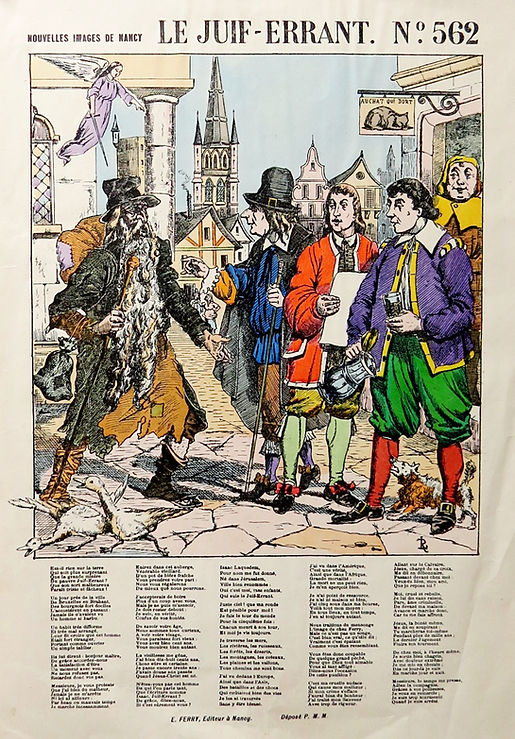
'LE JUIF ERRANT' ' - 'THE WANDERING JEW'
ANTISEMITIC GRAPHIC POSTER WITH POEM
'MY CRUEL AUDACITY CAUSES MISFORTUNE'
LATE 19TH CENTURY, FRANCE
RESERVE: $2400 (estimate $3000-$3500)
"I am no longer a wandering Jew who migrates from country to country, from exile to exile.' - President of Israel, Ezer Weizmann A fascinating late 19th‑century French graphic poster titled Le Juif Errant presents a period example of visual antisemitism that circulated stereotypes in European popular imagery and verse. The image depicts the Wandering Jew as a grotesque stereotype: long curly beard, exaggerated nose, tattered clothing, and a walking stick, set before well dressed townspeople who regard him with suspicion and scorn. Issued by Nouvelles Images de Nancy, the plate couples caricature with a mocking poem including the line, "My cruel audacity causes misfortune," which pathologizes Jewish existence and frames Jewish presence as a social threat. As a mass‑market image, the poster shows how European popular culture recycled familiar tropes into everyday propaganda that normalized exclusion and contempt. Historically the poster draws on a long Christian legend that transformed religious thought into a moralized myth: the Wandering Jew was said to have taunted or refused God's commandments, and as a punishment was condemned to wander until the end of days. In European devotional and popular print culture from the medieval period onward, that legend became a cultural shorthand for eternal Jewish exile and alleged culpability, and by the nineteenth century it merged with racialized antisemitic ideas and socioeconomic anxieties. The poster therefore participates in a layered visual rhetoric that mixes religious blame, modern pseudo‑science, and political scapegoating to produce a powerful symbol of othering. Confronting this object today requires clear ethical framing: it is not collectible celebration but documentary evidence of how religious legend was repurposed into secular prejudice. Preserving and studying such prints helps scholars and educators trace the mechanisms by which mythic theology and mass imagery prepared social ground for discrimination and violence, and it offers contemporary audiences critical tools to recognize and resist the visual strategies of dehumanization. 16.75x11.25in; In Very Good Condition
'LES JUIFS' ANTISEMITIC MAGAZINE
DEALING WITH THE 'JEWISH PROBLEM'
AND CRITIQUES OF EARLY ZIONISM
RAV KOOK, EINSTEIN, FREUD & MORE
SEPTEMBER 1936, PARIS, FRANCE
RESERVE: $800 (estimate $1200-$1500)
A provocative September 1936 Paris special issue of Crapouillot titled "Les Juifs" assembles a polemical survey of the so‑called Jewish problem that mixes archival reproduction, caricature, and trenchant commentary at a dangerous historical inflection point. Printed as a thick, illustrated issue under editor Raymond A. Dior, the magazine dedicates extended sections to the legend of the Wandering Jew and to recurring anti‑Jewish stereotypes, reproducing caricatures from the nineteenth and early twentieth centuries that had circulated across European popular culture. Inside readers find photo essays presenting victims of early twentieth century pogroms, sensational reportage of street humiliations in Munich, and a rare reproduced portrait and critical column on Rabbi Abraham Isaac Kook identified as "Rabbi of Jerusalem." The issue also republishes contested images and documentary fragments from the Dreyfus Affair alongside contemporary polemics, creating a deliberate collage that blends historic grievance with present‑day invective. Substantive articles critique modern Jewish movements and public figures with a hostile bent, including essays that challenge Zionist claims and selectively quote or caricature voices such as Einstein and Freud to suggest cultural and political difference. The magazine prints an illustrated feature on Julius Streicher and excerpts that normalize public abuse, while editorial copy frames migration and national projects as social problems rather than responses to persecution. Thick paperstock and numerous plates indicate the publisher intended the issue for wide circulation and archival impact, transforming inflammatory journalism into a durable record of interwar prejudice. Placed in context, this 1936 special issue both reflects and amplifies the rhetorical and visual strategies that made antisemitism a transnational mass phenomenon in the 1930s. As a primary source it is invaluable for scholars and educators tracing how pseudo‑history, selective documentation, and mass imagery were marshaled to delegitimize the Jewish People and to confront efforts toward national refuge. Preserving and studying this problematic artifact demands explicit ethical framing so contemporary readers can examine the mechanisms of hatred and strengthen tools for resistance and remembrance. 12.25x9.75in; 72 Pages, In Very Good Condition


HONORING HAGANAH SOLDIERS DEFENDING
JERUSALEM IN WAR OF INDEPENDENCE
'IF I FORGET THEE, O JERUSALEM'
MID 2OTH CENTURY, ISRAEL
RESERVE: $1200 (estimate $2000-$2300)
David Ben-Gurion emphasized during the War of Independence that Jerusalem represents the "soul of the Land of Israel," and thus he made its defense a crucial, non-negotiable mission for the Haganah. This powerful copper‑toned charger from the early days of the State, honors the Haganah and the fallen soldiers who sacrificed to secure Jerusalem during the War of Independence, its rim lightly etched in Hebrew with the mournful vow "If I forget thee, O Jerusalem" and "A memorial from Israel". The platter centers the Haganah emblem of a sword entwined with an olive branch, visually uniting the twin obligations of defense and the pursuit of peace. The engraved line evokes Psalm 137 and frames the object as both memorial and moral pledge, tying private remembrance to communal duty on behalf of the Jewish People and the future of Eretz Yisrael. Executed in warm copper tones with restrained ornament, the charger reads as a ceremonial object intended for display where memory and civic gratitude intersect. Historically the image commemorated by this platter recalls the Haganah’s pivotal role in keeping Jerusalem connected and alive during 1947–49. The organization’s operations ranged from the strategic offensives of Operation Nachshon which opened key mountain passes, to the clandestine engineering of the Burma Road that bypassed blockaded highways and delivered food, fuel, and munitions to a besieged city. In the chaotic weeks of British withdrawal Haganah and Palmach units executed Operation Kilshon to secure abandoned outposts and police stations, strengthening Jewish control of vital positions around the city. These efforts, together with the defense of isolated neighborhoods and forward posts like Ramat Rachel, constituted the practical labor by which the Jewish People staked a living claim to the Land of Israel. This charger is therefore more than decorative metalwork; it is a material ledger of sacrifice, ingenuity, and communal fidelity. As an object to display and reflect beside, it invites its steward to remember the tactical risks and ethical commitments that underwrote Jerusalem’s survival and the making of a national reality in Eretz Yisrael. 9.5in Diameter In Very Good Condition with beautiful patina and faded etched lettering

'DEFENSE OF THE GALILEE- TEL HAI DAY'
VINTAGE POSTER HONORS TRUMPELDOR &
JEWISH FIGHTERS PROTECTING OUR LAND
1960s, JERUSALEM, ISRAEL
RESERVE: $650 (estimate $1000-$1200)
This very cool vintage 1960s poster commemorates Tel Hai Day and transforms the story of Joseph Trumpeldor and the outpost defenders into a patriotic lesson for young Jews about sacrifice, courage, and the defense of the Land of Israel. Produced by the Jewish National Fund, the sheet visualizes the Tel Hai narrative that crystallized in Zionist memory after the March 1, 1920 clash in the Upper Galilee. The poster links Trumpeldor’s reputed last words, "It is good to die for our country," to the Roaring Lion monument and to the ritual of Tel Hai Day, which memorializes the eight victims and presents their stand as a formative act of self‑defense. Graphically the image was designed to be didactic and iconic, rendered in clear, accessible pictorial language while embedding the architecture of place and symbol that ties the tiny outpost to the broader project of national revival in Eretz Yisrael. Historically Tel Hai became a touchstone because a handful of defenders held ground against superior forces at a moment when settlement depended on the courage of isolated pioneers. The episode sharpened Yishuv debates about armed self‑defense and accelerated the formation of organized militias that would later coalesce into national defense institutions. The JNF poster must be read in that pedagogical context: in the 1960s the agency used visual education to teach new generations about land reclamation, afforestation, and the moral narratives that underpinned statehood, making Tel Hai a bridge between early sacrifice and contemporary civic responsibility toward the Jewish People and the Land of Israel. This poster is therefore both a piece of history, collective memory offering the buyer a direct, tangible link to how successive generations in Eretz Yisrael learned to remember, honor, and transmit the story of Jewish self-defense and belonging. 19x13in; In Very Good Condition

CHAIM WEIZMANN & ALBERT EINSTEIN
'ISRAEL AND THEIR LAND' ZIONIST ESSAYS
RARE PUBLICATION WITH EINSTEIN'S FOREWORD...
'MAY THIS BOOK CONVEY BURNING PASSION FOR ISRAEL'
1924, LONDON, UK
RESERVE: $360 (estimate $600-$800)
"Whatever the Jewish national home may become, even if it becomes a home to millions of Jews, we will remain an island in the middle of the Arabian Sea." This historic Zionist treasure is a 1924 London edition titled Israel und sein Land. It gathers Chaim Weizmann’s key Zionist speeches and addresses within it an amazing handwritten letter as the printed foreword by the legendary genius Albert Einstein, offering a compact manifesto of early Zionist strategy and argument. Albert Einstein embraced early Zionism as a moral project, lending his fame, voice, and energy to institutions that would sustain the Jewish People’s revival. He championed the creation of the Jewish State and supported fundraising and public advocacy. Einstein believed in the renewal of the People in the Land of Israel as essential to national and spiritual regeneration. Einstein insisted on the necessity of a safe Homeland where Jewish life, scholarship, and conscience could flourish, and he worked with leaders like Chaim Weizmann to translate intellectual conviction into practical institution building for Eretz Yisrael. The year 1924 was a pivotal time for the Land of Israel due to the Fourth Aliyah (a massive wave of Jewish immigration) and the strict U.S. Immigration Act of 1924, which forced many Eastern European Jews to immigrate to Eretz Yisrael instead of America. Published by Keren Hayesod, this 58‑page German volume collects Weizmann’s aphoristic reflections on Zionism, the reconstruction of Eretz Yisrael, Jewish‑Arab relations, and the role of Keren Hayesod as a national fundraising instrument. The pamphlet reproduces Einstein’s warm endorsement, including his dated note of January 12, 1924, that praises Weizmann’s directness and passion and invites readers to feel the author’s burning commitment to Israel. The text assembles speeches delivered in the early 1920s when debates over self‑determination, settlement policy, and minority rights shaped the political options available to the Jewish People. Weizmann’s prose here is practical and rhetorical by turns: he traces the development of the Zionist idea, invokes examples such as Baron Rothschild’s investment in colonies as proof of national capability, and argues that Jewish rebuilding in Palestine must proceed in cooperation with existing communities while insisting on the Jewish People’s right to a national home. Several passages emphasize economic and social development as the basis for political claims, and Weizmann repeatedly frames Zionist activity as proof of capacity to govern and to contribute constructively to the region. The volume thus functions as both a primer on early Zionist statecraft and a contemporaneous record of the intellectual case advanced on behalf of Eretz Yisrael. This edition brings together two towering voices of Jewish modernity in a single, readable artifact. It preserves Weizmann’s strategic voice and Einstein’s imprimatur as part of the archival conversation that helped shape later diplomatic and popular campaigns for national restoration, making the book a focused link to the arguments that guided the Jewish People toward political revival. 5.75x8.75in; 58 Pages, In Very Good Condition


MENACHEM BEGIN STUDIO PHOTOGRAPH
HAND-SIGNED BY BEGIN & THE ARTIST
JULY 1949, BUENOS AIRES, ARGENTINA
RESERVE: $700 (estimate $1000-$1500)
"Massacres against Jews will never be carried out again because the world has seen the Jew resist oppression" - Menachem Begin This remarkable black-and-white studio portrait of Menachem Begin, taken during his July 1949 visit to Argentina, captures the future Prime Minister of Israel at a pivotal moment in Zionist and global Jewish history. Handwritten ink dedication in Hebrew by Begin on the right side ('With compliments, Begin") and signed in the negative by renowned Buenos Aires photographer Sivul Wilenski, whose ink stamp appears on the reverse, the photograph is a rare and significant artifact from the earliest days of Israel’s statehood. Begin’s 1949 South American visit was his first major international trip after Israel’s independence, representing not a government mission, but a Herut Party goodwill tour aimed at building support among the Jewish diaspora. The trip came only a year after the declaration of the State of Israel, and only months after Israel’s War of Independence concluded. Begin, the former commander of the Irgun Zvai Leumi, had recently transitioned from underground leader to political figure—now at the head of Herut, the Revisionist Zionist party inspired by his mentor, Ze’ev Jabotinsky. During his time in Argentina, Begin was received by President Juan Perón, marking a symbolic gesture of legitimacy to a man whose Irgun past was still controversial within Israel. At a banquet in Buenos Aires on July 18, 1949, attended by 800 guests, Begin gave a powerful address declaring: "Many millions of Jews will inhabit the whole of the fatherland... Massacres against Jews will never be carried out again because the world has seen the Jew resist oppression." In his speech, he paid tribute to Theodor Herzl, Ze’ev Jabotinsky, and fallen Irgun fighters, while also toasting Presidents Chaim Weizmann and Juan Perón. Importantly, he praised the Haganah, Irgun, and Stern Group alike—an early sign of his efforts to unify Zionist factions under a shared legacy of Jewish resistance and national revival. The rare signed photograph offered here stands as a powerful document of that moment. Begin’s presence in Argentina, far from the political center of Tel Aviv or Jerusalem, reflected the urgent need in 1949 to solidify Zionist unity, raise political support, and inspire Jewish communities worldwide. His signature, together with that of the Argentine Jewish photographer who captured this striking image, make this portrait both a historical artifact and a moving tribute to the global dimensions of Zionist leadership in the aftermath of statehood. This photograph lot also comes with an historic Menachem Begin card. This photograph is a museum-worthy piece connecting Menachem Begin’s underground legacy to his rising political path, through the lens of Argentina’s Jewish community. It is an incredible piece of Jewish history. 9.5x8.25in; In Excellent Condition

'SIX DAYS FOR ETERNITY' FILM POSTER
'THE ISRAELI EPOCH' FRENCH RELEASE
ZIONIST GRAPHIC CELEBRATING VICTORY
1968, PARIS, FRANCE
RESERVE: $3200 (estimate $4000-$5000)
A rare 1968 French release poster for the film Six Days for Eternity frames the Six‑Day War as an epochal moment that transformed Israel’s territorial reality and the imagination of the Jewish People. Printed for the Paris release of the film that chronicles the June 1967 campaign, the poster evokes the whirlwind of operations that began with preemptive air strikes and ended six days later with Israel’s seizure of the Sinai, Gaza, the West Bank including Old Jerusalem, and the Golan Heights. The Zionist film and its promotional art present sequential scenes of bravery and consequence: the tactical surprise that neutralized opposing air forces, the rapid ground advances across multiple fronts, the fierce urban fighting that reclaimed the Western Wall, and the psychological aftershock that followed victory. Filmmakers and on‑screen figures such as Illi Gorlitzky and Zaharira Harifai translate battlefield footage into a narrative of existential peril turned into national triumph, a story that reverberated in diaspora cinemas and public squares from Paris to Tel Aviv. Contextualizing the poster reveals why the film mattered beyond immediate reportage. The Six‑Day War reshaped geopolitics across the Middle East and intensified debates about security, sovereignty, and the moral responsibilities of occupation. For the Jewish People the victory produced ecstatic jubilation and renewed claims to historical places, yet it also opened complex political dilemmas that would dominate subsequent diplomacy and warfare. The documentary captures both the exhilaration and the sober strategic calculations of June 1967, and the French release signals how European audiences were invited to witness a conflict that altered maps and memories across continents. This poster is therefore more than cinematic advertising; it is a visual document of a moment when modern combat, collective identity, and historical symbolism collided. As a single sheet intended to call viewers into a mediated remembrance, it preserves the rhetoric of a brief, decisive war and the textures of awe and responsibility that followed, offering its buyer a tangible reminder of how six days in 1967 forever changed the future of Eretz Yisrael and the lives of the Jewish People. 63.5x47in; In Very Good Condition with fold lines that will frame beautifully

PRIME MINISTER BEN-GURION AUTOGRAPH
ON 'ISRAEL' BY ZIONIST ARTIST ARTHUR SZYK
1949, PRINTED IN CANADA
RESERVE: $7500 (estimate $8500-$9500)
This extraordinary artwork by Arthur Szyk is a visual and historical masterpiece from his Visual History of Nations Series, completed in 1948—the year of Israel's independence—and printed in 1949. This work captures 4,000 years of Jewish history, seamlessly blending biblical narratives with modern Zionist triumphs. The vibrant lithograph would be incredible enough, but this item is also hand-signed by Prime Minister David Ben-Gurion, making it exceptionally rare. At its heart lies the iconic blue Star of David, radiating messages of divine protection and resilience. Above the star is a crown, a symbol of reverence and honor, while below it is inscribed Hillel’s profound dictum: “If I am not for myself, who will be for me?” This timeless phrase embodies the spirit of self-reliance and determination that has characterized the Zionist movement. The print composition features prominent biblical figures who represent the strength and legacy of Jewish history. King David and his son, King Solomon, appear at the top corners, with Solomon holding a copy of the Song of Songs. Below them are three central figures: Hur, the warrior; Moses, the lawgiver; and Aaron, the high priest. Together, they reflect the diverse roles that have shaped Jewish tradition and faith. Szyk seamlessly weaves historical and prophetic elements into the artwork. To the left of the Star of David sits Bar Kochba, a leader of the revolt against Roman rule and a symbol of Jewish resistance. His shield bears the Star of David, underscoring its enduring significance as a symbol of strength and divine protection. On the right is the prophet Ezekiel, whose vision of the return to the homeland after Babylonian exile resonates deeply with the modern rebirth of Israel. The bottom of the image depicts symbols of modern Israel, an IDF soldier and determined Kibbutznik. The lithograph also celebrates the natural and agricultural bounty of Israel, with clusters of grapes and oranges framing the composition. These elements connect the land’s biblical heritage to its contemporary achievements as a flourishing nation. At the base of the artwork, two majestic Lions of Judah stand guard around the Ten Commandments, symbolizing the enduring strength and spiritual legacy of the Jewish People. Interwoven throughout the piece are the twelve symbols of the ancient tribes of Israel, which integrate the composition and highlight the nation’s foundational unity. Arthur Szyk, the artist behind this masterwork, was renowned for his meticulous illuminations and his unwavering dedication to Jewish and Zionist causes. Born in 1894, Szyk’s art often celebrated Jewish history and heroism, presenting the Jewish People not as victims, but as active participants in shaping their destiny. During World War II, his work reached millions through exhibitions, magazines, and newspapers, serving as both a rallying cry for Jewish rescue efforts and a testament to the resilience of his people. This lithograph was part of the Visual History of Nations Series, commissioned by Canadian philatelist Kasimir Bileski in 1945. The series aimed to honor member states of the newly formed United Nations. While Szyk envisioned around 60 designs for the series, only nine were completed before his untimely death in 1951. This particular piece, commemorating the creation of the State of Israel, is one of the most significant works in the series, embodying Szyk’s genius and his deep connection to Jewish history and Zionist ideals. This lithograph is an important artifact, a testament to the enduring spirit and creativity of the Jewish People, and a centerpiece for any Zionist home. Note that many institutions worldwide have this same artwork (without Ben-Gurion's autograph) in their own collections, including the United States Holocaust Memorial Museum in Washington D.C. 9.75 x 7.25in; In Excellent Condition

'SHABBAT KODESH'
ZIONIST CANDELABRA
WITH 'TZION' & MAGEN DAVID
MID 20TH CENTURY, ISRAEL
RESERVE: $750 (estimate $1200-$1500)
“Shabbat is our most amazing sign of national solidarity from generation to generation, and anyone who undermines it undermines the unity of Israel ... Preserve the Shabbat, and it will preserve us.” - Mayor Meir Dizengoff, First Mayor of Tel Aviv "More than Jews have kept Shabbat, Shabbat has kept the Jews." - Asher Ginsburg, 'Ahad Ha'am', Tel Avivi & Founder of Cultural Zionism "Every Shabbat, the individual sheds the trappings of secular life. With the Shabbat, comes rest. The soul begins to free itself of its heavy shackles. It seeks higher paths, spiritual acquisitions befitting its nature." - Rav Avraham Yitzchak HaCohen Kook, Tel Avivi & First Chief Rabbi of Eretz Yisrael "Eretz Yisrael will never be built without Shabbat ... The Jewish People will never give up Shabbat, which is not only the keystone of Israel's existence but of human existence. Without Shabbat, there would be no godliness and no semblance of humanity in the world." - Chaim Nachman Bialik, Tel Avivi & Israel's National Poet & Founder of Oneg Shabbat In Jewish tradition, the light of Shabbat candles is deeply associated with Shalom Bayit—the peace and tranquility of the home. By literally and metaphorically illuminating the space, the flames are meant to chase away darkness, prevent the frustration of stumbling, and foster a warm, loving environment for the family. From the early days of the birth of the State of Israel comes this stunning 'Shabbat Kodesh' two‑candle candelabra, incorporating a Magen David enclosing the word "ציון", Zion, transforms ritual light into a bold emblem of Zionist hope and communal renewal in the Land of Israel. Rendered in brass with crisp geometric florishes typical of early Israeli metalwork, the candlestick pairs liturgical function with explicit national symbolism. The central Magen David motif contains the stylized Hebrew Tzion, an early Zionist emblem that signaled allegiance to the project of return while remaining fully compatible with domestic ritual use. In private homes this object would have radiated around Friday-night family Shabbat meals as both a religious observance and a material reminder of the Jewish People’s historic aspiration to reestablish sovereign life in Eretz Yisrael. Placed in its historical context, the piece reflects the mid‑20th century moment when everyday objects became carriers of civic identity and pedagogy. As the Yishuv and later the State of Israel knitted religious tradition to national revival, Judaica designers adapted liturgical forms to express public commitments: menorahs, prayer books, and ritual accoutrements incorporated flags, maps, and inscriptions that taught successive generations the inseparability of faith and Homeland. This two‑candle Shabbat candelabra therefore functions both as a modern useful working ritual object and as an educational emblem that quietly reinforced the values of continuity, return, and communal resilience. For the individual who treasures visible links between ritual life and national memory, this candlestick offers a weekly, luminous reminder of the bond between household devotion and the larger Zionist story; it is an artifact meant to be used, to be seen, and to kindle reflection on the enduring love for the Land of Israel. 8.25x6.5in; In Very Good Condition

'THIS LAND IS OURS' HABOKER PAPER
HONORING LORD BALFOUR & HERZL
FIGHTING AGAINST THE WHITE PAPER
MAY 18 1939, TEL AVIV, ERETZ YISRAEL
RESERVE: $1300 (estimate $1800-$2300)
"We must assist the British in the war as if there were no White Paper and we must resist the White Paper as if there were no war." - David Ben-Gurion One incendiary May 18, 1939 Haboker special issue titled "This Land Is Ours" captures the Yishuv’s immediate fury and mobilization after the British Third White Paper curtailed Jewish immigration and land purchase in the Land of Israel. Printed the day after Prime Minister Neville Chamberlain’s policy announcement, the issue assembles a dramatic photomontage pairing Lord Balfour, Theodor Herzl, settlement imagery, and the Tel Hai monument to dramatize a rupture between 1917 promises and 1939 policy. Its front‑page banner proclaims collective resistance while inside pages publish furious analysis of the White Paper’s provisions limiting immigration to 75,000 over five years, restricting land sales, and pledging the eventual creation of an independent Palestine not explicitly Jewish. Reportage and editorials document the general strike, mass demonstrations that shut cities down, clashes with British police in Jerusalem and Haifa, and the rapid escalation from political protest to organized civil and clandestine resistance. Contextualized in history, this number marks a turning point when formal political bargaining gave way to more militant strategies of rescue, immigration, and practical defiance. The White Paper crystallized the Yishuv’s view that legal avenues were being closed at a moment of growing peril for European Jewry, and it catalyzed expanded efforts such as Aliyah Bet, intensified underground activity, and new international advocacy to secure the Jewish People’s future in Eretz Yisrael. As a contemporaneous press artifact, the paper records both the rhetorical outrage and the tactical shift that propelled the Yishuv from petition to praxis. For the buyer who keeps the memory of decisive moments alive, this Haboker special issue is a raw, documentary witness to the day the struggle for a Jewish Homeland moved from contested diplomacy to open mass action, and it preserves the combustible rhetoric and imagery that galvanized an embattled people to defend their claim to the Land of Israel. 22x18in; 8 Pages, In Good condition with minor edge damage and fold lines. Will frame beautifully.

ENAMEL VINTAGE STREET SIGN HONORING WWII
JEWISH BRIGADE SOLDIERS, 'REHOV HA'CHAYAL'
MID-20TH CENTURY, ISRAEL
RESERVE: $1300 (estimate $2000-$2300)
This once utilitarian vintage Israeli enamel street sign for Rehov Ha-Hayil ("Street of the Soldier") is a poignant tribute to the brave soldiers of the Jewish Fighting Brigade who valiantly fought during World War II. Likely produced in the late 1940s or early 1950s, this sign is crafted from heavy metal and coated with enamel, showcasing raised blue lettering that remains vibrant despite its age. Crafted from thick metal and vitreous enamel, the sign reads in Hebrew a dedication to the Jewish Brigade fighters of the Second World War and pairs that memorial text with an English transliteration, reflecting the multilingual public memory of the early Yishuv and the new State. The Jewish Brigade, formed under British command in 1944, was composed of volunteers from the Jewish People in the Land of Israel who saw combat in Italy and served as a visible testament to Jewish contribution to the Allied victory; the Brigade’s service also strengthened political and moral claims for rescue and return after the Shoah. Physically, the sign’s durable construction and raised lettering indicate municipal or commemorative use, the kind of durable street fixture intended to mark public spaces of honor and remembrance. Placed in historical perspective, this artifact bridges two linked narratives: wartime military contribution and postwar nation building in Eretz Yisrael. The Jewish Brigade’s veterans returned with battlefield experience, organizational networks, and a renewed sense of communal agency that fed into the campaigns for displaced persons, clandestine immigration, and the eventual defense of the nascent State. As a piece of street signage it embodies how public ritual and urban memory were being inscribed into the landscape to ensure that acts of service remained visible to passing generations. This sign is a rooted piece of tangible memory, meant to hang where it would inspire Jews to remember the courage of those who fought; it offers its steward a daily, public connection to the bravery and legacy of the Jewish Brigade and the continuing story of the Jewish People in their Land. 16x8in; In Excellent Condition

'THE ROAD TO VICTORY' FOR JEWISH CHILDREN
RARE ANTI-NAZI GRAPHIC GAME BOARD
1942, ERETZ YISRAEL
RESERVE: $3600 (estimate $4500-$5000)
This rare prestate Eretz Yisrael children’s board game dramatizes Allied victory over Nazi Germany as a 100‑space combative journey from battlefront to surrender, teaching wartime geography and Jewish self-defense through play. Produced in the early 1940s in the Yishuv while the war against the Axis powers in Europe was still raging, the color lithographed board maps theaters of war across North Africa, the Middle East, and Europe and invites up to six players to advance as Allied nations including a local Eretz Yisraeli side. Vivid vignettes show British infantry, tanks, Spitfires and Messerschmitts, naval engagements, a figure labeled a Japanese spy, and moments of dramatic closure where Mussolini is struck down and Hitler is captured, culminating in the kneeling German commander as the final emblem of defeat. Rules direct movement by dice and station instructions, turning historical events into game mechanics meant to instruct as well as entertain young players. This game must be read in the context of a Yishuv freshly conscious of global conflict and Jewish survival. Many children who would have played such a set grew up amid refugee flows and the immediate aftermath of the Shoah, and the board’s narrative of Allied triumph functioned as both consolation and civic pedagogy: it affirmed the Jewish People’s alignment with antifascist victory and rehearsed the moral logic that underwrote campaigns for rescue, immigration, and national renewal in the Land of Israel. The inclusion of an Eretz Yisraeli player slot also signals early efforts to normalize local national identity alongside established Allied powers. As a material object, this board is rare singular survivor from a small, formative printing culture that used play to process trauma and to instill a sense of historical agency. It offers its buyer a striking artifact of how wartime lessons were domesticized for children and how the story of defeat and liberation was translated into imaginaries that helped shape a generation poised to build and defend a new homeland. 18x13.5in; In Good Condition with some wear

'AN EYE FOR AN EYE' BROADSIDE
AGAINST BRITISH MILITARY OCCUPATION
PUBLISHED BY THE LEHI 'STERN GANG'
'FIGHTERS FOR THE FREEDOM OF ISRAEL'
1940s, ERETZ YISRAEL
RESERVE: $500 (estimate $900-$1100)
This striking 1940s Lehi broadside proclaims "An Eye for an Eye" in bold Hebrew type as a public call to vengeance and resistance against British military rule in the Land of Israel. Printed and distributed by the Lehi (Stern Gang) underground movement, the small wall placard uses a dramatic biblical formula from Exodus 21:24 to authorize armed reprisal and to frame the fighters’ struggle in sacramental, juridical language. The sheet’s bold Hebrew lettering and stark layout were designed for rapid public impact, converting a scriptural mandate into a political slogan that both rallied supporters and announced Lehi’s uncompromising stance toward British occupation. As a Lehi publication, the broadside belongs to a contested repertoire of underground propaganda that sought to mobilize small, committed networks and to intimidate adversaries by making defiance visible in public space. Historically this item belongs to the intense and volatile late Mandate period when multiple Jewish underground movements pursued divergent strategies for achieving national independence. Lehi’s tactics were among the most revolutionary and controversial; its rhetoric invoked ancient law and redemption in ways that fused religious symbolism with modern guerilla practice. The broadside therefore records how political theology, scriptural citation, and urban pamphleteering combined to legitimate violence in the name of national liberation. It also documents the rhetorical environment that helped shape postwar debates about legitimacy, resistance, and the moral claims of the Jewish People in their return to Eretz Yisrael. It should be noted that in July 1947, following the British execution of Jewish underground fighters at Acre Prison, the Lehi engaged in retaliatory actions. Most notably, they kidnapped and hung two British intelligence sergeants, booby-trapping the bodies to injure the officers who found them. This culminated in the end of British executions in Palestine For any individual who is passionate about the Jewish People's fraught path to statehood, this Lehi broadside is a raw primary document. It preserves the muscular language and public theater of underground politics and invites reflection on the moral and strategic tensions that accompanied the Jewish People’s struggle to secure sovereignty in their ancestral Homeland. Recently discovered, this rare and previously undocumented broadside is not present in any of the institutional collections in Israel, including the National Library in Jerusalem, the Zionist Archives, the Beit Jabotinsky Archives, or in any other institutional collections worldwide 10.25x5in; In Very Good Condition

EARLY HAND-CRAFTED FLAG
STATE OF ISRAEL
MID-20TH CENTURY, ISRAEL
RESERVE: $360 (estimate $600-$800)
We love seeing these retired old flags honored in style when framed prominently on the wall. Nothing compares to the pride one feels when knowing that the star and stripes of Israel’s blue and white flag had a long life fluttering in the breeze. Few symbols carry as much weight and meaning as the iconic blue and white flag of the State of Israel. More than a national emblem, it represents the enduring unity of the Jewish People, our faith, and our mission as a light unto the nations. This hand-crafted linen flag, sewn during the earliest days of Israel’s modern statehood, is a poignant tribute to the sacrifices and triumphs of the Zionist pioneers who transformed an ancient dream into a living reality. With its simple yet profound design, the Star of David flanked by two blue stripes symbolizing the traditional tallit, Israel’s flag has become a powerful representation of the Jewish journey. It embodies the painful past, resilient present, and hopeful future of the Jewish People, uniting those at home and abroad in shared heritage and purpose. This flag, lovingly sewn by hand, likely waved proudly in the years surrounding Israel’s founding, a time when the sacrifices of Israel’s founding Zionists forged the path to independence. It stood as a beacon of hope for generations, weathering the winds of a newly established homeland and symbolizing the collective resolve of a people who overcame insurmountable odds to achieve self-determination. Whether displayed prominently in a home, office, or institution, this historic flag serves as both a striking artifact and an enduring reminder of the ideals upon which the State of Israel was founded. This extraordinary piece invites us to honor the legacy of Israel’s creation and celebrate the unity and perseverance that continue to define the Jewish People. A timeless addition to any collection of Zionist history or Judaica, it stands as a testament to the enduring spirit of a nation and its People. 52x37in; In Beautifully Frameable Condition with edge wear and minor discoloration commensurate with years fluttering in the wind watching over the rebirth of the Jewish People in their Homeland 29x22.25in; In Beautifully Frameable Condition with edge wear and minor discoloration commensurate with years fluttering in the wind watching over the rebirth of the Jewish People in their Homeland


