

THE GARAGE CHARITY AUCTION
100 YEARS OF ART MASTERPIECES
FROM THE LAND OF ISRAEL
Tzedaka bidding in support of Israeli young adults with mental health challenges
Please bid generously on these artistic treasures spanning a century of painting in Eretz Yisrael, all sourced by the curators at Curio Auctions. Use your charitable giving to acquire authentic heirlooms that will inspire your family’s relationship with tzedaka for generations to come, while helping to transform lives at The Garage pre-academic art school for talented youth in Tel Aviv.
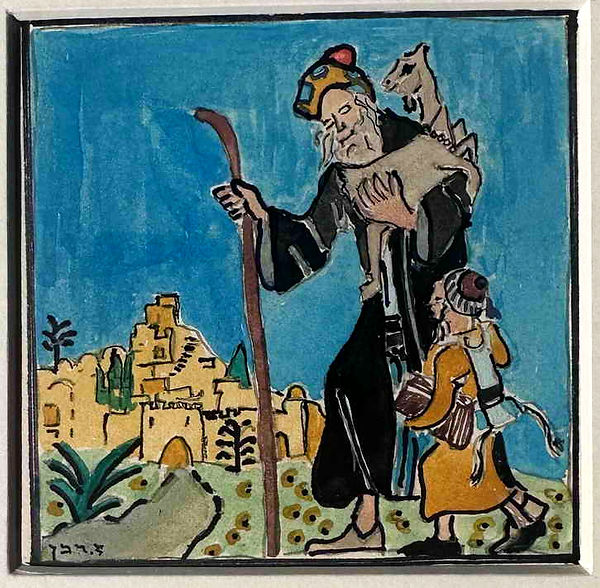
ZE'EV RABAN
'CHAD GADYA'
1920s, ERETZ YISRAEL
RESERVE: $1200 (estimate $2000-$3000)
Ze'ev Raban (1890–1970) was a pioneering artist, designer, and teacher whose visionary blend of European academic training and deep engagement with Jewish and Middle Eastern themes helped define early 20th‑century Jewish visual culture in Palestine; born in Poland and educated at the Warsaw School of Fine Arts, he continued his studies at École des Beaux‑Arts in Antwerp before immigrating to Ottoman Palestine in 1912, where he became a leading figure of the Bezalel School of Arts and Crafts in Jerusalem—serving as one of its principal artists and later as a professor—creating paintings, mosaics, stained glass, book illustrations, theatrical designs, and decorative objects that married Art Nouveau and Eastern motifs with Biblical and Zionist subjects; Raban’s iconic, richly colored posters and prints, with their stylized figures, ornamental borders, and Hebrew lettering, celebrated the revival of Hebrew culture and Jewish settlement while visually inventing a new local aesthetic that honored both ancient heritage and modern aspirations; as a craftsman he elevated applied arts—metalwork, ceramics, textile design—so that everyday objects became carriers of national meaning, and as a teacher he influenced generations of Israeli artists who carried forward the mission of culturally rooted modernism; his work remains sought after for its historical significance, technical skill, and inspiring synthesis of tradition and innovation, making any piece by Raban not only an object of beauty but a testament to the creative rebirth of a people and land. 'Chad Gadya' 1920s Preparatory design for the cover art of Raban's famed 'Chad Gadya" publication from 1926. Gouache on paper Signed 7.8x7.8cm
%20.jpg)
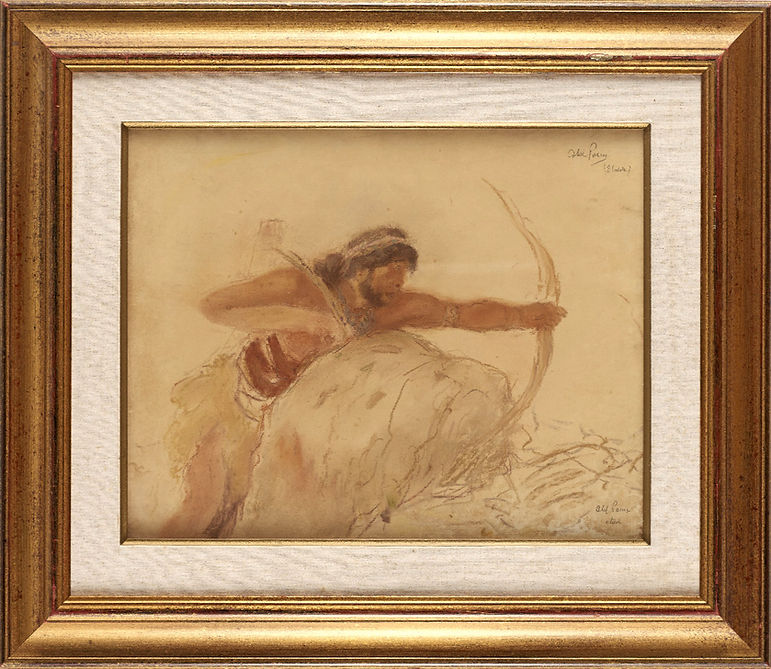
ABEL PANN
'NIMROD'
1920s, ERETZ YISRAEL
RESERVE: $6000 (estimate $8000-$9000)
Abel Pann (1883–1963) was a prolific and passionate painter and graphic artist whose work powerfully bridged European academic training, Jewish liturgical tradition, and the turbulent history of the early 20th century; born in Russia, he studied at the Imperial Academy of Arts in St. Petersburg and later in Munich and Paris, absorbing realist and symbolist techniques before immigrating to Ottoman Palestine in 1913, where he became deeply engaged with Biblical narrative, Jewish mysticism, and the everyday life of the Yishuv—Pann gained particular renown for his vivid, emotionally charged paintings, watercolors, and drawings that reimagined Biblical scenes with dramatic theatricality and intense psychological insight, often using local landscapes and models to root ancient stories in the contemporary land; during World War I he documented the suffering of Eastern European Jewish communities and, after the 1929 Hebron massacre, created a series of haunting works portraying the tragedy and resilience of Jewish victims, contributing both to public memory and advocacy; his skill as an illustrator found wide circulation in books, periodicals, and exhibition catalogs, and his teaching and mentorship helped shape a generation of Israeli artists committed to narrative depth and cultural identity; combining technical mastery with a fervent moral imagination, Abel Pann’s oeuvre stands as a moving testament to faith, loss, survival, and the creative reclamation of history—works prized for their historical importance, evocative power, and capacity to inspire reflection and empathy. 'Nimrod' 1920s Pastel on paper Signed 40.5x50cm
HERMANN STRUCK
'ATLIT FROM THE SEA'
1927, ERETZ YISRAEL
RESERVE: $500 (estimate $1000-$2000)
Hermann Struck (November 25, 1876 – August 3, 1944) was a German‑Jewish painter and master printmaker whose lifelong devotion to etching, pedagogy, and Zionist ideals made him a pivotal figure in early 20th‑century Jewish art; born in Mogilno, then in the Prussian Province of Posen, Struck studied art in Berlin and Paris and quickly gained recognition for his extraordinary technical command of drypoint and etching, producing intensely observed portraits, landscapes, and character studies that combined realism with expressive line work—his intimate, luminous prints captured both the dignity of his sitters and the soul of the spaces he recorded; deeply engaged with Jewish identity, he became an ardent Zionist and contributed to the cultural revival of the Jewish people by teaching, writing influential manuals on etching technique, and helping to establish artistic institutions; Struck’s close relationship with Theodor Herzl and friendship with younger Jewish artists and students extended his influence beyond aesthetics to cultural nation‑building, and his travels to Palestine in the 1920s left a lasting imprint on his subject matter and commitment to the land and its people; despite the upheavals of his era, including rising anti‑Semitism in Europe, Struck remained steadfast in mentoring a generation of Jewish artists, publishing accessible technical guides that democratized printmaking, and producing works that marry technical rigor with humanist empathy; today his etchings and drawings, celebrated for their refinement, psychological depth, and historical resonance, stand as inspirational testaments to an artist who used mastery of craft to express identity, resilience, and a hopeful vision for Jewish cultural renewal. 'Atlit From The Sea' 1927 Watercolor on paper Signed, Minor foxing 21x31cm

JOSEPH ZARITSKY
'LANDSCAPE'
1936, ERETZ YISRAEL
RESERVE: $1800 (estimate $2500-$3500)
Joseph Zaritsky (1891–1985) was a pioneering Russian‑born Israeli painter and a central figure in the development of modern art in Israel whose lifelong commitment to abstraction, landscape, and artistic leadership shaped the visual language of the nascent state; born in Krynki, in the Russian Empire (now Poland), Zaritsky trained at art schools in Vilnius and Odessa before immigrating to Ottoman Palestine in 1923, where his early work balanced figurative studies with an emergent sensitivity to light and place—qualities that would evolve into a distinctive abstracted landscape idiom that sought to translate the Mediterranean atmosphere into planes of color and subtle structure; as a founding member and leading voice of the Ofakim Hadashim (New Horizons) group in 1948, he championed a universal, lyrical modernism that fused European avant‑garde influences with local topography and cultural aspiration, organizing exhibitions, mentoring younger artists, and advancing the cause of abstraction against more conservative tendencies in Israeli art; throughout his long career Zaritsky continually refined a restrained visual vocabulary—muted palettes, layered washes, and a disciplined relationship between form and emptiness—that conveyed both the physical landscape and a contemplative inner world, producing seminal works that include his “Carmel” and “Palguim” (fields) series; honored domestically and internationally, he represented Israel at major exhibitions, taught and influenced generations of painters, and served as a symbol of aesthetic rigor, intellectual integrity, and artistic resilience in a society undergoing rapid social and cultural change; Zaritsky’s paintings remain admired for their quiet power, poetic clarity, and steadfast belief in the ability of abstract art to express place, memory, and national identity—qualities that make his life and work an inspiring testament to artistic innovation in service of a people and a landscape. 'Landscape' 1936 Watercolor & pencil on paper Signed 55x75cm

REUVEN RUBIN
'AFRICAN VIOLETS'
1940s, ERETZ YISRAEL
RESERVE: $60,000 (estimate $75k-$85k)
Reuven Rubin (1893–1974) was a foundational figure in the development of modern art in the Land of Israel and a leading voice in shaping the young State of Israel’s visual identity; born Reuven Rubinstein on September 14, 1893 in Galați, Romania, to a traditional Jewish family, he studied at the National School of Fine Arts in Bucharest where he absorbed Post Impressionist, Fauvist and Symbolist influences and began to develop the luminous palette, flattened planes and decorative rhythms that would mark his work; after first visiting the Land of Israel in 1920 and deciding to settle there permanently in 1923, Rubin devoted himself to painting its light, landscapes, ports and people—orchards and villages, the hills and streets of Jerusalem, the ports of Jaffa, pastoral scenes and biblical motifs reimagined through modernist form—rendering figures such as peasants, pioneers, children and shepherds as archetypal presences that blend narrative, folk tradition and symbolic simplicity; his early works were praised and sometimes labeled naïve for their apparent directness, yet they reveal a sophisticated synthesis of folk imagery with modern European practice and a deliberate role in cultural nation‑building; Rubin was active institutionally and internationally—organizing exhibitions, teaching and mentoring younger artists, representing the Land of Israel and later Israel abroad (notably at early Venice Biennales), and serving as cultural attaché in Romania in the 1950s—efforts that broadened audiences for his art and strengthened cultural ties; working in oil, watercolor and gouache and producing an extensive body of drawings and works on paper, he maintained a consistent sensibility while refining composition and surface, so that later works often read as quieter, more meditative reflections on memory and place; Rubin’s engagement with Jewish and biblical themes is modern and symbolic rather than literal, translating ancient narratives into a decorative, emblematic visual language that resonated with the aspirations of Jewish society in the twentieth century; widely collected by museums and patrons in the Land of Israel and the State of Israel and abroad, and honored with major retrospectives, Reuven Rubin died on April 22, 1974, leaving a prolific oeuvre and a lasting legacy as a master colorist, cultural organizer and one of the architects of Israeli visual culture. 'African Violets' 1940s Oil on canvas Signed 51x41cm

MOSHE ELNATAN
'EILAT'
1949, ISRAEL
RESERVE: $5000 (estimate $8000-$9000)
Moshe Eltnatan (1904–1969) is Israel's preeminent folk artist. He was an Iranian‑born Israeli self‑taught artist whose peripatetic early life found himself studying art in Bombay, India. He married during a stay in Iraq, and made Aliyah to Eretz Yisrael in 1939. He reveled in a unique naïve‑surreal visual language that fused myth, politics, and cosmic imagination. After serving in the British army and being discharged following an injury, he settled in Jerusalem, where he supported himself as the city’s much‑loved “Falafel King,” running a small King George Street eatery that doubled as an informal exhibition space and later a modest gallery on Nevi’im Street. Eltanan’s canvases are densely populated with events of cosmic proportions and biblical tableaux, portraits of Zionist leaders, all set amid occult symbols, and an array of rockets, spaceships, and otherworldly planets alongside spectacular floral bouquets—juxtapositions that braid the mythic and the futuristic, the mundane and the awe‑inspiring. His art reveals a creator who lived intensely before he began to paint and who absorbed the latest technological and political currents—Cold War anxieties, atomic dread, and the space age—filtering them through child‑like figures, surreal battle scenes, and dreamlike landscapes to produce art at once urgent, eccentric, and deeply human; his paintings, rooted in Israel's cultural fringe, remain a moving testament to resilience, imaginative breadth, and the power of outsider vision to capture universal concerns. 'Eilat' 1949 Oil on canvas Signed 60x135cm

MARCEL JANCO
'ON THE WAY TO EIN HOD'
1950s, ISRAEL
RESERVE: $3000 (estimate $4000-$6000)
Marcel Janco (1895–1984) was a Romanian‑born Jewish artist, architect, and pioneering modernist whose restless creativity helped shape European avant‑garde movements and later the visual culture of the nascent State of Israel. Born Marcel Hermann Iancu in Bucharest, he trained at the local School of Fine Arts and soon joined a circle of young intellectuals and poets that included Tristan Tzara; in 1916–1917 he co‑founded the Dada movement in Zurich with Hugo Ball, Tristan Tzara, and others, contributing provocative collages, masks, and stage designs that challenged traditional aesthetics and embraced chance, irony, and social critique. Returning to Romania after World War I, Janco became a central figure in the Romanian avant‑garde: he produced bold paintings and woodcuts marked by geometric abstraction and expressive color, designed theatrical masks and sets, and worked as an influential teacher and critic who promoted Constructivist and Expressionist ideas. An architect as well as a painter, Janco integrated modernist principles into practical projects—most notably in the 1930s when he designed a series of villas and apartment buildings in Bucharest that married functionalism with a lyrical sensibility. Facing rising anti‑Semitism and political instability, Janco emigrated to Palestine in 1941, where he became a leading force in Israeli art: he taught, exhibited widely, co‑founded artists’ groups, and in 1953 established the Ein Hod artists’ village, transforming a depopulated mountain hamlet into a vibrant communal center for creativity that nurtured generations of Israeli artists. Throughout his long career Janco moved fluidly between media—painting, collage, sculpture, architecture, stage design, and writing—synthesizing avant‑garde experimentation with civic engagement and cultural institution‑building. His work, which ranges from the Dada masks and sharp, angular compositions of his early years to later, more luminous landscapes and portraits, reflects a commitment to artistic renewal, humanist values, and the belief that art can reshape society. Recognized today as one of the 20th century’s important transnational modernists, Marcel Janco left a durable legacy of innovation, pedagogy, and cultural institution‑building that bridged European modernism and Israeli art. 'On The Way To Ein Hod' 1950s Watercolor & gouache on paper Signed 29x45cm

NAHUM GUTMAN
'MENDING THE NETS'
1950s, ISRAEL
RESERVE: $45,000 (estimate $55K-$65K)
Nahum Gutman (1898–1980) was one of the pioneering artists whose paintings, illustrations and public works shaped the visual language of early Jewish settlement and later the State of Israel; born on October 14, 1898 in Telenești (then in the Bessarabia Governorate of the Russian Empire, today in Moldova), Gutman immigrated with his family to Ottoman-era Jaffa in 1903, grew up amid the rapid growth of the new Jewish urban communities, and was deeply influenced by the light, landscape and everyday life of the Yishuv; after studying at the Bezalel School in Jerusalem (1913–1918) and briefly in Vienna and Berlin, he returned to Mandate-era Jaffa and Tel Aviv, where he became intimately associated with the city’s cultural life—recording its streets, ports, cafés, workers and children in a lively, heartfelt, often slightly nostalgic style that combined elements of lyricism, folk art and modernist simplification; Gutman worked across media—oil, watercolor, gouache, illustration, stage and set design, mural painting and sculpture—and his prolific output included book illustrations (notably for Hebrew children’s literature), graphic work for newspapers and magazines, and major public commissions that made art part of everyday civic space; his style balanced narrative warmth and poetic color with formal clarity: flattened planes, rhythmic compositions and a palette that evoked Mediterranean light while retaining a gentle, narrative intimacy; Gutman was also an important chronicler of the founding generation’s memory and myths, portraying pioneers, fishermen, market scenes, and biblical references that linked contemporary life to ancient roots; active as a teacher and community figure, he participated in exhibitions at home and abroad and received multiple honors, including the Israel Prize in Fine Arts in 1973, recognition of his central role in cultivating a visual culture for the nascent state; his later years saw large-scale murals and sculptures installed in public places, ensuring his imagery remained woven into the fabric of Israeli daily life; Nahum Gutman died on November 27, 1980 in Tel Aviv, leaving a vast, accessible oeuvre beloved by generations for its warmth, civic resonance and poetic vision of place and people. 'Mending The Nets' 1950s Oil on canvas Signed 38x46.5cm

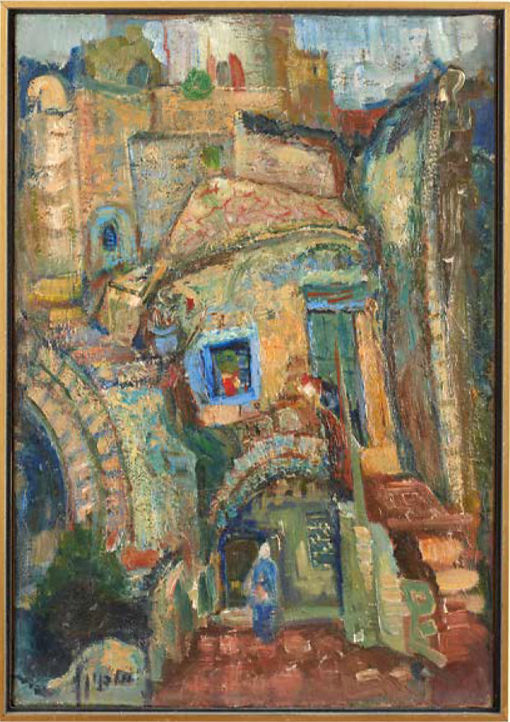
MORDECHAI LEVANON
'TZFAT'
1955, ISRAEL
RESERVE: $2500 (estimate $3500-$4500)
Mordechai Levanon (1901–1968) was a seminal Israeli painter whose luminous, lyrical landscapes transformed the emotional language of modern Hebrew art by fusing mystical longing with a poetic vision of the Land of Israel; born in Kraków (then Austria‑Hungary) and trained briefly in European ateliers, he immigrated to Palestine in 1920 and became closely associated with the Safed and Jerusalem art scenes, where his work absorbed both the spiritual atmosphere of the Galilean hills and the austere, sun‑blanched light of the Judean landscapes. Deeply influenced by Symbolism and by the spiritual searches of artists such as Henri Rousseau and Odilon Redon, Levanon developed a distinctive idiom—soft, glowing planes of color, simplified forms, and a permeating sense of silence and reverie—that rendered olive groves, terraced fields, lonely fig trees, and ancient stone villages as metaphysical stages where history, memory, and sacred time converge. His canvases often suggest interior states as much as topography: winding paths, distant houses, and silhouetted trees become emblems of exile and return, of human yearning for rootedness and transcendence; critics and collectors have long noted his ability to evoke Biblical resonances without literal illustration, producing scenes that feel at once intimately observed and mysteriously archetypal. Active in the cultural life of British Mandate and early Statehood Israel, Levanon exhibited widely, taught younger artists, and participated in the evolving debate over national style—yet he remained singular, favoring contemplative mood over overt nationalism or trendy formalism. Across a career that moved from more descriptive early work to increasingly meditative compositions, Levanon pursued a consistent aim: to render the spiritual atmosphere of the land with color, silence, and a patient lyricism. Today his paintings are prized for their emotional depth, restrained modernism, and their capacity to offer viewers a meditative encounter with landscape as vessel of memory and hope—an inspiring legacy for collectors, institutions, and anyone moved by art that seeks the sacred in everyday places. 'Tzfat' 1955 Oil on canvas Signed 55x38.5cm
PINCHAS LITVINOVSKY
'FIGURES'
1950s, ISRAEL
RESERVE: $2300 (estimate $3000-$4000)
Pinchas (Piotr Vladimirovich) Litvinovsky (1894–1985) was a pioneering Israeli artist whose career bridged the late Russian avant‑garde and the formative decades of modern art in Mandate Palestine and early Israel. Born into a religious merchant family in Novogorod‑Yezersk (now in Ukraine), he emigrated in 1912 to Palestine to study at the Bezalel Academy before continuing his training at the Art Academy in St. Petersburg. Returning to Palestine in 1919 aboard the ship Ruslan with his wife, he settled in Tiberias and became active in the emerging Hebrew cultural scene. In the 1920s Litvinovsky worked in a Russian constructivist idiom—producing portraits and scenes of “oriental” figures and designing graphic emblems such as the symbol for the Ohel Theater (1925)—and in 1926 he designed stage elements for The Dybbuk at the Habima Theater in Tel Aviv. He lived and worked in Jerusalem from the late 1920s, participating in the Association of Hebrew Artists (1924–25), the Modern Artists exhibitions at “The Hut” (mid‑ to late‑1920s), and the Egged group (1929), and later joined the artists’ colony at Motza Ilit in the late 1930s. From the 1930s his work moved toward Expressionism; by the 1950s he increasingly produced works on paper and graphic reductions that distilled form and mood. Throughout his long career Litvinovsky contributed to the visual vocabulary of the Yishuv and the young state—blending avant‑garde formal experiments with portraiture and local subjects—and left a legacy as a formative, if sometimes overlooked, figure in early Israeli modernism. 'Figures' 1950s Oil on paper mounted to board Signed 45x60cm

MORDECHAI ARDON
'ISRAEL LANDSCAPE COMPOSITION'
1950s, ISRAEL
RESERVE: $18,000 (estimate $20K-$25K)
Mordechai Ardon (1896–1992) was a central figure in twentieth‑century Israeli painting whose luminous, symbolically charged canvases fused mystical, biblical and landscape themes into a distinctive modernist vision; born Max Bronstein on December 13, 1896 in Tczew (then in the German Empire, now in Poland), he studied art in Berlin at the Staatliche Akademie and with influential teachers such as Erich Wolfsfeld and later at the Academy for Jewish Art under Arthur Segal, absorbing Expressionist and Symbolist currents while developing a deep interest in spirituality and Jewish cultural memory, and in the 1920s he traveled widely—studying in Prague and London and spending time in Paris—before immigrating to the Land of Israel in 1934, where the light, terrain and biblical heritage profoundly shaped his artistic language; settling in Jerusalem, Ardon taught at the Bezalel School of Arts and Crafts and later at the Teachers’ Seminary, becoming an influential educator as well as a prolific painter whose mature work combined meticulous composition and a richly textured surface with a palette that shifted between glowing, jewel‑like colors and somber, contemplative tones; he used symbolic motifs—mountains, cityscapes, gardens, liturgical objects, scrolls and radiant windows—to explore themes of exile and return, prophetic vision, and the continuity of Jewish cultural life, often juxtaposing the real topography of the Land of Israel (Jerusalem’s walls, Galilean hills, the Sea of Galilee) with visionary, transcendent elements—floating figures, metaphysical light, and layered pictorial planes—so that his landscapes read as both actual places and spiritual maps; Ardon’s work bears the imprint of European modernism while asserting a distinctly local, metaphysical purpose: to render history, scripture and collective memory as living, present forces, and he represented Israel at international exhibitions, received the Israel Prize for Painting in 1960, and was honored with major retrospectives that traced his evolving synthesis of myth, history and modern form; in addition to oil painting he produced drawings, watercolors and stage designs, and his teaching and writings helped shape subsequent generations of Israeli artists, and when he died on November 6, 1992 in Jerusalem he left a body of work noted for its meditative power, symbolic depth and the fusion of the sacred with the modern. 'Composition' 1950s Mixed technique on board Signed 25x34cm

JAKOB STEINHARDT
'GALILEE'
1959, ISRAEL
RESERVE: $3000 (estimate $4000-$6000)
Jakob Steinhardt (1887–1968) was a German-born Jewish artist and printmaker whose powerful, expressionist woodcuts and paintings gave voice to the anguished spiritual and social currents of his time and helped shape modern Jewish art in the Land of Israel; born Jakob Steinhardt on December 11, 1887 in Zerków (then in the Prussian province of Posen, now in Poland), he trained at the School of Applied Arts in Munich and later at the Academy of Arts in Berlin, where he absorbed Expressionist currents and developed a mastery of woodcut technique that allowed him to render figures and scenes with stark, chiseled lines, dramatic contrasts of black and white, and intense psychological force; deeply influenced by Biblical narrative, Jewish ritual life, the plight of Eastern European Jewry and the trauma of World War I, Steinhardt’s work often focused on solitary, contemplative figures, scenes of exile, shtetl life, religious study and moments of moral crisis, combining raw emotional directness with formal rigor; in 1922 he participated in the Berlin art world, exhibiting widely and teaching, but the rise of Nazism and mounting antisemitic persecution compelled him to leave Germany—he immigrated to the Land of Israel in 1933, where he became a central figure in art education and community life, joining the Bezalel School and later teaching at the New Bezalel and other institutions, influencing generations of Israeli printmakers and graphic artists; in Jerusalem and Tel Aviv he continued to produce woodcuts, paintings and illustrations imbued with both European modernist technique and Jewish thematic focus, publishing notable cycles such as his biblical and Passover series and creating evocative portraits of Jewish experience that bridged memory and contemporary reality; Steinhardt also worked as an illustrator for books and periodicals, designed theater sets and participated in exhibitions at home and abroad, receiving recognition for his contribution to Jewish visual culture; his late work maintained the expressive austerity and moral intensity of his earlier woodcuts while occasionally opening to quieter, more reflective moods; Jakob Steinhardt died on January 13, 1968 in Jerusalem, remembered as a master printmaker, a devoted teacher, and an artist who translated the spiritual trials and resilience of Jewish life into a visually arresting and ethically engaged body of work. 'Galilee' 1959 Oil on board Signed 50x70cm

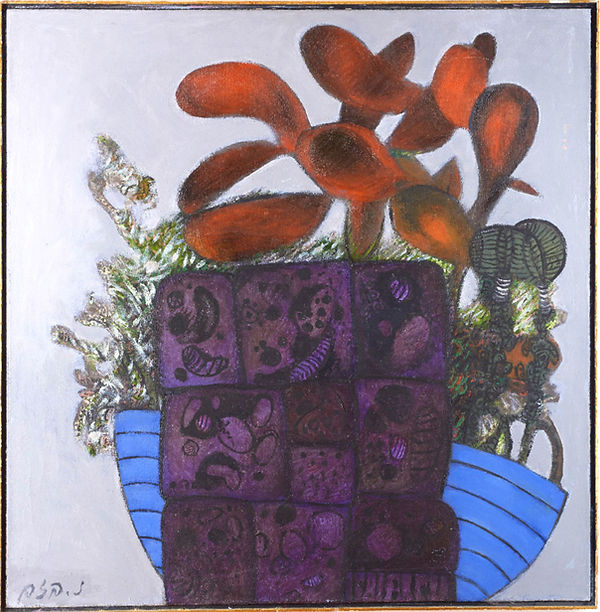
NAFTALI BEZEM
'ALTAR'
1968, ISRAEL
RESERVE: $7500 (estimate $9000-$12,000)
Naftali Bezem (1924–2018) was an influential Israeli painter, sculptor, muralist, and illustrator whose work engaged deeply with memory, narrative, and the formation of Israeli identity; born in Ein Harod (then British Mandate Palestine) to Jewish immigrants from Eastern Europe, he studied at the Bezalel School in Jerusalem and later at the École des Beaux‑Arts in Paris and in Rome, experiences that broadened his technique while anchoring him in the evolving cultural life of the Yishuv and the State of Israel. Bezem’s art spans figurative painting, large‑scale public murals and mosaics, sculpture, and book illustration, characterized by a synthesis of modernist form and strong narrative content. He produced powerful series addressing collective trauma and national history, most notably his sustained engagement with the Holocaust: works such as his major cycle of paintings and murals confront loss, survival, and the ethical responsibility of memory with stark, often monumental imagery that balances symbolic archetypes and individual figures. He also created murals and public commissions for civic spaces, schools, and synagogues—work that contributed to the visual vocabulary of Israel’s public landscape—executing mosaics and frescoes that combine decorative craft with expressive, didactic intent. Throughout his career Bezem explored biblical and historical themes alongside contemporary social and moral questions, employing a robust, tactile handling of paint, simplified forms, and an often sober palette that could turn to luminous color when the subject demanded. He was an active participant in Israel’s cultural institutions: teaching, exhibiting widely at home and abroad, and receiving awards such as the Dizengoff Prize and other honors recognizing his contribution to Israeli art and culture. Bezem’s multifaceted oeuvre—ranging from intimate book illustrations to monumental public art and searing paintings of memory—marks him as a central figure in twentieth‑century Israeli art, committed to art’s civic role in shaping remembrance, identity, and moral reflection. 'Altar' 1968 Oil on canvas Signed 100x100cm
ARIEH ALLWEIL
'TZFAT OLIVE GROVE'
1960s, ISRAEL
RESERVE: $6000 (estimate $8000-$9000)
Arieh Allweil (1901–1967) was a painter, printmaker, typographer and educator whose work bridged European Expressionism and the emerging visual culture of Eretz Yisrael. born Piotr (Arieh) Allweil in Bobrka (Bobroysk), Galicia, into a working-class family—his father a metalsmith—he carried early memories of village life, study and the upheavals of World War I into a lifelong artistic and cultural commitment. He joined Hashomer Hatzair and helped organize its activity in Bobrka and the wider Galician region before emigrating to Eretz Yisrael in 1920 and briefly becoming a halutz in the Bitanya Ilit settlement. Sensing that his future lay in art rather than agriculture, he left for Europe to study at the Kunstgewerbeschule in Vienna (1921–1925), where he absorbed currents of German Expressionism, joined the avant‑garde Kunstschau circle and exhibited with them (including participation in a prominent Vienna exhibition of Austrian art in 1924–25), produced the 1924 lithograph portfolio Tura Afura and deepened a visual language at once modern and rooted in Jewish content. Upon returning to Eretz Yisrael in 1926 after travels through Paris and Italy, Allweil settled into a dual career as a painter of landscapes, cityscapes and biblical-themed compositions and as a masterful linocut artist and calligrapher who designed his own Hebrew lettering, carved and printed his plates by hand and founded the small press Hillel to publish his works. Between 1939 and 1949—years of global catastrophe and local transformation—he created and self‑published a significant series of handmade books and illustrated megillot (including The Anonymous Jew, Amos, Lamentations, Ruth, Esther and a Passover Haggadah), in which he intertwined stark, often anguished black‑and‑white linocuts, expressive figurations and original lettering to address biblical themes through the lens of contemporary tragedy and hope, the prints registering both a response to the Holocaust and an affirmation of Jewish continuity. Allweil was also active institutionally—he was among the founders associated with the early Tel Aviv Museum and with the Midrasha art teachers’ college—and exhibited widely, taught, and influenced a generation of students while continuing to paint in color, producing a parallel body of richly hued landscapes and scenes that critics have read as the utopian counterpart to his darker graphic work; his books were often produced in small, hand‑printed editions (frequently of about 100 copies), with pages where large letters were themselves cut in linoleum and smaller texts produced by hand and photographed for metal plates, reflecting his deep interest in the form and soul of Hebrew letters as well as image. He was honored with awards such as the Touroff Prize (1955) for his Bible illustrations. Allweil married twice (first to the poet Esther Raab, later to Rachel Bugrashov), raised three children and remained engaged with both European modernist practice and Jewish cultural traditions until his death in 1967, leaving a distinctive oeuvre of oil paintings, linocuts, hand‑printed books and type designs that testifies to a singular voice in twentieth‑century Jewish and Israeli art. 'Tzfat Olive Grove' 1960s Oil on canvas Signed 62x50cm

DAVID TARTAKOVER
'SHANA TOVA / SMILING SUN'
1963, ISRAEL
RESERVE: $400 (estimate $900-$1100)
David Tartakover (1944-2025) is one of Israel's seminal graphic designers, political poster artist, typographer, and public intellectual whose work has profoundly shaped Israel’s visual and political culture; born in Haifa to Austrian & Egyptian‑born parents and raised in a milieu marked by collective memory and civic debate, Tartakover trained at the Bezalel Academy of Art and Design and later studied graphic design and typography abroad, bringing international modernist clarity to the fraught visual landscape of a young nation. Across a career spanning more than five decades he became known for incisive, minimalist posters and campaigns that fuse sharp conceptual wit with spare, powerful imagery—steel‑edged metaphors, photographic détournements, and bold typographic solutions—that interrogate Israeli identity, memory, war, peace, human rights, and the ethics of public policy; his work has both campaigned for peace and criticized official narratives, blending artistry and activism in pieces that function as persuasive public argument as much as aesthetic objects. Tartakover’s practice extends beyond poster making to book and magazine design, corporate identity, exhibition curatorship, and teaching, where he has influenced generations of designers through his roles at Bezalel and internationally; he has received major awards including the Israel Prize for design, retrospectives at leading institutions, and a lasting reputation for combining rigorous formal discipline with civic conscience. Deeply engaged with the politics of memory, Tartakover frequently reworks historical photographs, archival material, and typographic form to reveal contested narratives and to ask viewers to reconsider received truths, making his work a persistent visual forum for public debate. Whether designing cultural institutions, protesting policies, or helping to define modern Hebrew visual language, David Tartakover’s clear, provocative, and ethically charged graphic voice has made him one of Israel’s most influential designers and conscience‑shaping visual communicators. 'Shana Tova / Smiling Sun' 1963 Collage and ink on paper Signed 7x14cm

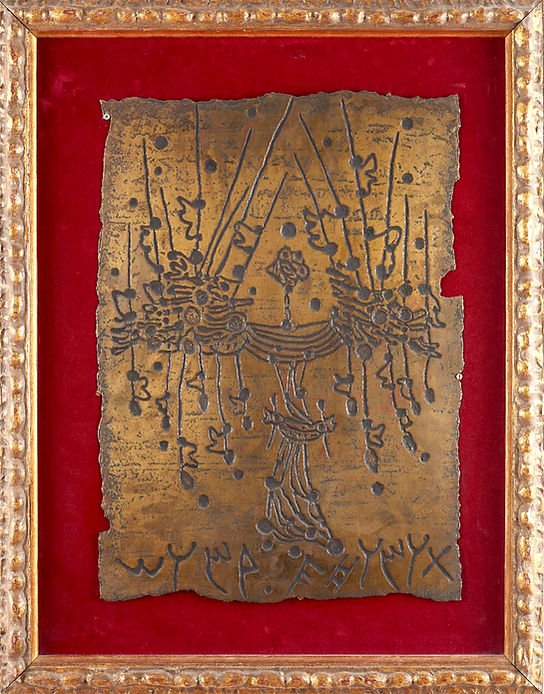
MOSHE CASTEL
'GUARDIAN OF THE WALLS'
1970s, ISRAEL
RESERVE: $5000 (estimate $8500-$9500)
Moshe Castel (1909–1991) was one of Israel’s leading modern painters, celebrated for synthesizing Jewish and Middle Eastern visual traditions with European modernism to create a distinctive, textured abstract‑figurative language; born in Jerusalem in 1909 to a Sephardic family and raised amid the material culture of the Old Yishuv—liturgical art, synagogue textiles and vernacular crafts—he trained at the Bezalel School of Arts and Crafts (1926–1928) and continued his studies in Paris (1929–1932), where exposure to the École de Paris and interwar modernist debates helped shape his evolving aesthetic; returning to the Land of Israel, Castel worked as a designer and teacher while gradually developing a personal idiom that balanced figurative memory and symbolic reference with increasing abstraction, and by the 1940s and 1950s he began exploring heavily textured, relief‑like surfaces, incorporating natural materials, earth pigments, gesso and embedded objects into his panels to produce low‑relief canvases that evoke ancient mosaics, parchments, ritual vessels and the archaeological strata of the region; his works from this period fuse Hebrew letters, archetypal human forms, ritual vessels and geometric signs—often arranged in dense, grid‑like compositions—linking Jewish textual culture and ancient Near Eastern art with contemporary abstraction, while a restrained, earthy palette of ochres, umbers, deep reds and blacks reinforces a sense of antiquity and sacredness; in the 1960s and 1970s his surfaces grew more sculptural and monumental as he received growing institutional recognition—solo exhibitions, retrospectives and acquisitions by major museums at home and abroad—he taught and influenced younger generations of artists and was honored with awards including the Israel Prize for Painting (1969); throughout his career Castel balanced modernist formal concerns with an orientation toward memory, ritual and cultural continuity, deliberately rooting contemporary painting in the historical, religious and material landscape of the Jewish people, and he died in 1991 leaving a powerful, symbolically charged body of work central to the story of Israeli modern art. 'Guardian Of The Walls' 1970s Etched brass 55x40cm
LEON ENGELSBERG
'YEMIN MOSHE'
1980s, ISRAEL
RESERVE: $5000 (estimate $8000-$9000)
Leon Engelsberg (1908–1998) was a Polish‑born Israeli painter, draughtsman and influential chronicler of Jerusalem whose life and art were shaped by wartime survival, formal academic training and a long devotion to the city’s landscape and people; born in Warsaw in 1908, Engelsberg endured the catastrophes of World War II — his eldest brother was killed in the 1939 German bombardment of Warsaw, and Engelsberg escaped with another brother to Lwów, later fleeing in 1940 to the Soviet Union where he was subjected to forced labor while his parents and sister remained in the Warsaw Ghetto and perished — and in 1943 he joined the Polish Army under General Zygmunt Berling, serving as a draughtsman in a unit allied with the Red Army, during which he was wounded in the 1944–45 campaigns and received a citation for his service; after the war he studied at the Academy of Fine Arts in Warsaw (1946–1950), developing a strong foundation in draftsmanship and composition that would inform his mature work, and in 1957 he immigrated to Israel, settling in Jerusalem’s Abu Tor neighborhood in a deserted Arab house where he became captivated by the local vistas and joined the ranks of Israeli landscape painters whose work expresses a deep emotional and aesthetic response to the region’s light, architecture and topography; Engelsberg worked in oil, watercolor and graphic media, producing portraits, cityscapes and lyrical studies of Jerusalem that combine rigorous draftsmanship with sensitive observation, and his works entered the collections of major Israeli museums while he continued to teach, exhibit and influence younger artists; among his recognitions are the 1991 Shoshana Ish Shalom Prize (The Artists House, Jerusalem) and the 1991 Sussman Prize for Artists Depicting the Holocaust (Yad Vashem, Jerusalem); he remained productive in Israel until his death in 1999, leaving a body of work valued for its technical assurance, historical resonance and heartfelt engagement with the city he made his home. 'Yemin Moshe' 1980s Oil on canvas Signed 71x84cm

YAACOV AGAM
'CHAI'
1980s, ISRAEL
RESERVE: $2600 (estimate $3600-$5000)
Yaacov Agam (1928-2026) is an Israeli‑born pioneer of kinetic and optical art whose multi‑sensory, participatory works transformed postwar abstraction into moving, luminous experiences that engage viewers as active participants; born in Rishon LeZion in 1928, he trained at the Bezalel School in Jerusalem and continued studies in Zürich and Geneva, absorbing European modernist currents while developing an enduring interest in movement, perception and the integration of art into public life, and in the 1950s he moved to Paris where he entered avant‑garde circles and began experimenting with artworks that change appearance through mechanical rotation, sequential viewing, lenticular surfaces and layered planes—techniques that made temporal experience and optical illusion central to his practice; his signature creations, often called “Agamographs” (images that shift as the viewer moves) and motorized sculptures, combine bright, contrasting color, geometric order and controlled chance to produce shifting compositions that reveal multiple images, rhythms and narratives depending on vantage point and motion, and his output ranges from intimate prints and paintings to monumental public commissions—fountains, mosaics, façades, stained glass and large‑scale kinetic sculptures—designed to animate architecture and civic space and to bring his ideas about communal, democratic art to broad audiences; active on the international stage from the 1950s onward, Agam represented his country at major exhibitions, received prizes and honors for his innovations in visual perception and urban art, and pursued theoretical and pedagogical interests—publishing statements on viewer participation, visual time and the social function of art while teaching and lecturing globally; working across painting, printmaking, sculpture and design, he has maintained a consistent emphasis on color theory, modular construction and engineered movement, often realizing complex pieces through collaboration with fabricators and technicians so that technical precision supports sophisticated perceptual effects, and over a long career he has continued to experiment with new materials and technologies, expanding his repertoire of kinetic strategies while preserving the core conviction that art is completed through perception and participation, a stance that has secured his reputation as a foundational figure in kinetic and optical art whose public projects and studio works have left a visible imprint on late twentieth‑century and contemporary visual culture. 'Chai' 1980s Serigraph Signed & numbered 110x60cm

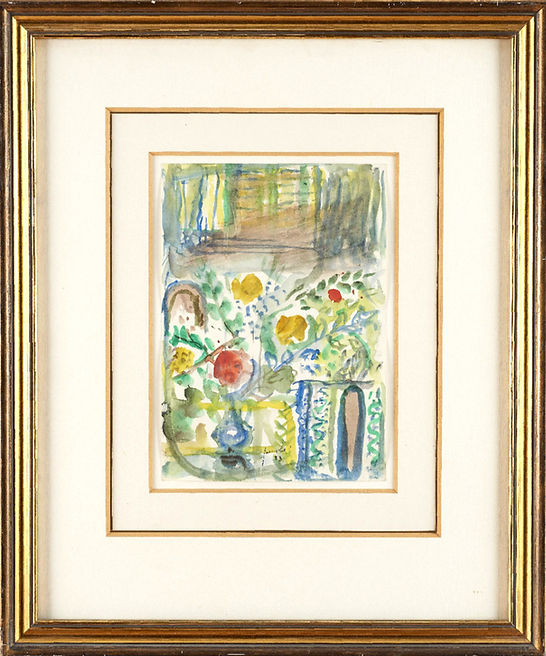
YEHEZKEL STREICHMAN
'FLOWERS ON THE TABLE'
1989, ISRAEL
RESERVE: $1500 (estimate $2000-$3000)
Yehezkel Streichman (1906–1993) was a central figure in the development of modern painting in the Land of Israel and later Israel, a painter, teacher and leader whose commitment to abstraction, color and formal rigor helped define generations of Israeli art; born in 1906 in Kovno (Kaunas), Lithuania, he trained at the Kaunas art school before emigrating to Eretz Yisrael in 1923 where he continued his studies at the Bezalel School in Jerusalem and later at the École des Beaux‑Arts in Paris and in Amsterdam, absorbing European modernist currents while forging a personal language that emphasized expressive brushwork, clear structural composition and a disciplined sense of color; in 1927 he co‑founded the modernist artists’ group “The New Bezalel” (HaBezalel HaHadash) and, more importantly, in 1948 he co‑founded the influential “Ofakim Hadashim” (New Horizons) group with Yosef Zaritsky and others, championing lyrical abstraction and the integration of international modernism with local subject matter; Streichman’s paintings range from figurative landscapes, portraits and scenes of daily life—rendered with economy and monumentality—to increasingly abstract canvases where flattened planes, rhythmic brushstrokes and a refined palette negotiate light, form and emotional intensity; as a teacher at the Avni Institute and other schools he mentored many younger artists, shaping Israeli art education and institutional life, and he exhibited widely both domestically and abroad, receiving major prizes and retrospectives that acknowledged his role as a master colorist and formalist; throughout his long career Streichman balanced respect for pictorial tradition with a persistent push toward abstraction and modernist experimentation, leaving a legacy of disciplined, lyrical work and a central place in the history of twentieth‑century Israeli painting. 'Flowers On The Table' 1989 Watercolor on paper Signed 30x21cm
ZADOK BEN-DAVID
'THE MAN'
1994, ISRAEL
RESERVE: $3500 (estimate $4500-$6000)
Zadok Ben‑David (born 1949) is an award‑winning Israeli sculptor and installation artist who also works between London and Portugal. His monumental practice has, over five decades, established him as one of the most poetic and formally rigorous voices in contemporary sculpture. Born in Bayhan, Yemen, and brought to Israel with his family during their 1949 Aliyah, Ben‑David studied and trained in Israel before relocating to London to refine his sculptural education at St. Martin’s School of Art, where he graduated in Advanced Sculpture and later served on the teaching staff from 1977 to 1982, an early period that consolidated his technical mastery and conceptual interests. Working primarily in metal; steel, corten, bronze and occasionally aluminum, he has developed a distinctive visual language that oscillates between delicate, jewel‑like miniatures and expansive, site‑specific installations, often producing intricate laser‑cut silhouettes, freestanding forms and vast arrays of repeating modules that produce optical and spatial effects; metal’s solidity and raw surface are paradoxically rendered into works of extraordinary lightness and lyricism as Ben‑David exploits negative space, shadow, reflection and precisely cut edges to summon landscapes, insectile forms, botanical motifs and human figures that address themes of migration, memory, evolution and the fragile relationship between the individual and the collective. Across a career marked by persistent craftsmanship and refined restraint, he has made public commissions and permanent installations for museums, civic plazas and parks worldwide, works that invite slow looking and shift their meaning as the viewer moves, while his gallery and museum exhibitions have been accompanied by finely detailed smaller objects and tabletop sculptures that reveal an equally exacting concern for scale, proportion and surface. Ben‑David represented Israel at the Venice Biennale in 1988 and has participated in numerous international biennales and exhibitions, including the XXII Cerveira International Art Biennial (Portugal, 2022), Breda Photo Biennial (Netherlands, 2020), Krasnoyarsk Biennale (Russia, 2019), Busan Biennale (South Korea, 2010), Biennale Cuvee (Austria, 2009), the Singapore “Wonder” Biennale (2008) and Sculptuur Biennale (Netherlands, 2007). His work is held in major public and private collections, such as the Victoria & Albert Museum (London), the Israel Museum (Jerusalem), the Tate and other European and American institutions, garnering prizes and critical recognition for its intellectual depth and visual poetry. Throughout his practice Ben‑David has probed the paradoxes of natural and cultural history, evolutionary forms rendered as elegant silhouettes, archival and ecological concerns distilled into minimal structures, while developing technical innovations in metalwork, precision cutting and modular assembly that allow fragile, ephemeral impressions to emerge from an industrial medium; critics often describe his work as magical and meditative, a bridge between meticulous craftsmanship and metaphysical inquiry, and he continues to produce new commissions, public projects and exhibitions from his studios in London and Portugal, sustaining a body of work that is at once formally exacting, conceptually rich and quietly humane. 'The Man' 1994 Painted stainless steel Signed on back 19x9cm

YUVAL SHAUL
'THE KIDDUSH CUP'
2000s, ISRAEL
RESERVE: $4500 (estimate $8000-$9000)
Yuval Shaul (born 1961, Tel Aviv) is a leading figure in contemporary Israeli art whose restless experimentation and material inventiveness have secured him a prominent place in museum and public collections across the country; a graduate of the Avni Institute (Art Studies, 1988) who also trained in Zvi Milstein’s studio in 1984, Shaul established an early reputation—winning the Young Artist Prize from the Ministry of Education, Culture and Sports (1991), receiving consecutive one‑year scholarships from the America‑Israel Cultural Foundation and the Sharett Foundation (1989–1990), and later taking the 2011 Cutlog Prize in Paris—that enabled a career spanning painting, sculpture, and large‑scale public practice. For two decades he concentrated primarily on sculpture, building a vocabulary of constructed forms and tactile surfaces, but in recent years he has returned to painting with renewed vigor: in the exhibition New Abstract he presented a body of colorful, interrelated canvases that generate dynamic, dialoguing compositions and signal a decisive reorientation of his practice toward process‑based abstraction. Shaul’s working method is alchemical and performative—he mixes traditional oils with industrial metal paints, thinners, and unconventional additives, tilting and propping paper and supports so that pigments run, drip, lift and mingle, allowing gravity and chance to choreograph marks in what he describes as “painting in action / in motion.” This hybrid, laboratory‑like approach produces surfaces that are simultaneously controlled and accidental, chromatically bold yet materially complex, and it reflects Shaul’s interest in painting as event rather than static object. His works are held in major public collections including the Israel Museum (Jerusalem), Tel Aviv Museum of Art, Herzliya Museum of Art, Janco Dada Museum (Ein Hod), the Leumi, Discount and Hapoalim bank collections in Tel Aviv, and the Knesset Collection, testifying to his significance within Israel’s cultural institutions and to a practice that continues to push the boundaries between medium, movement, and material. 'The Kiddush Cup' 2000s Metal paint on paper 75x39cm

DALIT SHARON
'HABIMA THEATER'
2010, ISRAEL
RESERVE: $600 (estimate $1000-$1200)
Dalit Sharon (born 1957) is an Israeli artist, educator and cultural director based in Tel Aviv who combines a long professional practice in the visual arts with institutional leadership and academic work; a graduate of the Bezalel Academy of Arts and Design (BFA, Department of Fine Arts, 1979–1983), Sharon was teaching in Landscape Architecture at the Technion – Israel Institute of Technology, linking art, spatial thinking and pedagogy in her practice. As an arts leader she is CEO of The Garage, a pre‑academic art school in Tel Aviv, and in 2004 she founded Kenafayim (Wings), an NGO and arts center dedicated to artists with special needs, an initiative that demonstrates her sustained commitment to inclusive arts education and community engagement. Sharon’s career thus spans studio practice, teaching, research and arts administration; in addition to developing curricula and mentoring emerging artists at The Garage and in academic settings, she has been involved in projects at the intersection of art, urbanism and social policy, and her name also appears in professional contexts connected to landscape architecture. Whether working in the studio, the classroom, or through public programs and NGOs, Dalit Sharon’s practice is characterized by a commitment to accessibility, interdisciplinary exchange and the social potential of art. 'HaBima Theater' 2010 Oil on paper 57x76cm

OSNAT OLIVA
'JERUSALEM LEMONS'
2020s, ISRAEL
RESERVE: $4500 (estimate $6000-$7000)
Osnat Oliva (born 18 June 1986, based in Tzur Hadassah) is an Israeli painter whose deeply researched engagement with the longue durée of Italian and European painting has been transmuted into a distinctively contemporary pictorial language that balances historical awareness with material experimentation; after graphic‑design studies in Jerusalem she refined her drawing and painting in sustained programs with Israel Hershberg and at the Jerusalem Studio School and the Israel Museum, and frequent residencies and workshops in Italy exposed her directly to fresco cycles and landscape traditions, an encounter famously crystallized the first time she saw the Roman frescoes in the garden of Villa di Livia and thereafter became a catalytic moment that redirected her practice toward the fresco idiom’s layered surfaces, tonal subtlety and timeless gravitas. Oliva’s early series translated this sensibility into lyrical depictions of the Jerusalem hills—flowers, branches and fruit rendered with textural depth, layered glazes and carefully modulated color, and over time her work has shifted toward fragmented figurative tableaux and re‑interpretations of Old Master scenes (Poussin and other European precedents recur as provocations rather than templates), in which figures and still‑life elements emerge from complex strata of paint, abrasion and abrasion‑like scumbling. Her signature process combines rich color fields, repeated layering, and a choreography of angles, curves and edges to orchestrate an interplay of light, texture and space that sits between representation and abstraction; she deliberately transforms inherited imagery through an informed yet intuitive method aimed at producing something new from tradition. In recent years Oliva has also expanded into printmaking and monochrome drawing, exploring how the compositional richness and layered sensibility of her oil paintings can translate into works in black, white and grey—while continuing to spend hours building surfaces in oil that reveal figures as if excavated from pictorial strata. Her exhibition history is international and active—solo shows such as Fragments of Light (Nicelle Beauchene New York project space, 2024) and Tsfunot (Gordon Gallery, Jerusalem, 2024), presentations at venues across the UK, USA and Israel, participation in the Jerusalem Biennale and numerous group shows in Washington DC, Seattle, London, Amsterdam and Tel Aviv—testifies to a practice that is simultaneously scholarly, tactile and image‑driven. Oliva’s work, semi‑representational, materially rich and compositionally poised, seeks to renew classical pictorial problems for the present: to balance narrative emergence with formal harmony, to honor historical technique while insisting on transformation, and to challenge herself continuously by varying media, scale and restraint so that whether in color or strict monochrome she arrives at a visual language of layered memory, light and fragile, deliberate revelation. 'Jerusalem Lemons' 2020s Oil on canvas mounted to wood 40x50cm

YOEL GILINSKY
'HERZL & SABRA'
2020s, ISRAEL
RESERVE: $2600 (estimate $3600-$5000)
Yoel Gilinsky (born 1954) is an Israeli painter and seasoned educator who taught at the Bezalel Academy of Arts and whose work has been shown in major institutions including the Israel Museum and the Haifa Museum of Art; in his early career Gilinsky explored the sublime through spiritual and esoteric registers—religion, Kabbalah and mysticism—undertaking deep research into occult imagery and often incorporating biblical quotations and angel‑like motifs into meditative, symbol‑rich compositions that sought transcendence and metaphysical meaning. In 2012 a personal crisis and a felt fracture prompted a decisive shift in his practice: turning inward and retrospective, he began to mine Israeli nostalgia and childhood memory, transforming his palette and subject matter toward warmer, more intimate depictions of innocence and longing. Drawing on his adolescent fascination with hand‑painted commercial signs and the graphic design of mid‑century packaging, Gilinsky’s recent work resurrects objects and motifs from the 1940s and 1950s—old boxes, labels and signage rendered in vivid color and affectionate detail—as vehicles for both private recollection and collective cultural memory; by reworking this vernacular visual language he negotiates the overlap of personal history and national narrative, offering viewers a nostalgic, colorful glimpse of a naïve, formative era while retaining the formal rigor and symbolic depth developed over decades of practice. 'Herzl & Sabra' Acrylic on wooden box frame Signed 30x42cm

MENACHEM REGEV
'FLAGS OF ISRAEL'
1976, ISRAEL
RESERVE: $1800 (estimate $2400-$3000)
Our Curio curators typically round off each charity auction with a vintage Israeli flag lot, and in that tradition we proudly present this vintage artistic graphic design masterpiece. Menachem Regev (born June 30, 1950, Wrocław, Poland) is an Israeli designer and typographer widely regarded as one of Israel’s leading record-cover designers from the 1970s through the 1990s; his family immigrated to Israel in 1957, he served in the IDF paratroopers, and after military service he trained as a designer working for five years under Reuven Adler and collaborating with peers such as David Tartakover (their joint work appearing as “Tartakover and Friends”); in 1978 Regev opened his own studio and—before retiring in 2018—built a prolific career designing roughly 300 album covers, as well as posters and print materials for many of Israel’s most beloved musicians and cultural figures (including Arik Einstein, Shalom Hanoch, Jonathan Geffen, David Broza, Naomi Shemer, Yehudit Ravitz, Nurit Galron, Meir Ariel, Yardena Arazi, Gali Atari, Gidi Gov and others), plus broadcast graphics, agency commissions (including work for the Government Advertising Bureau and agencies such as Impulant), and the printed materials for the fifteenth Maccabiah; an autodidact with a strong eye for visual identity, Regev also created over 100 typefaces that he used across his projects, won awards for selected works, and is celebrated for shaping the visual language of Israeli popular music and culture in the late 20th century—works that carry both historical significance and nostalgic, artistic appeal for collectors and institutions. 'Flags Of Israel' 1976 Signed & numbered Silkscreen 50x70cm


