

GRILLING FOR ISRAEL
SERVING IDF HEROES IN WAR
CHARITY AUCTION / PESACH 2026
Tzedaka bidding to serve those who serve us. Am Yisrael Chai!
Please bid generously on these historic treasures connected to Zionism and the Jewish People, all sourced by the curators at Curio Auctions. Use your charitable giving to acquire authentic heirlooms that will inspire your family’s relationship with tzedaka for generations to come, while supporting Grilling For Israel's mission feeding our heroic IDF soldiers with the love and gratitude they deserve.
VINTAGE GRAPHIC DESIGN
SIX-DAY WAR ERA POSTER
SUPPORTING IDF SOLDIERS
MID-1960s, JERUSALEM, ISRAEL
RESERVE: $800 (estimate $1200-$1500)
This remarkable poster is more than a beautiful artifact from the mid-1960s, it is a stirring emblem of the resilience, unity, and shared destiny of the Jewish People. Created on the eve of the Six-Day War, during a formative period for the State of Israel, it advertises the “Grand Annual Lottery” organized by the Soldiers Welfare Association for the Hebrew year תשכ"ו. In bold yellow Hebrew, it proudly announces life-changing prizes—a 4-room cottage/apartment, ten cars, five television sets, and a thousand total gifts. But the true reward lies in the way this campaign rallied the Israeli public around its defenders. At the heart of the poster’s imagery stands a soldier in motion, approached by a young girl in a white dress offering a flower—a poignant visual metaphor for the bond between the IDF and Israeli society. This moving scene symbolized not only gratitude and hope, but the collective guardianship that every Jew, in Israel and the Diaspora, holds for those safeguarding the Jewish Homeland. The very existence of such fundraising efforts stems from a Zionist ethos rooted in mutual responsibility. The Association for the Wellbeing of Israel’s Soldiers was founded in 1942 by David Ben-Gurion, then head of the Jewish Agency, and the Jewish National Council. In its earliest days, the organization supported Jewish soldiers serving with the Allies, embodying the rebirth of Jewish self-defense and an enduring vision: that the Jewish People would never again stand alone. With the establishment of the State, programs like this became a lifeline for generations of IDF soldiers, funding rest homes, sports facilities, cultural programs, and emergency support. These historic posters are more than collectibles; they are symbols of solidarity in a time when the nascent state faced existential threats. By participating in the lottery, every Israeli—and every supporter of Israel abroad—became a partner in the national project of survival and self-determination. For Jews everywhere, the welfare of IDF soldiers is deeply personal. These young men and women are not only defending the Israeli state—they are upholding the security, dignity, and future of the Jewish People as a whole. The commitment to their well-being is a sacred trust, echoing the values that have sustained Jewish communities through adversity across centuries. This Six-Day War era poster is therefore a lasting testament to the unbreakable bond between Israel’s defenders and Jews across the globe—a vivid artifact of courage, gratitude, and the faith that the fate of one Jew is intertwined with the destiny of us all. 32x22.5in; In Excellent Condition

WAR OF INDEPENDENCE 'CHULENT POT'
DOUBLE STAMPED צה"ל DURING 1948
& 'LONDON 1942' FOR BRITISH IN WWII
1940s, LONDON, UNITED KINGDOM
RESERVE: $1500 (estimate $2500-$3000)
Before us is one of the rarest and most evocative relics of IDF equipment from the 1948 War of Independence. This metal "chulent pot," double-stamped for British World War II service and later by the nascent IDF for use in the war that birthed the State of Israel. Crafted by F. Francis & Sons of London, a renowned tin box manufacturer established in 1869, this sturdy "dixie" cooking pot bears a 1942 British Army mark, evidence of its service during WWII. By 1948, the lid was additionally stamped with the צ of צה"ל, repurposed amid the crucible of the War of Independence. While we will never know the precise meat stew recipes once simmered inside, what is certain is that this very vessel delivered life-sustaining nourishment—and endless comfort—to the courageous soldiers fighting for Israel's future. Each spoonful not only sustained the body, but lifted the spirits of the men and women charged with the defense and rebirth of the Jewish Homeland. The victories of the War of Independence were nothing short of miraculous. The blood, sweat, ingenuity, and unwavering resolve of our soldiers combined with Divine Providence. returned sovereignty to the Jewish People in their ancestral Land of Israel for the first time in nearly two millennia. Yet, these miracles came at a terrible cost: Israel lost fully 10% of its population repelling seven Arab armies, in the face of international apathy. The unwavering support of the Jews of Eretz Yisrael, together with dedicated allies among the global Jewish People, proved indispensable, most notably, American Jews who provided vital financial assistance when it was needed most. Prime Minister David Ben-Gurion faced the formidable task of building an army from a patchwork of secondhand and often smuggled equipment. Much of the infant IDF's matériel, like this British "chulent pot," was ingeniously repurposed from WWII surplus—testament to both resourcefulness and necessity. Each such relic, still bearing its layered stamps, tells a profound and unspoken story of hope, struggle, and survival. The so-called "dixie" pot—originally from the Hindi word "degchi"—holds three gallons and consists of a main body and lid, the latter also used as a frying pan or serving plate. Its design enabled large-scale meals, essential for keeping soldiers fed amidst the chaos of battle. This extraordinary culinary artifact not only provided sustenance, but played its own role in the spiritual and physical victory of the Jewish People. As you hold this relic, you grasp a piece of the heroic legacy of Eretz Yisrael, reminding us of the miracles, sacrifices, and partnerships that forged the Jewish Homeland and continue to inspire the world.

WOMAN'S ZIONIST COOKBOOK
RECIPES & FOOD ADVERTISEMENTS
FOR LIFE IN THE EARLY YEARS OF ISRAEL
A TREASURE OF CULINARY ZIONISM
1955, JERUSALEM, ISRAEL
RESERVE: $500 (estimate $900-$1100)
This rare WIZO Israel 1955 special edition Kosher Cookbook is far more than a collection of recipes—it is a living chronicle of the challenges, resourcefulness, and enduring spirit of the Jewish People in the early years of the Jewish Homeland. Published in Jerusalem in the shadow of the miraculous founding of the State of Israel, the cookbook captures a young nation coming together around food, family, and collective destiny. As Eretz Yisrael blossomed in the 1950s, Jews from Europe, North Africa, the Middle East, and far beyond brought with them the flavors and recipes of their homelands. Within its pages, the cookbook preserves a remarkable mosaic: nearly 1,000 Kosher recipes reflecting the traditions of Ashkenazi, Sephardic, and Mizrachi Jews, symbolizing the miraculous ingathering of exiles and the forging of a new, uniquely Israeli identity. Yet the cookbook is also a testament to perseverance during years of deep hardship and sacrifice. The era was marked by scarcity—rationing, known as tzena, touched nearly every family, as staples like bread, eggs, meat, sugar, and oil were tightly controlled and often scarce. Through these limitations, home cooks became champions of ingenuity, inventing flavorful substitutions and creative techniques to prepare nourishing, Kosher meals for their families. Each recipe stands not only as a culinary delight but as evidence of the creativity and hope that flourished even in difficult times. Food in this context was never just sustenance. For Holocaust Survivors and new Olim, the preparation and sharing of meals became a powerful, healing ritual—an essential part of rebuilding lives and shaping a shared Israeli identity. This cookbook, filled with vibrant advertisements, period photography, and practical kitchen wisdom, embodies the spirit of “culinary Zionism”, the belief that nourishing the body was itself an act of establishing and sustaining the Land of Israel. A beautifully bound hardcover volume of over 185 pages with illustrated chapters in Hebrew, this cookbook remains a treasure for collectors of Kosher cuisine, Judaica, and the living history of Israel. Its pages are filled with charming glimpses of Israeli life, standing as a testament to how the Jewish table—set with whatever could be found, became a beacon of hope, resilience, and unity. In every sense, this WIZO cookbook is an artifact of the rebirth of the Jewish People in Eretz Yisrael. It tells a story that goes far beyond food; it captures a nation built upon shared sacrifice, faith, and the daily miracles that unfolded around humble kitchen tables throughout the Land of Israel. 6.5x9.5in; In well worn kitchen-used condition, yet with all the recipes in tact.

ELABORATE RABBINIC CERTIFICATION
INSCRIBED & SIGNED BY RAV KOOK
FOR JERUSALEM KOSHER SHOCHET
'YOU MAY SLAUGHTER CATTLE...AND EAT AS GOD COMMANDED' DEUT 21:12
1920s, ERETZ YISRAEL
RESERVE: $26,000 (estimate $30,000-$36,000)

Historic museum-worthy artifacts like this hardly exist in private hands. This remarkable document is an elaborate Rabbinic certification, inscribed and decorated at length, bearing the signatures and stamps of some of the most revered Torah giants of the early Yishuv, including Rav Avraham Yitzchak HaCohen Kook and Rabbi Zvi Pesach Frank, along with other distinguished gadolim. Issued in the 1920s in Eretz Yisrael, it formally certifies a Jerusalem-based kosher shochet named Yaccov Leib, authorizing him to perform ritual slaughter of cattle in strict accordance with halachic law, fulfilling the sacred commandment from Deuteronomy 21:12: “You may slaughter cattle…and eat as God commanded.” as scribed on the document's heading. Rav Kook, the first Ashkenazi Chief Rabbi of British Mandatory Palestine, was a towering spiritual figure whose visionary leadership helped shape the religious and national revival of the Jewish People in their ancient Homeland. His profound wisdom, messianic optimism, and commitment to unity inspired countless individuals during a time of great challenge and change. Rav Kook saw the return to Eretz Yisrael not only as a political achievement but as a divine process of redemption, where spiritual renewal and halachic observance would fortify the Jewish Nation and its connection to God. Rabbi Zvi Pesach Frank, renowned as the Chief Rabbi of Jerusalem for over four decades, was a scholar of extraordinary depth and compassion, known for his dedication to Torah scholarship and his deft halachic rulings. He played a critical role in guiding the Jewish community through years of transition, safeguarding traditional Jewish law, and ensuring that religious practice thrived alongside the burgeoning modern society emerging in the Land of Israel. Together, the endorsements of Rav Kook, Rabbi Pesach Frank, and other leading sages on this certification represent a profound continuity of Torah leadership committed to the highest standards of Kashrut and Jewish life. This document symbolizes more than mere authorization; it is a timeless testament to faith, responsibility, and the sacred task of sustaining the Jewish People’s spiritual heritage in Eretz Yisrael. In a period marked by renewal and hope, their signatures affirm an unbroken chain of Torah tradition, inspiring present and future generations to uphold the divine commandments with integrity and devotion. This certificate, richly inscribed and solemnly sealed, embodies the enduring bond between the Jewish People, their rabbis, and their eternal Homeland, reflecting a legacy of holiness and dedication that continues to guide the Jewish heart and soul. Although this document has obvious condition flaws with some missing areas, the main body of the sofer stam text, and Rav Kook's own handwriting is preserved clearly.

YOM KIPPUR WAR ERA GRAPHIC TIN
'LOOF' CAN FOR IDF SOLDIERS
ISSUED KOSHER MEAT RATIONS
MID-20TH CENTURY, ISRAEL
RESERVE: $360 (estimate $600-$800)
This Yom Kippur War era “Loof” can stands as a vivid testament to the enduring spirit, resilience, and sacrifice of the Israeli Defense Forces during one of the most challenging chapters in the history of the Jewish Homeland. Issued to IDF soldiers as a kosher preserved meat ration, this mid-20th century artifact bears bold Hebrew lettering and the iconic "צ" IDF emblem, featuring a spirited cartoon soldier gripping a fork, ready to face the famously tough sustenance of “Loof.” Though modest in its nature, the Loof ration embodies the grit and determination that sustained generations of warriors protecting Eretz Yisrael. Developed as a kosher alternative to American Spam or British bully beef, it became iconic for its extreme longevity and controversial taste among soldiers. Developed in the late 1940s shortly after Israel's founding, Loof met the demand for a kosher, non-perishable meat for soldiers, with the name being a corruption of "meatloaf". Loof is remembered with a mix of nostalgia and disdain by generations of Israelis, often regarded as a "trauma" of military service, yet still popular among some as a nostalgic item. The story of Loof in the IDF is inseparable from the larger narrative of the young State of Israel, forged in fire and forged by the collective will of the Jewish People. Faced with constant existential threats, the fledgling Israeli military relied on practical, durable, and kosher provisions to fuel soldiers defending the Land. Loof, a preserved meat product derived from naturally tough cuts, became a symbol of the hardships endured and overcome by those who stood watch over Israel’s borders. It was not a gourmet meal, but one eaten by heroes who understood that every bite contributed to the survival of the Jewish Homeland and the continuity of a people returned to their ancestral Land. During the Yom Kippur War—a conflict marked by sudden siege and relentless struggle—these rations nourished soldiers working tirelessly under extraordinary conditions. The Loof can’s bold vintage graphics served as more than mere packaging; they were a tangible reminder of the bond between the Israeli public and the men and women at the front lines, a symbol of unity and shared purpose. Collecting this piece allows one to hold a fragment of history that transcends its humble function. It honors the spirit of sacrifice, the ingenuity shaped by necessity, and the unyielding faith that defines Zionism. This artifact stands as a tribute to those who sustained the dream of freedom and sovereignty for the Jewish People, merging the practical with the profound, the mundane with the heroic, within the context of Israel’s ongoing journey in the Land of Israel. 3.5x3in: Can & graphics in Very Good Condition. Contents aren't recommended to be consumed.

EIM HABANIM SEMEICHA, 1ST ED.
RABBI YISSACHAR SHLOMO TEICHTAL
PRINTED DURING THE HOLOCAUST
1943, PUBLISHED IN BUDAPEST, HUNGARY
RESERVE: $3800 (estimate $4400-$4700)
This is the exceedingly rare first edition of Eim HaBanim Semeicha (A Joyful Mother of Children), the magnum opus of Rabbi Yissachar Shlomo Teichtal, printed in Budapest by Meshal (Zalman) Katz Katzburg in 1943–1944, as the fires of the Holocaust raged across Europe. The subtitle declares its purpose: "On Our Redemption and the Redemption of Our Souls from This Last Exile." Composed in an attic while the author was in hiding from the Nazis, this monumental work passionately calls for Aliyah, love of Eretz Yisrael, and unity among the Jewish People — even between the devout and the secular. With only his phenomenal memory to draw upon, Rabbi Teichtal filled the Hebrew book with hundreds of citations from Tanach, Talmud, Midrash, Rishonim, and Acharonim, creating an unparalleled Torah-based defense of rebuilding the Land of Israel. What makes this volume so extraordinary is not only its scholarship but its courage. Rabbi Teichtal, once a staunch anti-Zionist Chassid of the Munkatsher Rebbe, openly retracted his earlier views, writing that the Jewish People’s tragedy in the Holocaust was bound up with their failure to return to the Land. He issued an urgent, uncompromising rebuke to the rabbinic establishment — including Agudat Israel — for not joining the Zionist enterprise before it was too late. His words were prophetic: “Those who toil and build have the influence, and they are the masters of the Land… I do not know if [the Haredim] will ever be able to vindicate themselves before the heavenly court for not participating in the movement to rebuild the Land.” Printing of this first edition began in Tevet 5703 (1943) and concluded on Chanukah 5704 (1944), mere months before the German occupation of Hungary and the destruction of Hungarian Jewry. Rabbi Teichtal himself was caught in Slovakia in early 1945, deported, and brutally murdered by the Nazis on a transport train — his life ending, but his voice immortalized in these pages. Today, Eim HaBanim Semeicha remains the most comprehensive Torah treatise on Eretz Yisrael, Jewish redemption, and unity ever written. Its call is as urgent in our generation as it was in 1943: to end Jewish division, to return Home, and to rebuild. This book is not merely a historical artifact — it is a living prophecy, a spiritual clarion call, and a testament to Jewish resilience. This first edition has its original printed paper covers (front and back) present, slightly loose with spine loss, and minor wear to covers consistent with age surviving the Shoah. A museum-worthy piece — printed under Nazi occupation, in the shadow of extermination, yet filled with an unshakable faith in the Jewish future in the Land of Israel. 9 x 5in; 360 Pages, In Good but aged condition


'J.E.R-USA-L.E.M' BEZALEL BRACELET
INTRICATE SILVER FILIGREE WORK
EARLY-20TH CENTURY, ERETZ YISRAEL
RESERVE: $1300 (estimate $2000-$2300)
This exquisite antique bracelet, crafted from fine silver, is a breathtaking example of the timeless artistry and cultural heritage rooted deeply in the Land of Israel. This bracelet showcases intricate silver filigree work, a masterful technique that traces its rich history through Jewish craftsmanship and tradition. On each of the segments reads letters in English spelling “J.E.R.-USA-L.E.M”, highlighting the coincidental 'USA' in the center of the eternal capital of the Jewish People, clearly intended for an American devout tourist, both a lover of the United States & Zion. Created during the British Mandate period in Eretz Yisrael, this bracelet represents the visionary spirit of the Bezalel School of Arts and Crafts, founded in 1906 by Boris Schatz. The Bezalel School was a cornerstone in the Zionist cultural renaissance, where Jewish artists and craftsmen came together to revive ancient artistic traditions and forge a distinctive style celebrating the Jewish People’s connection to their ancestral Homeland. Bezalel artists blended European techniques with Middle Eastern motifs and Jewish symbolism, fostering a unique artistic movement that embodied the hopes of a people returning to Eretz Yisrael. Jewish filigree silverwork, as seen in this bracelet, reflects centuries of tradition that span from the Diaspora communities to the Jewish artisans in the Land of Israel. Filigree, a delicate art of twisting and soldering fine silver wires into intricate lace-like patterns, requires extraordinary skill and patience. This bracelet’s craftsmanship resonates with the spiritual and cultural continuity of the Jewish People, symbolizing both the detailed beauty of their heritage and the resilience that brought it alive in the Land of Israel. Measuring 7 inches in length with a centerpiece width just under an inch, and weighing 11.2 grams, this sterling silver jewel stands as a wearable testament to a pivotal era when art and nationalism intertwined. Wearing or owning this bracelet means embracing a legacy of creativity, faith, and the enduring Zionist dream, a dream actualized through the hands of skilled artisans who made the spirit of Jerusalem tangible and eternal. This Bezalel filigree bracelet is far more than jewelry; it is an emblem of Jewish identity, artistic revival, and the profound bond between the Jewish People and their historic Homeland, Eretz Yisrael. As a cherished piece in any collection, it inspires pride and honors the visionary artisans who shaped Israel’s cultural heritage during a foundational chapter in Zionist history. 7in; In Excellent Condition

PRAYERS FOR YOM HA'ATZMAUT
RARE SIX-DAY WAR ERA PUBLICATION
'HE WHO BLESSES THE IDF SOLDIERS'
1960s, TEL AVIV, ISRAEL
RESERVE: $1200 (estimate $2000-$2400)
This deeply moving Six-Day War era prayer booklet titled “Prayers for Yom HaAtzmaut” in-Hebrew offers a profound spiritual connection to Israel’s Independence Day, published by Sinai Publishing in Tel Aviv during the 1960s. At just 31 pages, it contains prayers especially composed for Yom HaAtzmaut and Yom HaZikaron for the fallen heroes of the IDF, reflecting the heartfelt gratitude, solemn remembrance, and hopeful aspirations of a people newly returned to their ancient Land. The prayers invoke timeless biblical themes of deliverance and redemption, recalling how the Jewish People were saved from oppression in distant lands, gathered from exile, and led back to Eretz Yisrael, a journey both physical and spiritual. They are imbued with the powerful imagery of light overcoming darkness, freedom replacing slavery, and unity emerging from dispersion. The texts call upon God to inspire love and awe in the hearts of Israel’s sons and daughters and to grant mercy, protection, and ultimate salvation to the IDF soldiers who stand guard over the Jewish Homeland, from the borders stretching from Lebanon to the wilderness of Egypt and from the sea to the desert. Within these prayers, one feels the echo of centuries-old covenantal promises renewed in the modern era, blessings upon the defenders of the Land, prayers for healing and protection from harm and disease, and a hopeful vision of peace filled streets and blessed people. The language lifts the soldier and the community alike, uniting them in holy purpose and shared destiny. The memories of sacrifice and loss of fallen heroes are sanctified through prayer, weaving the individual and collective wounds into a tapestry of faith and national rebirth. More than a prayer book which includes the Shema, this rare publication embodies the spiritual backbone of the Yom HaAtzmaut celebrations and Israeli resilience during a pivotal moment in history. It connects past and present, mourning and joy, reminding us that the survival and flourishing of the Jewish People in Eretz Yisrael are miracles forged by courage, divine providence, and unwavering prayer. Owning this booklet is owning a cherished piece of Israeli cultural and Jewish heritage, a vessel of hope, remembrance, and blessing that continues to inspire and uplift all who cherish the enduring bond between the Jewish People, their soldiers, and their sacred Land. 3.5x2.5in, In Very Good Condition

ZOOMORPHIC BUTCHERS MEAT CLEAVER
HEBREW INSCRIBED 'KOSHER YOUNG GOAT'
LATE-19TH CENTURY, EASTERN EUROPEAN
RESERVE: $1300 (estimate $2000-$2300)
This extraordinary late-19th century butcher’s meat cleaver is a rare and evocative relic of Jewish ritual life from Eastern Europe, embodying centuries of tradition, faith, and cultural identity. Featuring a zoomorphic goat-headed cleaver edge crafted with meticulous skill and a wooden handle, with the blade bearing the Hebrew inscription “Kosher Young Goat,” this tool is steeped in the sacred history of Jewish ritual slaughter, or shechita. For generations, shechita has been central to the religious and cultural life of the Jewish People, ensuring that meat is prepared in strict accordance with halachic law, emphasizing compassion, respect, and holiness. The ritual slaughter process is designed to minimize suffering and to sanctify what is consumed, imbuing every meal with spiritual significance. Although not used for the quick clean severing of the animal's neck, this cleaver served as a vital instrument in the kosher butchers' process, a physical symbol of the deep connection between body and soul, sustenance and sanctity. Meat holds a unique place in Jewish culture and religion, symbolizing celebration, community, and the fulfillment of divine commandments. From the joyful feasts of Shabbat and festivals to the solemn offerings of the Temple era, kosher meat prepared through shechita connects the Jewish People to their ancient heritage and their covenant with God. Especially in the Eastern European shtetls, tools like this cleaver were essential to daily life, supporting a centuries-old tradition maintained amid challenges and upheavals. This zoomorphic cleaver, with its striking goat-headed blade, is more than a utilitarian object; it is a tangible link to the artisans and ritual slaughterers who safeguarded Jewish law and nourished their communities. It speaks to the enduring reverence for life, the meticulous care given to kosher practice, and the profound role that food plays in sustaining both body and spirit. As a treasured artifact, this cleaver invites us to honor the ritual, history, and faith that have defined Jewish identity through the ages, preserving the sacred bond between the Jewish People and the Land of Israel, even from the farthest reaches of the Diaspora. 10.5x3.5in; In Very Good condition with minor oxidation


IDF'S FIRST PASSOVER HAGADAH INCLUDING
BLESSING TO INDEPENDENCE WAR SOLDIERS BY
CHIEF MILITARY RABBI GENERAL SHLOMO GOREN
1949, PUBLISHED IN JERUSALEM, ISRAEL
RESERVE: $1500 (estimate $2200-$2400)

The unit of the Military Rabbinate was created at the same time as the Israel Defense Forces in 1948. The Chief Military Rabbi, appointed by the Chief of Staff, is the highest religious authority in the IDF and advises the Chief of Staff on matters relating to religion. According to the law, a representative of the rabbinate must be present in each IDF unit. These representatives are in charge of all religious aspects according to the needs and traditions of the soldiers. This is the IDF"s first Hagadah printed after the creation of the Jewish State by the first Chief Rabbi of the army, who was then still known by his original family name, Rabbi Shlomo Goronczik, a year later changed to 'Goren'. Then also a Brigadier General, the Chief Rabbi opens the Hagadah with a heartfelt blessing to both the soldiers who recently finished the grueling battles of the War of Independence, and an added blessing to the IDF's top commanders. "To the soldiers of the Israel Defense Forces wherever you are! After two thousand years of both physical and spiritual slavery, this is the first time that we celebrate the holiday of Passover - the holiday of freedom, from real freedom, national freedom, political freedom, and spiritual freedom. The light of redemption and redemption that appeared in the skies of Israel in the darkness of Egypt has shone upon us anew. And as when we left Egypt, we saw the wonders of God, in the heroics of the war of liberation that we waged in our holy land. Carry high the banner of freedom and splendor that was purchased by you with supreme courage and great devotion, until we are worthy to witness the vision of complete redemption, and to celebrate the holiday of Passover in the Temple of God in Jerusalem, the capital, built on a mound. B"H To the Chief of Staff, the General Staff, commanders and soldiers of the Israel Defense Forces! On the eve of the first Independence Day in the State of Israel, I extend a holiday blessing. This holiday served as a ray of light and encouragement to our people throughout the dark days of exile. It reminded us of the wonders of our exodus from Egypt to freedom and freedom. It strengthened the faith in the Rock of Israel and its Redeemer, who will bring us out of slavery to redemption. This faith is what filled the defenders and liberators of the homeland with the strength and the power to stand bravely, adorned with majesty and glory, in all the difficult campaigns. We honor this holiday today as a symbol of the fulfillment of the vision of our prophets and a great lever for the gathering of our scattered people in a homeland built from freedom and preserving our eternal values." 8 x 5.5in; 30 Pages, In Good Condition with appropriate Seder used wine stains
RABBI GOREN SHOFAR BLOWING AT THE KOTEL
HISTORIC PHOTO WITH SIX-DAY WAR PARATROOPERS
FAMED PHOTOGRAPHER DAVID RUBINGER
JUNE 7 1967, JERUSALEM, ISRAEL
RESERVE: $3200 (estimate $3800-$4200)
When at the height of the 1967 Six-Day War, brigade commander Motta Gur was given the order to take the Old City, IDF Military Chief Rabbi General Shlomo Goren sprinted straight toward the Lions’ Gate. Paratroopers were spread out along both sides of the road, with heavy artillery raining down incessantly. At the gate, a bus was on fire, and a tank had stalled. “Rabbi Goren, you’ll get yourself killed,” a battalion commander shouted. “Come with us and stick close to the wall.” “I’m the highest-ranking officer here,” the Chief Rabbi, replied. “You can’t make me do anything.” Goren had in mind the Biblical practice of blowing a horn in the heat of battle. In the Book of Numbers, God instructs the Israelites: “and if you go to war in your land, against the enemy that oppresses you, then you shall blow an alarm with the trumpets; and you shall be remembered before the Lord your God and you shall be saved from your enemies.” Drawing closer to the Lions’ Gate, Rav Goren began blowing the shofar. The Israeli troops reached the tank that had been stuck, blocking the entrance to the Temple Mount. So Goren climbed it and slid down the other side. Making his way to the site of the Temple, in between blasting the shofar, he prayed-shouted to the soldiers, “In the name of God, take action and succeed. In the name of God, liberate Jerusalem, go up and be successful.” The Old City was recaptured by the IDF. Jerusalem was reunified. When the dust had settled, Goren headed from the Temple Mount down to the Kotel. A minyan was gathered. There the rabbi recited Kaddish for the soldiers who had fallen in battle. Someone made an audio recording. Paratroopers can be heard crying as the prayer ends. Rav Goren then blew the shofar, while famed photographer David Rubinger was able to capture this historic moment for us all. David Rubinger was one of the important photographers who worked in the State of Israel in the first decades of its existence. Born in Vienna, Austria, in 1924, he made Aliyah in 1939. In the years 1942-1945 he served in the British Army, as part of the Jewish Brigade. Between the years 1954-2001 he was an official photographer for TIME and also photographed independently for newspapers in Israel and around the world. In 1997 Rubinger won the Israel Prize. This period print from his studio is as iconic today as it was when the Temple Mount & Kotel came back into our hands. 7.25x 4.52in; In Very Good condition

RARE IDF ARMY COOKBOOK
DURING YOM KIPPUR WAR ERA
'COOKING & NUTRITION IN THE FIELD'
NOVEMBER 1973, ISRAEL
RESERVE: $750 (estimate $1100-1300)
This super cool IDF army cookbook from the Yom Kippur War era, titled “Cooking & Nutrition in the Field,” offers a unique and inspiring glimpse into the daily lives and resilience of Israeli soldiers during a defining moment in the history of the Jewish Homeland. Published in November 1973 by the Israel Defense Forces, this compact paperback pocket-sized book contains 134 pages of practical, straightforward recipes designed specifically for field kitchens, emphasizing sustenance, efficiency, and nourishment under challenging conditions. Written in Hebrew and richly illustrated with humorous caricatures, the cookbook strikes a remarkable balance between practicality and morale-boosting spirit. The recipes, purposefully scaled for ten soldiers, cover a broad spectrum of dishes—from basic omelets and salads to hearty soups, beef, chicken, fish, vegetarian options, and nourishing side dishes. The chapters also include sauces, dairy dishes, desserts, cakes, traditional Jewish holiday specialties, and a “Do It Yourself” section, reflecting the ingenuity required to provide comfort food even in the field. This cookbook is not merely a manual; it represents the resourcefulness, solidarity, and determination of the soldiers who relied on these meals while defending Eretz Yisrael during one of the most challenging conflicts in modern Israeli history. The presence of familiar Jewish culinary traditions alongside basic field fare underscores the enduring connection between faith, culture, and the fight for the Jewish People’s survival and sovereignty. This well-preserved volume is a tangible piece of military history and Zionist heritage. It honors the everyday heroes who nourished their bodies and spirits with these meals, reminding us that sustaining life in the harshest conditions was an essential part of Israel’s enduring fight for freedom and security. This cookbook is an inspiring tribute to courage, creativity, and the unbreakable spirit of the IDF and the Jewish People. 4x5in; 134 Pages, In Very Good Condition


YAACOV AGAM'S SHALOM WINDOW
SCULPTURE OF BRASS & PLEXIGLASS
SIGNED & NUMBERED EDITION OF 99
1980s, HAMBURG, GERMANY
RESERVE: $3500 (estimate $5000-$6000)
A visionary masterpiece by Yaacov Agam, this limited edition “Shalom” window sculpture is a stunning embodiment of the artist’s profound love for Israel, the Jewish People, and the timeless message of peace. Crafted in brass and plexiglass during the 1980s in Hamburg, Germany, this rare work, one of only 99 signed and numbered editions, captures the kinetic, vibrant spirit that defines Agam’s revolutionary 3D art. Agam, a pioneering figure in kinetic and optical art, has long been celebrated for infusing his creations with deep spiritual and cultural significance rooted in Jewish heritage and Zionist ideals. Born in Eretz Yisrael in 1928 to a rabbi/kabbalist father, his early experiences during the formation of the Jewish Homeland profoundly shaped his artistic vision. His works transcend visual aesthetics to become living symbols of unity, hope, and renewal, concepts central to the Zionist narrative and the enduring relationship between the Jewish People and Eretz Yisrael. This edition is inspired by Agam’s iconic design for the synagogue doors of Rodfei Zedek Synagogue in Chicago, a testament to his dedication to integrating sacred architecture with dynamic art. Manufactured at the prestigious Meissner Galerie in Hamburg, where Agam produced most of his 3D screenprints, this piece combines craftsmanship and cutting-edge printmaking techniques, featuring a screenprint on glass set within a brass frame enhanced with illumination. Signed in blue ink on the glass and numbered, this artwork radiates light, movement, and the eternal greeting of “Shalom”, peace which resonates deeply within Jewish tradition and humanity at large. Owning this window sculpture is not only possessing a rare collector’s treasure but embracing a beacon of artistic innovation and heartfelt connection to the Jewish People’s past, present, and hopeful future. This Shalom window stands as a luminous tribute to Yaacov Agam’s enduring passion for Israel, his visionary spirit, and the universal dream of harmony that continues to inspire generations across the Land of Israel and the world. 29x13.5x3in; In Excellent Condition

1948 WAR OF INDEPENDENCE
HAGANAH STEN GUN MANUAL
JULY 22 1948, ISRAEL
RESERVE: $1300 (estimate $2000-$2200)
This exceptional rarity is a tangible link to Israel’s fiercely fought War of Independence and the unwavering determination of the Jewish fighters who laid the groundwork for the State of Israel. Printed on July 22, 1948, this Haganah IDF Sten Gun Manual offers a rare glimpse into the clandestine efforts of the Jewish community during their struggle for sovereignty. As the nascent State of Israel faced overwhelming odds, the Haganah—Israel’s underground defense organization—embarked on a resourceful mission to produce its own weaponry, including a version of the British Mk 2 Sten submachine gun. Known for its simplicity in design and ease of manufacture, the Sten became a vital tool in the Jewish fighters’ arsenal, embodying ingenuity and resilience. This 54-page manual, originally compiled in 1946 and reprinted in the crucible of war, served as a crucial guide for Jewish soldiers, instructing them in the assembly, maintenance, and operation of their weaponry. The Sten’s design—featuring a blowback operation that allowed rapid and reliable firing—was ideal for underground production and frontline combat alike. Its iconic name traces back to the combined efforts of British designers Major Reginald V. Shepherd and Harold J. Turpin, with “En” referencing the Enfield factory where it was manufactured. Over four million units of this firearm were produced in various versions, symbolizing mass mobilization and resourcefulness in the face of adversity. Today, this manual stands as a powerful symbol of Jewish ingenuity, patriotism, and the unyielding spirit that carried the Jewish community from peril to independence. It is a testament to the grit and determination of those early warriors who, against all odds, fought tirelessly for the land they loved. Owning this piece offers a profound connection to a pivotal chapter in Jewish history—an inspiring reminder of how unity and resilience can forge a nation against formidable obstacles. 6.5 x 4.75 in; In Good Condition


ART NOUVEAU PASSOVER SEDER PLATE
CZECH PORCELAIN WITH FINE GILT
1920S, KARLSBAD, CZECHOSLOVAKIA
RESERVE: $1600 (estimate $1900-$2200)
The Art Nouveau movement began in 1890 with the goal of modernizing design and abandoning the classical, historical styles that had previously been popular. Art Nouveau artists drew inspiration from natural elements, such as flowers or insects. Curves, asymmetrical forms, and intense colors were other common motifs of the movement. The Art Nouveau aesthetic also appeared in various media, including decorative art, paintings, architecture, and even advertisements. Art Nouveau’s origins can be traced back to the Arts and Crafts movement, a reaction to the academic art styles of the 19th century. An influx of Japanese woodblock prints that contained floral motifs and strong curves also influenced the style. Art Nouveau remained popular until 1905 but today is considered an important predecessor to Modernism. This stunningly beautiful seder plate is made of white porcelain with a spectacular pearly glaze and gilt decorations. Identical examples feature in Jewish museums worldwide. In the center, an inscription of Karlsbad, the famed spa city also known as Karlovy Vary. Manufacturer's stamp on the reverse reads 'TK Thun Czechoslovakia'. 9.5in Diameter; In Good Condition with minor wear to gilt.

HEADLINE 'STATE OF ISRAEL IS BORN'
ICONIC GRAPHIC EDITION HONORING
DECLARATION OF INDEPENDENCE &
WAR OF INDEPENDENCE IDF SOLDIERS
MAY 20 1948, TEL AVIV, ISRAEL
RESERVE: $2600 (estimate $3100-$3600)
This iconic graphic edition titled “State of Israel Is Born” from the celebrated Israeli weekly Ha’Olam HaZe, dated May 20, 1948, captures one of the most profound moments in Jewish history, the miraculous establishment of the State of Israel. Printed in Tel Aviv mere days after the historic Declaration of Independence, this special issue honors both the birth of the Jewish Homeland and the courageous IDF soldiers of the War of Independence who fought tirelessly to secure its survival. Within its 18 pages, this edition offers a powerful photo spread documenting the signing of the Declaration of Independence, featuring visionary leader David Ben-Gurion at the pivotal moment Israel’s sovereignty was proclaimed. Complementing this are compelling images of the Haganah’s fierce defense of Tel Aviv and the critical battles to liberate nearby Yafo, underscoring the valiant efforts of the soldiers who risked everything for their people’s future. The magazine’s cover poignantly depicts a determined Sabra proudly elevating the Israeli flag, symbolizing the indomitable spirit and unity that fueled the Jewish People’s return to their ancestral Land of Israel after millennia of exile. This rare publication is more than a historical record; it is a vibrant testament to courage, faith, and the extraordinary resolve that brought the Jewish Homeland into being against overwhelming odds. Owning this edition is to hold a tangible piece of Zionist history, a tribute to the pioneers and soldiers whose sacrifices formed the foundation of the modern State of Israel, inspiring generations to cherish and uphold its enduring legacy.

EXTRAORDINARY MOSSAD SPY
ERETZ-YISRAELIT PASSOVER HAGADAH
1953, PUBLISHED IN TEL AVIV, ISRAEL
RESERVE: $1400 (estimate $1900-$2200)
French-German artist Charles Duvall was a darling of Cairo’s high society, a bohemian character who styled himself as 'Charduval'. He was a tall young man with a cigarette dangling permanently from his lips. He relocated from Paris to Cairo in 1950 after declaring his love for the land of the Nile. Local Egyptian art critics gushed about his work, which they felt was strongly influenced by Picasso, displaying a modern abstract style with Oriental themes. Charduval was honored with a November exhibition of his work at the national Cairo Museum of Modern Art, which even caught the attention of art lover and the King of Egypt, Farouk I. The Egyptian Minister of Culture was such a fan of his artistry that he bought two Charduval paintings for his personal collection. It was an impressive debut for a young artist, made even more remarkable by Charduval’s real identity: the ‘artist’ was Mossad spymaster Shlomo Cohen-Abravanel, posing as a painter while running an Egyptian spy network for the Zionist State. Cohen-Abravanel operated networks of agents in Egypt and recruited new assets throughout the Arab world. He collected information about Nazi war criminals who had taken refuge in the Middle East, and he reported to his Mossad superiors on the initial attempts of German rocket scientists to sell their services to Arab armies. Shlomo Cohen-Abravanel was born in Hamburg, Germany in 1921, one of four sons. With the rise of the Nazi party his family moved to France and later Palestine in 1935 where he worked as a graphic artist and served in the Haganah. WWII’s end allowed Cohen-Abravanel to return to France in 1947 to study art, but the Haganah recruited him for Operation Aliyah B, based out of Marseilles. His first job for the covert secret services was to use his artistic talents forging passports and travel visa documents used by Jewish refugees smuggled into Palestine in violation of anti-Jewish British Mandate immigration limitations. When Cohen-Abravanel returned to Israel after his stint as an undercover artist in Egypt in 1952, he established the Mossad unit to find and kill escaped Nazis. He was reportedly involved in the search and capture of Nazi war criminal Adolf Eichmann, a German SS officer and the focus of Operation Finale. Shlomo Cohen-Abravanel had obtained a crucial lead in the operation: the Eichmann family's address in Buenos Aires Argentina. Years later, Eichmann was hanged by Israel for his part in the Holocaust and extermination of Jews. In 1960, he was appointed the first commander of the "Amal" unit in the Mossad, a special unit established to combat manifestations of anti-Semitism and neo-Nazism around the world. He was said to be a major figure in the Middle East, Europe, and South America, ultimately serving as Mossad’s deputy chief. After taking a command role in Mossad, Cohen-Abravanel also designed the agency’s emblem. At its center is a seven-branch menorah and a seal that bore a legend: "For by subterfuge you will make war." This was later changed to: "Where there is no subterfuge - the nation falls, but in the multitude of counselors there is safety. Shlomo Cohen-Abravanel died on July 4th 1981 at age 60. His cause of death wasn't publicly revealed. However, his name and talent lives on. Cohen-Abravanel apparently spent his spare time in the 1948 War of Independence between his undercover work for the Haganah, illustrating this beautiful edition of the Hagadah. This rare Hebrew/English edition titled 'Hagadah Eretz-Yisraelit l'Pesach' was published by Sinai in Tel Aviv, at the beginning of the State of Israel. This treasure contains some of Cohen-Abravanel's illustrations highlighting his Zionist pioneering ethos of Jewish self-defense, including photographs of the building of the Yishuv. 7.25 x 4in; 50 Pages, In Excellent Condition


WWII JEWISH BRIGADE TRENCH ART
BRASS ARTILLERY SHELL ENGRAVED WITH
JERUSALEM OLD CITY & LAND OF ISRAEL MAPS
1944, SHELL MADE IN QUEBEC, CANADA
RESERVE: $3100 (estimate $4000-$4500)
.png)
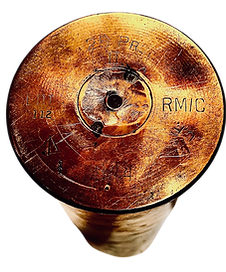
This beautiful trench art hand-engraved heavy artillery brass shell was likely created by a WWII soldier while serving in the Jewish Brigade under the British army. One side of the polished shell is a map of the Land of Israel with cities and landmarks noted in Hebrew, including Hevron, Yafo, Acco, Yerushalayim, Shechem, Beer Sheva, Aza, Ashdod, Ashkelon, and most interestingly 'Etzion Geber' the Biblical name for what would become the region of Eilat after 1948. The shell's other side depicts a fascinating map of the walls and gates of Jerusalem's Old City, including the Temple Mount. The Hebrew lettering marks locations such as the Kings' Graves, Gihon Spring, Rachamim Gate, Tzion Gate, Yafo Gate, New Gate etc.., including a crescent, cross and star placed accordingly to denote the various quarters of each religion's control within the city. The shell was used in an Ordnance QF 25-pounder heavy artillery gun, with a caliber of 3.45 inches. This piece of field artillery was commonly used by British and Commonwealth forces in the Second World War. Durable, easy to operate and versatile, it was the most produced and used British field gun and gun-howitzer during the war. The shell was produced in 1944 by the Robert Mitchell Company in Quebec, Canada. The 25-pounder gun fired two-part ammunition – the projectile was loaded separately from the propelling charge in its brass cartridge case with its integral primer. Trench art can be defined as any item made by soldiers, prisoners of war, and civilians, from war matériel, as long as it and they are connected in time and space with armed conflict or its consequences. Trench art is war art, but in its sensuous and tactile qualities, and its memory-evoking power, it is far more than that, because it can simultaneously embody the experiences of its makers and transform their pre-war selves. The maker of this item, clearly had a heart and vision for Zion. 11.5 x 4in; In Good Condition
SIX-DAY WAR COMBAT ORDERS #1
HISTORIC DOCUMENT FOR SOLDIERS
'ENEMY LAUNCHED A NEW WAR SHELLING OUR SETTLEMENTS BORDERING GAZA...
FORWARD TO BATTLE & VICTORY!'
JUNE 5 1967, ISRAEL
RESERVE: $2400 (estimate $3200-$3800)
This historic "Combat Sheet No. 1," dated June 5, 1967, marks the very first day of the legendary Six-Day War, a conflict that dramatically reshaped the Middle East and secured the survival of the Jewish Homeland. Issued to the soldiers of the Israeli Defense Forces’ Southern Command, this original document carries not only an urgent operational order but a deeply inspirational call to arms at one of the most critical junctures in modern Jewish history. The Six-Day War erupted amid escalating regional tensions, with Egypt’s President Gamal Abdel Nasser having taken provocative steps that threatened Israel’s security and freedom of navigation. In clear violation of international law, Egypt expelled the United Nations Emergency Force from Sinai and blockaded the Straits of Tiran, cutting off Israel’s vital access to the Red Sea port of Eilat. According to the combat sheet itself, “Nasser concentrated most of his forces in Sinai, removed the UN emergency force from our borders and blocked the Straits of Tiran on the way to Eilat, in clear violation of international laws and obligations.” This aggressive posture was interpreted by Israel as an existential threat that demanded decisive action. The order of the day recounts Israel’s rapidly executed response. “Our planes advanced towards Sinai this morning, hitting and destroying enemy aircraft and installations.” The successful Israeli Air Force strikes effectively neutralized the aerial threat, setting the stage for ground forces to break through enemy lines. “IDF units broke through to the Egyptian power centers in Sinai and on the Gaza border,” the sheet declares, heralding the opening of a swift and sweeping military campaign. Stirring words are directed to the fighters themselves: “Commanders and soldiers of the South! For eleven years, the ruler of Egypt forged a multidimensional military power by openly declaring his intentions to destroy the State of Israel.” The document recalls the bitter history of conflict, reminding troops that while “eleven years ago, the IDF defeated the Egyptian enemy and conquered all of Sinai,” the threat remained as urgent as ever, “the bitter lesson of this defeat has been forgotten by the Egyptian dictator.” Chillingly, some of the text is incredibly relevant for today's Oct 7th new Israel. "Today, after the enemy launched a new war, shelling our settlements on the border with the Gaza Strip, the order was again given to our forces to fight back with all their might." The rallying cry in the text vibrantly captures the unity and determination of the Israeli forces, a combination of seasoned veterans from the War of Independence, courageous soldiers of Operation Kadesh, reservists, and the regular army. “The tanks are roaring into battle again,” the combat sheet proclaims, “the ranks of fighters have been reorganized for battle… charging to defend the homeland. We are in the midst of the campaign! Southern fighters, forward to battle and victory!” Signed by Major General Yeshayahu Gavish, the commander of the Southern Command, this document embodies the resolute spirit of the Israeli Defense Forces and the Jewish People defending their sovereignty against overwhelming odds. It provides an unfiltered lens into the emotions, resolve, and strategic reality of that fateful day, when swift victories laid the foundation for Israel’s future security and regional standing. This original combat sheet is a rare and priceless artifact, granting collectors and historians a tangible connection to the moment when the Jewish People faced their adversaries with unwavering courage and emerged victorious. It stands as a testament to faith, resilience, and the indomitable will that defined a nation forged in the crucible of war and bound by the eternal promise to defend Eretz Yisrael. 12x8in; In Very Good Condition

ERETZ YISRAEL EARLY GAME BOARD
'OUR WAR' OF INDEPENDENCE
IDF SOLDIERS LIBERATING ISRAEL
EARLY 1950s, TEL AVIV, ISRAEL
RESERVE: $2300 (estimate $3000-$3700)
This rare and captivating “Our War” board game worthy of framing, was published in the early 1950s by pioneering Israeli publisher Binyamin Barlevi. This treasure offers a vibrant glimpse into the formative years of Eretz Yisrael and the heroic saga of the War of Independence. This beautifully illustrated Zionist game features a detailed map of Israel designed to engage players in the geography, history, and patriotic spirit of the newborn Jewish Homeland. The board preserves its rich lithographic colors and evocative imagery. Binyamin Barlevi (1894–1964) was a foundational figure in the early Israeli children’s game industry. Based in Tel Aviv, he produced over 250 games, maps, and books throughout the 1940s and 1950s. Barlevi’s games were more than entertainment—they were tools of education and national pride, designed to instill Zionist values, historical knowledge, and a deep connection to the Land of Israel in young minds. His pioneering use of Hebrew language and Zionist themes made him a key architect of Israel’s cultural identity during its earliest decades. “Our War” is a Monopoly-like board game that immerses players in the role of IDF soldiers, navigating military orders and strategic movements across an illustrated landscape marked by artillery and infantry symbols. The game playfully yet profoundly teaches the geography of Israel while commemorating the courageous battles and liberation efforts of the 1948 War of Independence. Iconic instructions such as “If you are first lieutenant, go immediately to conquer Nebi-Yusha and from there to Deganya” bring history alive and invite players to relive the heroic campaign to secure the Jewish Homeland. This game board is a tangible artifact of Zionist education and ideological transmission, inspiring a new generation to understand and appreciate their heritage through play. It stands as a testament to the enduring legacy of the IDF soldiers who fought to reclaim Eretz Yisrael and to the visionary creators like Barlevi who helped shape Israel’s cultural and educational landscape. Owning this original game board is to hold a piece of Israel’s early nation-building history, a symbol of youthful hope, resilience, and the unbreakable bond between the Jewish People and their Land. It offers collectors and history enthusiasts alike a rare opportunity to connect with the spirit of those turbulent, triumphant days through the joyful medium of play. 26.5x9.5in; In Very Good Condition with small corner repair

MID-1700s MAPS OF ERETZ YISRAEL ENGRAVED AND HAND-COLORED INCLUDING
THE LOCATION OF GAN EDEN BY JOSEPHUS
AND THE SETTLEMENT OF THE SONS OF NOAH
CIRCA 1760, ENGLAND, UNITED KINGDOM
RESERVE: $1800 (estimate $2200-$2500)
An extraordinary and rare 18th-century engraved and hand-colored map depicting Eretz Yisrael and the Biblical world, created by master cartographer Thomas Bowen, heir to one of England’s most esteemed mapping dynasties. This work illustrates the post-Flood division of the world according to the descendants of Noah—Shem, Ham, and Japheth—as recorded by the great Jewish historian Flavius Josephus. The map is richly adorned with five beautifully hand-colored inset panels, offering detailed views of the Holy Land, Egypt, Arabia, India, the Red Sea, and perhaps most evocatively, “The Garden of Eden as described by Josephus”. In a time before modern archaeology, the mapmaker combined sacred history, rabbinic tradition, and the best geographic knowledge of the Enlightenment era to bring the Biblical landscape to life. Eretz Yisrael is presented not merely as a geographic entity, but as the heart of human history—the spiritual axis around which the story of mankind revolves. Here, the journeys of the Avot and Imahot, the prophetic visions, and the battles for the Land are framed within the broader post-diluvian world. This vision of the Holy Land, colored by the hues of faith and scholarship, would have stirred the imagination of Jews and lovers of Zion around the globe, generations before the dream of return became the modern State of Israel. The map’s creator, Thomas Bowen (d. 1790), inherited the artistry and precision of his father, Emanuel Bowen (1693/4–1767)—Mapmaker to King George II of England and King Louis XV of France. The Bowens’ work was known for its accuracy, elegance, and accessibility, bridging the gap between the learned elite and the common man. Their maps graced the shelves of scholars, adorned libraries, and served as vital tools for education. For the Jewish People, such maps in the 18th century were more than academic curiosities—they were a reminder of destiny. In an age when our people were dispersed across continents, a map like this was a visual affirmation of our ancient homeland, a tangible connection to the depth of Tanakh, and a reminder that no matter how far we wandered, the Land of Israel was—and is—our eternal inheritance. In the modern era, with the State of Israel restored, this historic map becomes a bridge across centuries—a window into how our homeland was envisioned long before the blueprints of Zionism were drawn. It is both an artifact of cartographic brilliance and a silent testimony to the unbroken Jewish yearning for Eretz Yisrael. 15 x 10in; In Excellent Condition

HISTORIC ORIGINAL PHOTOGRAPH
PRIME MINISTER MENACHEM BEGIN
MEETS THE LUBAVITCHER REBBE
JULY 17 1977, NEW YORK, USA
RESERVE: $2770 (estimate $3770-$4770)
This rare and deeply evocative photograph captures a moment of profound historical and spiritual significance: the private meeting between Israeli Prime Minister Menachem Begin and the Lubavitcher Rebbe, Rabbi Menachem Mendel Schneerson, on the evening of the 2nd of Av, 5737 (July 17, 1977), at Lubavitch World Headquarters, 770 Eastern Parkway in Brooklyn, New York. Just weeks earlier, Begin had stunned the political world by leading the Likud Party to a dramatic electoral victory, ending nearly three decades of Labor Party dominance in Israel. As he prepared for his first official meeting with U.S. President Jimmy Carter in Washington, D.C.—a meeting that would shape the future of U.S.-Israel relations and the Middle East peace process—Begin made a conscious and symbolic decision to first stop in Brooklyn, to seek the counsel and blessing of the Rebbe. Their meeting, held just before midnight, would last over two hours. The Rebbe greeted Begin personally at the entrance to 770—an extraordinary gesture, as the Rebbe almost never left his private study to receive guests. Before the press, Begin explained the purpose of his visit: “I have come tonight to our great master and teacher, the Rabbi, to ask from him his blessings before I go to Washington to meet President Carter for the important talks we are going to hold on the future of the Middle East.” He added, “The people of Israel pray for the success of these very important meetings... Rabbi Schneerson is a great man in Israel. All of us respect him; all of us accept his judgment... His blessings are very important to me.” The Rebbe, speaking in Yiddish, then in English for the American press, responded: “I accept this honor of his visit not on my personal account, but on the account of the movement of Lubavitch… to permeate Jewish people everywhere with full faith in God Almighty, and the faith that they’ll have their wishes for good fulfilled… and to have real peace as a preparation for the coming of Messiah speedily in our times.” When asked whether he would bless Begin’s mission, the Rebbe replied simply, “Yes. More than a hundred percent.” After their statements, the Rebbe and the Prime Minister entered the Rebbe’s private study for a confidential discussion. While the details of the conversation were never publicly disclosed, Begin would later describe it as a “deep and uplifting encounter” that strengthened his resolve. One aide recalled that Begin emerged “a changed man,” visibly fortified for the trials ahead. In Begin’s own later remarks, he hinted at the Rebbe’s message: “The enemy wants that we should give them parts of the land of Israel so that they can attack us; however, our security relies on upholding our right to the land of Israel.” Begin stood firm during his summit with President Carter. Despite enormous international pressure to halt Jewish settlement in Judea and Samaria and accept Palestinian demands, Begin refused. He argued: “Why is it permitted for a Jew to settle and live in Bethel or Shiloh in the United States… but forbidden [for him] to build his home in the original Shiloh or Beth El?” He made it clear: “I shall not lend my hand to discrimination against Jews in the Land of Israel.” The impact of this meeting between Begin and the Rebbe reverberated beyond diplomacy. It was a moment when Jewish spiritual leadership and Jewish political sovereignty stood together, unapologetically and proudly. In the face of global scrutiny, the Rebbe gave Begin not only his blessing but his moral support, empowering him to lead with Jewish conviction and courage. This photograph taken by Jewish-American photographer Isaac Berez (with his studio stamp on the reverse) is far more than a record of a political meeting—it is a sacred image of two Jewish giants, united in vision and faith, standing at the threshold of history. It reflects the convergence of Torah and statehood, tradition and modernity, and the eternal Jewish mission to stand strong, rooted in righteousness, in defense of the Land and People of Israel. 8x10in; In Excellent Condition

'FUNNY THING HAPPENED...ON THE WAY TO TEL AVIV'
SATIRICAL MAGAZINE BY CAPTAIN AMERICA CREATOR
JOE SIMON, MARVEL & DC GOLDEN AGE COMICS ICON
MOCKING ISRAEL'S ENEMIES DURING SIX-DAY WAR
1967, NEW YORK, USA
RESERVE: $650 (estimate $950-$1100)
In the vibrant crucible of mid-20th Century America, a generation of Jewish immigrants and their children forged not only a new identity but a powerful cultural force that would resonate across the globe. Among these pioneers was Joe Simon, a proud Jewish American whose creative genius helped launch the Golden Age of Comics and whose work became a beacon of hope and strength for Jews everywhere. This extraordinary satirical magazine, “A Funny Thing Happened on the Way to Tel Aviv - A Mad History of the Arab-Israeli Campaign”, captures a critical moment in Jewish history — the miraculous victory of the young State of Israel in the 1967 Six-Day War — through the sharp lens of American Jewish satire and artistic brilliance. Joe Simon was born Hymie Simon into a humble Jewish immigrant family in Rochester, New York, where the dreams of the old world met the promise of the new. Deeply connected to his Jewish roots and the Zionist cause, Simon’s art was never just entertainment; it was a declaration of identity and resilience. Together with his legendary partner Jack Kirby, Simon co-created Captain America — a superhero unlike any before, who boldly punched Hitler on his very first cover, long before the world fully recognized the threat of Nazi tyranny. Captain America was a reflection of the Jewish-American spirit: courageous, defiant, and committed to justice. At the same time, across the ocean, the State of Israel was emerging from the ashes of exile, its people reclaiming their ancient homeland with determination and faith. In 1967, facing overwhelming odds and surrounded by hostile armies, Israel’s victory in the Six-Day War was nothing short of a modern-day miracle — a testament to the enduring Zionist vision of Jewish sovereignty, security, and renewal. “A Funny Thing Happened on the Way to Tel Aviv” channels this historic triumph through the eyes of American Jewish artists and writers, offering satire and insight that speak to the shared pride and passion of the American Zionist community. This comic magazine is more than a collection of historic photos with silly blurbs, satirical cartoons and biting commentary; it is a cultural bridge that connects the Jewish American experience — shaped by the Golden Age of Comics and the fight against antisemitism — to the heroic reality of Israel’s defense and survival. It celebrates the power of storytelling in all its forms: from the comic book pages that inspired millions to stand against evil, to the real-life battlefield where Israeli soldiers embodied the very ideals of courage and resilience. By owning this rare piece of history, you claim a tangible symbol of Jewish pride and Zionist triumph, a legacy born from the dreams of immigrants and warriors alike. It is an honor to hold in your hands the creative spirit of Joe Simon — a man whose art gave birth to heroes who fought for justice on paper, and whose people fought for their Homeland with the same unyielding spirit. This magazine is a celebration of the courage, creativity, and indomitable spirit that have defined the Jewish People from the streets of New York to the hills of Jerusalem. 10.75 x 8in; 66 Pages, In Excellent Condition


EXCEPTIONALLY LARGE & EARLY
HAND-CRAFTED ISRAELI FLAG
STAMPED 'צ' FOR IDF BASE USE
MID-20TH CENTURY, ISRAEL
RESERVE: $1600 (estimate $2000-$2500)

We love seeing these retired old flags honored in style when framed prominently on the wall. Nothing compares to the pride one feels when knowing that the star and stripes of Israel’s blue and white flag had a long life fluttering in the breeze. Few symbols carry as much weight and meaning as the iconic blue and white flag of the State of Israel. More than a national emblem, it represents the enduring unity of the Jewish People, our faith, and our mission as a light unto the nations. This hand-crafted linen flag, sewn during the earliest days of Israel’s modern statehood, is a poignant tribute to the sacrifices and triumphs of the Zionist pioneers who transformed an ancient dream into a living reality. With its simple yet profound design, the Star of David flanked by two blue stripes symbolizing the traditional tallit, Israel’s flag has become a powerful representation of the Jewish journey. It embodies the painful past, resilient present, and hopeful future of the Jewish People, uniting those at home and abroad in shared heritage and purpose. This flag, lovingly sewn by hand, likely waved proudly overseeing an IDF base, in the years surrounding Israel’s founding. This was a time when the sacrifices of Israel’s founding Zionists forged the path to independence. It stood as a beacon of hope for generations, weathering the winds of a newly established homeland and symbolizing the collective resolve of a people who overcame insurmountable odds to achieve self-determination. Whether displayed prominently in a home, office, or institution, this historic flag serves as both a striking artifact and an enduring reminder of the ideals upon which the State of Israel was founded. This extraordinary piece invites us to honor the legacy of Israel’s creation and celebrate the unity and perseverance that continue to define the Jewish People. A timeless addition to any collection of Zionist history or Judaica, it stands as a testament to the enduring spirit of a nation and its People. 5x7.25 feet; In Good Condition with minor wear


