

HASHOMER HACHADASH
CHARITY AUCTION
HANUKKAH / DECEMBER 2025
Bid today with your tzedaka to safeguard the Land of Israel
Please bid generously on these historic treasures connected to the pioneers & defenders of Israel sourced by the curators at Curio Auctions. Use your charitable giving to acquire authentic heirlooms that will inspire your family’s relationship with tzedaka for generations to come, while supporting HaShomer HaChadash in establishing & strengthening communities along Israel's borders.
HASHOMER NATIONAL MONUMENT
ALEXANDER ZAID ON HORSEBACK
BY POP ARTIST ODED FEINGERSH
BORN 1938, JERUSALEM, ERETZ YISRAEL
RESERVE: $1800 (estimate $2200-$2500)
This stunning oil on canvas by acclaimed Israeli pop artist Oded Feingersh offers a vivid and evocative portrayal of a cornerstone moment in Zionist history—Alexander Zaid on horseback, an enduring symbol of Jewish self-reliance and Jewish stewardship of the Land of Israel. Born in Jerusalem in 1938 and educated at Bezalel Art Academy, Feingersh’s diverse artistic journey has taken him across Paris, Brussels, and Madrid, enriching his work with influences from social realism, naturalism, pop art, and surrealism. His art reflects a profound connection to Israel’s landscape, history, and collective mythology, all expressed through a vibrant and experimental visual language. The painting captures the spirit of the Hashomer movement, a bronze sculpture erected in 1940 atop Givat Zaid near Bet Shearim, overlooking the Jezreel Valley. This monument immortalizes Alexander Zaid, a foundational figure of the Second Aliyah and a pioneer in establishing Jewish defense organizations such as Bar Giora and Hashomer. The depicted figure on horseback commands a panoramic view of the land he fought to protect and develop, symbolizing the early Zionist movement’s steadfast commitment to securing and cultivating the land of Israel. The monument itself, featuring detailed bronze reliefs, stands as a testament to the resilience and determination of those early settlers who laid the groundwork for the modern State of Israel. Feingersh’s masterpiece encapsulates not only the historical significance of Zaid’s legacy but also the enduring spirit of Jewish pioneering. Rooted in a tradition of both social realism and pop-art vibrancy, the work reflects Feingersh’s deep love for the Land of Israel, shaped by his studies, travels, and personal heritage. As a recipient of numerous awards—including the prestigious Dizengoff Prize—Feingersh’s art continues to resonate with themes of Homeland, heritage, and cultural continuity. Owning this piece offers a powerful connection to Israel’s early heroism and the ongoing narrative of its Land and People, beautifully rendered through the brushstrokes of a master artist rooted in Israeli history.

HASHOMER YOUTH PIONEERS
FOUNDING A JORDAN VALLEY
NEW ZIONIST SETTLEMENT
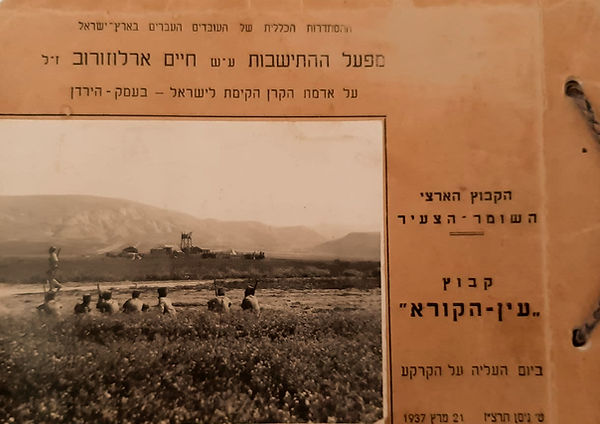
HISTORIC ORIGINAL PHOTO ALBUM
MARCH 21 1937, ERETZ YISRAEL
RESERVE: $700 (estimate $800-$1000)
This rare original photo album offers an extraordinary glimpse into the dawn of Zionist settlement in the Jordan Valley, capturing the pioneering spirit of the Hashomer youth movement in 1937. Documenting the founding of Kibbutz Masada/Sha'ar HaGolan—initially called Ein Hakora—and affiliated settlements of Homa and Migdal, this album commemorates a significant chapter in the establishment of the Land of Israel during the tumultuous period leading up to the State’s independence. Dated March 21, 1937, it contains 21 rare photographs depicting the initial foundation of a new Zionist village, illustrating a land vibrant with hope, resilience, and determination. Founded by enthusiastic members from Czechoslovakia and Poland, Hashomer youth activists organized their pioneering effort in 1930 in Rishon LeZion and built their first settlements as Tower and Stockade (Homa U-Migdal) communities—a strategy that provided protection amid hostile threats. The album, published by the General Federation of Hebrew Workers in Israel and dedicated in memory of the land landing day, captures moments of intense labor and dedication: preparations for guard duty, communal work efforts, early planting, construction of homes, and the building of strategic towers. Each photograph is captioned in Hebrew, offering a window into the collective effort that laid the foundations for the modern Israeli Homeland. The founding of this settlement, on Jewish National Fund owned land, marked a pivotal milestone in Zionist pioneering, reflecting the resolute determination to realize the dream of Jewish self-determination in Eretz Yisrael. These kibbutzim, built in the face of external threats and internal hardships, played a vital role in establishing Israel’s presence in the Jordan Valley—a strategic and historic heartland. Their story is also marked by the struggles of the 1948 Arab–Israeli War, when both Sha’ar HaGolan and Masada faced Syrian assaults, temporary occupation, and devastation. Their eventual return and resilience serve as a testament to the indomitable spirit of the pioneers. Owning this album is a profound connection to the courageous, pioneering families who dedicated their lives to building the Land of Israel. It stands as a testament to hope, sacrifice, and the unwavering belief in the realization of Jewish sovereignty—a vital chapter in the ongoing story of the Jewish People’s historic mission in Eretz Yisrael. 6.5x4.5in; In Good Condition

SHAYETET 13 IDF NAVAL RECRUITMENT POSTER
'THE DARING TO THE SEA COMMANDOS'
(KAVOD HASHOMER FOUNDER YOEL ZILBERMAN)
MID 20TH CENTURY, ISRAEL
RESERVE: $2400 (estimate $3000-$4100)
This striking poster from mid-20th century Israel captures the daring spirit of Shayetet 13, an elite unit of the Israeli Navy renowned for its paramount role within the Israel Defense Forces. Known as the "Sea Commandos," Shayetet 13 exemplifies courage, precision, and secrecy in the most challenging maritime missions. As one of Israel’s primary special forces units, they specialize in covert sea-to-land infiltrations, counter-terrorism, sabotage, maritime intelligence, hostage rescue, and boarding operations—many of which remain classified to this day. Their operations have been pivotal in Israel’s major conflicts, embodying the resilience and tenacity of Israel’s naval spetsnaz. This historic recruitment poster, published by the Israeli Navy and designed by A.A. Shwartz, features a bold and evocative James Bond-esque aesthetic that captures the daring and clandestine nature of Shayetet 13. The design’s striking visuals symbolize the unit’s silent, lethal efficiency and the mystique surrounding its secretive missions. The unit’s motto—“As the bat emerges from the darkness, as the blade cuts through with silence, as the grenade smashes in rage”—resonates with the fierce determination and bravery of Israel’s naval commandos, who operate at the edge of visibility and danger. Today, this poster not only honors the elite warriors of Shayetet 13 but also embodies the spirit of Israeli innovation and resilience. It is a testament to a unit that has earned worldwide respect, standing as a symbol of Israel’s unwavering commitment to security and survival. Owning this piece is a tribute to a shadowy, revered chapter of Israeli military history and the extraordinary bravery of those who serve in the most perilous conditions beneath the sea. This historic poster also connects to HaShomer HaChadash founder Yoel Zilberman, who was a courageous fighter in Shayetet. In 2007, Yoel was serving in the elite naval commando unit, busy with an officers’ course and other strenuous responsibilities. He then heard his family's farm was in trouble... 25.6 x 21.5in; With folds, In Fair Condition

RARE ALEXANDER ZAID BIOGRAPHY
ZIONIST DEFENSE ORGANIZATION FOUNDER
HASHOMER & BAR GIORA
1938, TEL AVIV, ERETZ YISRAEL
RESERVE: $400 (estimate $550-$600)
This rare biographical volume, Alexander Zaid — The Story of His Life by Bracha Habas, published in Tel Aviv in 1938 by the Histadrut Labor Union, offers a profound glimpse into the life of a pivotal figure in the Zionist pioneering movement. Alexander Zaid was a founding member of the legendary defense organizations "Bar Giora," "HaShomer," and "Agudat Shomrim," dedicated to protecting Jewish settlements and establishing our secure Homeland during the tumultuous years of the Second Aliyah. His leadership, bravery, and unwavering commitment to securing the Land of Israel left an indelible mark on the early Zionist movement. The book’s 84 pages in Hebrew include a portrait of Zaid, capturing the visage of a resilient and visionary leader, and recounting his extraordinary contributions to the Jewish community’s defense efforts. Tragically, Zaid was assassinated in 1938, a martyr in the ongoing struggle for Jewish sovereignty. A monument erected in his memory stands near Beit She'arim National Park and Beit Zaid, atop a hill overlooking the valleys and mountains he fought to protect. The monument features a commanding sculpture of Zaid on horseback, gazing over the land he loved and defended with unwavering resolve. Owning this biography not only provides a vivid portrait of a quintessential Zionist hero but also connects us to the foundational stories of Jewish defense and resilience. Alexander Zaid’s legacy remains a testament to courage, sacrifice, and the relentless pursuit of a sovereign Jewish Homeland. This rare publication serves as both a historical document and a tribute to a man whose life embodied the pioneering spirit that shaped the State of Israel. 84 pages; In Good Condition

WAR OF INDEPENDENCE ERA
IDF WOODEN BATON STAMPED 'צ'
ARMY FRONTIER CORPS GUARDS
MID 20TH CENTURY, ISRAEL
RESERVE: $2100 (estimate $3000-$3400)
This authentic wooden baton, stamped with the Hebrew letter 'צ' (Tzadi) for Tzahal (IDF), exemplifies the rugged resilience of Israel’s early security forces defending our People during the War of Independence era. Used by army patrol guards, this sturdy piece of equipment served as a vital tool in maintaining order and security during Israel’s challenging formative years. Crafted from durable wood, it was a practical yet symbolic implement wielded by those guarding on the front lines in a nascent state fighting for survival and independence. The Israeli Border Police, established in 1949 as the Frontier Corps (חיל הספר, Heil HaSfar), initially operated as a gendarmerie under the IDF, tasked with safeguarding rural areas and the borders of the newly declared State of Israel. Over the subsequent years, it was gradually transferred to civilian police control but retained its critical role in securing settlements and preventing infiltration by arab fedayeen, especially from Egypt and Jordan. This period saw intense border patrols, often involving armed guards using tools like this baton to uphold security in a volatile security environment. Throughout the 1950s and 1960s, the IDF's Border Police were instrumental during the Suez Crisis of 1956. During the Six-Day War of 1967, the Border Police fought alongside the IDF in combat and were subsequently deployed in the Shomron and Gaza Strip, charged with maintaining law and order. Their role deepened during the subsequent intifadas, exemplifying Israel’s ongoing struggle to maintain security in a complex and often hostile environment. In 1974, the elite counter-terror unit Yamam was established within the Border Police, further underscoring its importance in Israel’s defense and counter-terror efforts. Today, the Israel Border Police—colloquially known as Magav—remains a vital part of Israel’s security apparatus, exemplifying bravery, discipline, and resilience. This wooden baton is a tangible piece of that history—an emblem of the perseverance and dedication of Israel’s early patrol guards and security personnel. It stands as a testament to their vital role in forging and defending a young nation amidst relentless adversity, symbolizing the courage and determination that laid the groundwork for Israel’s continued security and sovereignty.

_edited.png)

'PIONEERS' POEMS & ARTWORK BY
EARLY ZIONIST ARTIST MEIR GUR ARIE
RARE BEZALEL FIRST EDITION
1925, JERUSALEM, ERETZ YISRAEL
RESERVE: $600 (estimate $800-$900)
This rare first edition of Pioneers, published in 1925 in Jerusalem by Bezalel, offers a captivating glimpse into the visionary spirit of early Zionist artistry and literature. Bound in gold-embossed white cloth hardcover, this volume features a remarkable collection of silhouettes and pioneer poems, illustrated by the distinguished early Zionist artist Meir Gur-Arie, one of the most influential artists produced by the Bezalel movement. The text was compiled by M. Narkis and embodies the pioneering ethos that fueled the revival of Jewish life and Land in Eretz Yisrael during the early 20th century. Meir Gur-Arie, born in Bobruisk, Russia (now Belarus), in 1891, was a pioneer not only of land but also of Israeli artistic expression. His early studies in Russia laid the foundation for a dynamic career that led him to Jerusalem, where he became a central figure at Bezalel Academy. After making Aliyah and adopting the name Gur Arie, he served as head of the drawing, ivory, and amulet departments and was a founding member of the Menorah group and the Hebrew Artists Association. His creative endeavors include pioneering work in industrial art and notable contributions to Jerusalem’s cultural landscape, such as the decorations for the YMCA building. This special edition of Pioneers features evocative silhouettes and poems celebrating the land, the pioneer spirit, and the hope that drove the Zionist movement. Among the poems are stirring pieces like "In Dvar," "When a Pioneer…," and "Machtseva," capturing the aspirations, struggles, and triumphs of Israel’s early settlers. Gur-Arie’s illustrations bring these verses alive with striking imagery, reflecting his mastery of silhouette art and his deep connection to the land and its pioneers. Owning this historic volume offers a profound connection to the cultural awakening of Israel and the artistic legacy of one of its most influential early artists. As a testament to the pioneering spirit that transformed barren land into a thriving homeland, this edition embodies the hope, resilience, and creative vision that laid the groundwork for the modern State of Israel. 9.25x6in; 56 Pages, In Very Good Condition


RARE POSTER OF 'PALESTINE TRANSFORMED'
50 YEARS OF ZIONIST PIONEERING' MAPS
1897-1927-1947 SETTLEMENT DEVELOPMENT
'THE ANCIENT LAND GROWS YOUNG' BY HERZL
1947, JERUSALEM, ERETZ YISRAEL
RESERVE: $800 (estimate $1000-$1300)
This rare and historically significant poster of three maps, titled "Palestine Transformed: Fifty Years of Zionist Pioneering", was published in Jerusalem in 1947 to commemorate a pivotal half-century of Zionist settlement and expansion in Eretz Yisrael. The set captures the dramatic changes from 1897 to 1947, illustrating the remarkable growth of Jewish communities, land development, and settlement during a period of profound transformation. Each map corresponds to a specific era: 1897-1917, 1918-1927, and 1928-1947, providing a visual chronicle of the pioneering efforts that shaped Israel’s landscape. Each map vividly marks the lands held by Jews, detailing the number of dunams cultivated, the names of settlements established, and the geographical expansion across the historic land. As you unfold these maps, you witness the evolution of a land once sparsely populated into a blossoming homeland filled with vibrant communities and burgeoning agricultural endeavors. The publication also features insightful quotes from Theodor Herzl’s writings from 1896, in which he envisioned that the ancient Land of Israel would once again bring happiness and honor to the Jewish People—a prophetic testament to the Zionist aspiration. Designed as a four-part folding publication, this poster not only serves as a valuable historical document but also as an inspiring tribute to the resilience and determination of the Jewish pioneers. It reflects the dramatic territorial and demographic changes that occurred over fifty years, ultimately leading to the re-establishment of a Jewish Homeland. This set is a powerful reminder of the pioneering spirit and relentless dedication that transformed barren wilderness into a thriving land—a legacy that continues to resonate today. 21.5x15.5in; In Very Good Condition

IDF TRENCH ART HANNUKIAH MENORAH
CARTRIDGE SHELL ON OLIVE WOOD BASE
CIRCA SIX-DAY WAR, ISRAEL
RESERVE: $1200 (estimate $1700-$2000)
Forged from the remnants of battle and mounted upon a base of Eretz Yisrael olive wood, this remarkable Hanukkiah carries the soul of a miraculous era. Its aged patina reflects the decades since the Six-Day War — a time when Israel’s very existence hung in the balance, and in just six astonishing days, the Jewish nation emerged victorious and reunited with the heart of its Homeland. Created from a military cartridge by the hands or inspiration of those who served, this is a prime example of IDF trench art — transforming the instruments of war into vessels of light. In the story of Hanukkah, the Maccabees reclaimed the Temple and rekindled the menorah against impossible odds. In 1967, the IDF reclaimed Jerusalem, the Kotel, and the holiest sites of our people. The parallel is as powerful as it is poetic. The olive wood base speaks of peace, continuity, and our unbreakable connection to the Land of Israel. The cartridge body stands as a symbol of Jewish self-defense, courage, and the willingness to protect our people — from the days of Judah Maccabee to the soldiers of the modern State. In those euphoric days following the Six-Day War, Jews across the world — from Tel Aviv to New York, from Paris to Buenos Aires — danced in the streets, sang Hatikvah with tears in their eyes, and dreamed of returning to a strong, united Jewish Homeland. This Hanukkiah is not just a ritual object; it is a piece of that history, a tangible link to the generation that saw ancient prophecy unfold before their very eyes. 10.5 x 5in base; In Good Condition with aged patina
_edited.png)
ICONIC ORIGINAL HISTORIC PHOTOGRAPH
'JEWISH BOY WITH HIS RIFLE' STANDS GUARD
FORTIFYING THE ZIONIST SETTLEMENTS
SEPTEMBER 7 1936, TEL AVIV, ERETZ YISRAEL
RESERVE: $900 (estimate $1200-$1600)
This historic original photograph captures a poignant and noble moment in the early struggle for the Land of Israel, depicting a young Jewish boy standing guard beside barbed wire fortifications in Tel Aviv on September 7, 1936. Titled "Martial Law to Be Proclaimed in Palestine. Fortifications Round Jewish Property," this powerful archival Keystone image from 1936 embodies the resilience, bravery, and unwavering dedication of the Jewish defenders who stood bravely against mounting threats during a perilous chapter in the history of the Yishuv. The year 1936 was a tumultuous period, marked by the Arab Revolt—a fierce uprising fueled by anti-Jewish and anti-British sentiments that threatened the very foundations of the Zionist enterprise. The Zionist community, faced with escalating violence, responded with unity, ingenuity, and unwavering resolve. As British military reinforcements arrived and martial law was proclaimed, Jewish youth took on a noble role—guardians of their homes, families, and burgeoning settlements. The boy in this photograph symbolizes the indomitable spirit of a generation committed to protecting our Land, our People, and the dreams of nationhood against all odds. This photograph is more than an image; it is a testament to the heroic sacrifices and nobility of the Jewish defenders of Eretz Yisrael during a time of existential threat. It captures a moment of silent patriotism and steadfast resolve—values that continue to inspire the Jewish People and their ongoing quest for independence and sovereignty. Owning this piece is a connection to the foundational days of our national renaissance, a reminder that the future of the Land of Israel was safeguarded by the courage of generations of defenders who believed fiercely in the revival and security of our Homeland. 10x8in; In Excellent Condition

'CONQUER WILDERNESS & LAND WILL BLOOM'
VINTAGE ZIONIST PIONEERING POSTER
1974, JERUSALEM, ISRAEL
RESERVE: $400 (estimate $600-$700)
This striking vintage Zionist poster captures the pioneering spirit and unwavering optimism that laid the foundation of modern Israel. Issued by the Jewish National Fund (JNF) and Keren Kayemet Le’Israel (KKL), this authentic lithographic iconic work commemorates the vital campaign to encourage Jewish settlement and agricultural development in the still-unsettled regions of Eretz Israel. The vibrant, colorful lithography vividly depicts a pioneering Jewish farmer diligently plowing the land with his tractor, symbolizing the tireless effort to transform barren wilderness into blossoming fields. Titled "Nichbosh Shmama - Nafriach Adama" loosely translated as (“We Shall Conquer the Desolate Wilderness and the Earth will Blossom”), this poster embodies the ethos of Zionist pioneering — a relentless drive to reclaim, settle, and flourish in the historic Land of Israel. The work is signed by the notable graphic designer Mischel P., and printed by the renowned Litho-Offset printing house “Ziv” in Jerusalem, adding to its authenticity and historical value. This poster serves as a tangible reminder of the courageous entrepreneurs and farmers who harnessed their strength and faith to cultivate our thriving Homeland. A testament to the enduring spirit of Zionism, this poster embodies the optimistic vision of a land reclaimed and a people fulfilled. It encapsulates a pivotal chapter in Israel’s history—an era of hope, perseverance, and commitment that transformed arid wilderness into fertile, thriving communities. Owning this piece not only celebrates Israel’s pioneering legacy but also inspires generations to carry that pioneering spirit into the future. 19x13in; In Excellent Condition

BEN-GURION HISTORIC BIRTHDAY PHOTO
'ARCHITECT OF MODERN ISRAEL'
IN HIS STUDY AT HOME IN SDE BOKER
WRITING MEMOIRS DURING HIS NEGEV
PIONEERING PERIOD + AUTOGRAPHS
OCTOBER 16 1972, SDE BOKER, ISRAEL
RESERVE: $1900 (estimate $2500-$3000)
This iconic archival original photograph, taken by the Associated Press and titled "Architect of Modern Israel," captures a deeply personal moment in the life of Israel’s founding father, David Ben-Gurion. The image shows Ben-Gurion pausing reflectively in his study at his desert home in Sde Boker, Israel, as he immersed himself in writing his memoirs during a time when he was shaping the future of the young nation. Born on October 16, 1972, during his 86th birthday, this rare image comes accompanied by Ben-Gurion’s original hand-written autographs in both English and Hebrew—an extraordinary and meaningful addition that elevates this offering to new heights of historical significance. Ben-Gurion’s link to Sde Boker and the Negev region exemplifies his unwavering Zionist vision: transforming the arid desert into a thriving land of hope and prosperity. Moving to his desert home in 1953, Ben-Gurion believed in pioneering and settling the Negev, actively fulfilling his conviction that “Israel’s future lies in the Negev.” His study, filled with over 5,000 books in nine languages, reflects his broad intellectual pursuits—covering Judaism, philosophy, history, geography, and security—serving as a sanctuary where he penned decades of his remarkable memoirs for Israel’s youth and future generations. His study remains as he left it in 1973, following his wishes, preserved for the public as a testament to his enduring legacy. This photograph and autographs provide a rare, intimate window into the life of Israel’s revered leader. Ben-Gurion’s visionary leadership, steadfast dedication to pioneering, and deep love for the Land of Israel are woven into the fabric of his desert home—a place where architecture and memorabilia embody the roots of the Jewish State and its indomitable spirit. Owning this piece is more than a possession; it is an opportunity to connect with the soul of the nation’s founder and to honor his profound contribution to the birth and blossoming of the State of Israel.


SALVADOR DALI ARTWORK
HAND-SIGNED & NUMBERED FROM HIS ICONIC ZIONIST 'ALIYAH' PORTFOLIO
'ARISE BARAK AND LEAD' (JUDGES 5:12)
1968, NEW YORK, USA
RESERVE: $3500 (estimate $4000-$5000)
Published in 1968 to commemorate the 20th anniversary of the rebirth of the State of Israel, Salvador Dalí’s legendary Aliyah portfolio is one of the most stirring artistic tributes ever created to the Jewish People’s return to their ancestral Land. This particular work, Arise, Barak, and Lead, draws its inspiration from the Book of Judges (5:12), where the prophetess Deborah calls the Israelite commander Barak to rise up and lead his people to victory. In Dalí’s interpretation, the call to arms blurs across millennia—are these warriors carrying the spears of ancient Israel or the rifles of the modern IDF? The ambiguity is intentional, a powerful reminder that the Jewish struggle for sovereignty is timeless. Dalí’s distinctive creative process is vividly on display here. A bold splash of red paint—achieved by literally firing paint from a gun—becomes a haunting visage once Dalí’s brush has added its human features. It is as if the very Land itself bleeds and calls its defenders to rise. This lithograph is one of just 250 produced, each hand-signed by Dalí in pencil and numbered, printed on luxurious Arches paper. It comes from the full Aliyah series—25 monumental works tracing the Jewish journey from Biblical patriarchs through exile, Holocaust, and ultimate redemption in 1948. The project itself was born of a moment of global Jewish pride and renewed Zionist energy. Conceived by Sam Shore, a passionate American Zionist and founder of Shorewood Publishers, the Aliyah series was created during the same era as Israel’s miraculous victory in the Six-Day War, when Jews worldwide felt an unshakable sense of unity, purpose, and awe. Shore envisioned the work as a visual counterpart to Marc Chagall’s stained-glass windows for Jerusalem’s Hadassah Hospital—an enduring, world-class artistic celebration of the Jewish People’s return to their Homeland. Dalí, despite no prior personal connection to Judaism, immersed himself in Biblical study and Israel’s modern story to create images that are at once surrealist masterworks and heartfelt tributes to Jewish resilience. Even the portfolio’s introduction carries immense historical weight—it was written by none other than David Ben-Gurion, Israel’s founding Prime Minister. Exhibited in partnership with Israel Bonds at the Huntington Museum in New York, the series was embraced not just as art, but as a declaration of Jewish vitality. Owning Arise, Barak, and Lead is to hold in your hands a rare convergence of fine art, Jewish heritage, and modern Zionist triumph. It is a treasure for the discerning collector—whether drawn by Dalí’s genius, by the history of Israel, or by the eternal call to stand and lead when our People and Land require it. 25 x 20in; In Excellent Condition

JOSEPH TRUMPELDOR LABOR BATTALION
ZIONIST PIONEERING HISTORIC RECORD
+ HIS WWI SOLDIER ICONIC PORTRAIT
JULY 28 1926, JERUSALEM, ERETZ YISRAEL
RESERVE: $800 (estimate $1000-$1300)
This is an extraordinary historical document lot from the formative years of Zionist settlement, this certificate affirms that Comrade David Suzi was an active and permanent member of Kibbutz Tel-Yosef, affiliated with the legendary Trumpeldor Labor Battalion (Gdud HaAvoda). The certificate notes that Suzi was managing the vegetable garden of the kibbutz and was departing for a recovery period in Germany, where he also intended to share news of the pioneering farming efforts in Eretz Yisrael with the Jewish community abroad. This document, issued by the Central Secretariat of the Trumpeldor Battalion, represents a direct link to one of the most iconic labor Zionist institutions of the 1920s—named in honor of Joseph Trumpeldor, the one-armed Russian-Jewish war hero whose final words, “It is good to die for our country,” became a rallying cry for Jewish self-sacrifice and national revival. Founded on August 8, 1920, Gdud HaAvoda was more than a labor force—it was a bold social experiment: a nationwide commune of Jewish pioneers committed to rebuilding the Land of Israel through physical labor, communal living, and self-defense. The battalion built roads, drained swamps, and laid the foundations of numerous kibbutzim, including Tel-Yosef, Ein Harod, Kfar Giladi, and Ramat Rachel. At its height, the battalion boasted hundreds of idealistic members, including such Zionist luminaries as Israel Shochat, Manya Shochat, and Yitzhak Sadeh. Though ideological divisions between socialist and Zionist factions eventually fractured the movement, its impact on the infrastructure and ethos of the early Yishuv was profound. The split in 1926 that ended cooperation between Tel-Yosef and Ein Harod marked the waning of the Gdud, but the pioneering spirit it embodied endured. Tel-Yosef, where this certificate originated, was one of the battalion’s crown jewels. Located in the valley beneath Mount Gilboa, it became a beacon of early pioneering Zionism, its residents enduring harsh conditions, malaria, and Arab attacks to fulfill their dream of Jewish renewal in the ancestral homeland. This striking photograph from the 1920s of Trumpeldor decked out in his WWI Jewish Legion uniform honors his fall at Tel Hai, defending the Jewish Homeland. Documents like this certificate are rare survivors of a pivotal moment in Jewish history—the intersection of idealism, struggle, and the tenacious rebirth of a nation. It captures the story not only of a man named David Suzi but of an entire generation who believed that with sweat, sacrifice, and shared purpose, the Jewish People could reclaim their land and destiny. 8x6.75in; Labor Battalion Record; In Fair Condition with crease wear due to aging


GUARDING YOUR JEWISH HOME
BEZALEL STYLE MEZUZAH CASE
WITH LAND OF ISRAEL HOLY SITES
LARGE HANDCRAFTED WOOD & BONE
MID 20TH CENTURY, ISRAEL
RESERVE: $1300 (estimate $1900-$2200)
This exquisite, handcrafted Bezalel-style mezuzah case combines artistry and spirituality, making it a meaningful addition to any Jewish home. Made from high-quality wood and bone, and adorned with intricate depictions of the Land of Israel’s holiest sites (The Kotel, King David's Tomb, Shmuel's Tomb, Rachel's Tomb), this unique piece embodies the enduring connection between our faith, Homeland, and divine protection. This ultimate guarding treasure reflects the artisanal craftsmanship and reverence for tradition that have sustained the Jewish People through generations. The mezuzah is more than a decorative object; it is a divine safeguard, a spiritual shield that invites Hashem’s presence into our homes. Throughout Jewish history, the mezuzah has symbolized protection, tranquility, and success. The sacred scroll one must insert, contains the Shema Yisrael, the declaration of God’s oneness, serving as a constant reminder of our commitment to Torah and mitzvot. In a world where human security measures are ever-increasing, the deepest assurance remains rooted in our faith and the mitzvah of mezuzah—an ancient gift, yet ever relevant and powerful. This beautiful artifact not only elevates your home’s spiritual ambiance but also serves as a testament to your Jewish identity and devotion. As the Torah teaches, true security comes from divine protection — from inviting Hashem’s watchful gaze into our lives. Owning this handcrafted mezuzah case is a tangible expression of faith, a reminder that amid life’s uncertainties, trust in Hashem and adherence to His commandments provide the greatest security and inner peace.

IDF 'SHOMER' SOLDIER POSTER
'GUARD YOUR UNIFORM'
1950S, MINISTRY OF DEFENSE, ISRAEL
RESERVE: $1500 (estimate $1900-$2200)
This strikingly designed mid-century poster in the retro-modern style of its time was published by the Ministry of Defense. The poster's message is a call to action for IDF soldiers to take the initiative to care for, repair and protect their uniforms. With the early state encouraging its soldiers to also be self-reliant, is it any wonder that only half a century later, Israel would be globally recognized as the 'Startup Nation'. Considered one of Israel's most influential graphic designers from the early years of the State, Asher Calderon truly left his mark on Israeli culture. Born in Bulgaria in 1929, he made Aliyah and studied at the famed Bezalel Art School in Jerusalem. Calderon was a prolific and passionate creator, known for his affinity for Judaism and the Bible, which was reflected in many of his works, including stained glass windows, the Passover Haggadah, wall hangings and postage stamps. He may be most remembered for having designed the Ten Shekel banknote featuring Prime Minister Golda Meir. His works have been exhibited all over Israel and around the globe. 27 x 19.25in; In Very Good Condition

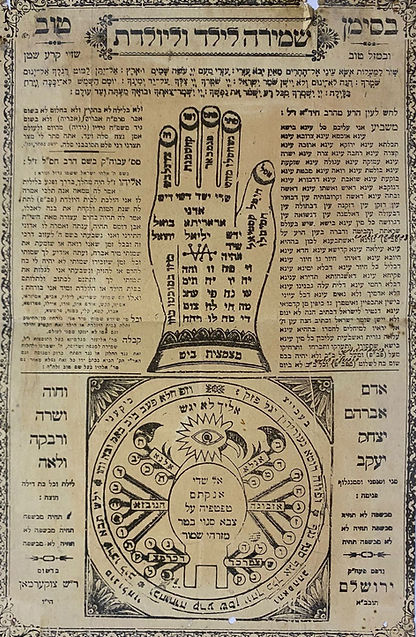
ANTIQUE KABBALISTIC GUARDING AMULET
PROTECTING JEWISH BOYS AND GIRLS
LATE 19TH CENTURY, JERUSALEM, ERETZ YISRAEL
RESERVE: $2600 (estimate $3000-$3600)
This extraordinary kabbalistic mystical amulet, crafted in the Old City of Jerusalem at the end of the 19th Century is a remarkable artifact of Jewish spiritual tradition, designed to protect a newborn child and mother from harm, particularly against the evil eye 'ayin hara'. It combines the sacred holy elements of Jewish heritage, weaving together Psalms, divine names of God, and spiritual symbols in a deeply meaningful composition. At the center of the amulet is a hamsa, the iconic open palm symbolizing divine protection and the repelling of negative energies. Surrounding it is a mystical wheel inscribed with kabbalistic combinations of letters, each carrying profound spiritual significance. Beneath the hamsa lies a detailed square containing further protective symbols, including an eye and a bird, representing vigilance and purity. The inclusion of Shir Hama'alot (Psalms 122), a psalm traditionally recited for safety and well-being, anchors the piece in the sacred texts of Jewish tradition. The vowelized text ensures precise pronunciation, as every syllable is imbued with spiritual power. This amulet draws heavily from the teachings of Rabbi Chaim Yosef David Azulai ben Yitzhak Zerachia (the Chida), a leading figure in Sephardic Jewish mysticism. His renowned work Avodat HaKodesh provided the foundation for many of the incantations inscribed here, blending deep kabbalistic wisdom with practical spiritual remedies. Other elements, such as the incantation by Rabbi Eliezer of Garmiza, add further layers of historical and mystical significance. Amulets like this one were essential in Jewish homes, especially during moments of vulnerability such as childbirth. Rooted in ancient traditions, these sacred objects were believed to channel divine protection, shielding families from illness, misfortune, and spiritual affliction. The craftsmanship reflects the rich spiritual life of Jerusalem in this era, where printers such as Zuckerman preserved and disseminated the mystical traditions of Jewish heritage. Rabbi Shmuel Zuckerman, ran one of the first printing houses in the Old City of Jerusalem, founded in 1872. Despite its age, this amulet remains in fine condition, retaining its artistic and spiritual essence. Rare and deeply personal, it stands as a testament to the enduring faith, creativity, and resilience of the Jewish People, offering a glimpse into their timeless quest for protection and divine connection. 11 x 8.25in; In Very Good Condition
LARGE BEAUTIFUL MAP OF ERETZ YISRAEL
HIGHLIGHTING EARLY ZIONIST SETTLEMENTS
CREATED TO INSPIRE JEWS AROUND THE WORLD
TO GIVE TZEDAKAH FOR ISRAEL'S REDEMPTION
1934, TEL AVIV, ERETZ YISRAEL
RESERVE: $1800 (estimate $2100-$2700)
This large and beautiful map of Eretz Yisrael, published in Tel Aviv in 1934 by the Jewish National Fund (JNF) and printed by Kaufman in Hebrew & German, is a rare and inspiring relic of the days when the redemption of the Land was still a dream in the making. More than simply a map, this piece of Jewish history was created to stir the hearts of Jews across the world, to inspire them to give tzedakah generously, and to bind them to the sacred task of rebuilding the ancestral Homeland. On the front, the map depicts the geography of the Land of Israel as it stood in the 1930s, a visual expression of a nation’s longing. On the back, a printed table invited families and communities to record their donations month by month, transforming the map itself into a living ledger of Jewish devotion. Alongside the table are words that thunder with urgency and faith: “We are all working for the redemption of the land and the understanding of land for the refuge of Israel. We will fulfill our commitment! For the redemption of the land… Consider how poor and insignificant our share has been so far on the soil of this land, the land of our hope, and consider how grave the task is that we still have to fulfill! Then will you know that large voluntary donations from every single person in the nation are necessary. Your donation is also necessary to accomplish the work of redemption.” These were not mere fundraising slogans. In 1934, the Jewish People stood at a crossroads. The rise of Hitler in Germany and the tightening grip of antisemitism across Europe made the call to action more urgent than ever. The JNF, founded at the Fifth Zionist Congress in Basel in 1901, had become the central instrument for transforming Jewish pennies and pounds into acres of redeemed land. With every parcel purchased, with every tree planted, the JNF gave physical shape to the prophetic promise of Jewish return. This map, then, was more than paper and ink—it was a rallying cry, a symbol of collective responsibility, and a sacred reminder that every Jew, no matter how far from the Land, could take part in Israel’s rebirth. Distributed in Jewish homes and synagogues, maps like these became constant companions in daily life. Families would gather around them, children would trace their fingers across the Galilee, Judea, and the Negev, and each new donation marked on the table was a small but mighty act of national redemption. The map is a window into a time when Jewish unity was expressed not only through prayer but through tangible sacrifice, and when the dream of sovereignty depended upon coins dropped faithfully into the blue JNF pushke. To own such a map today is to hold a piece of the spiritual and material engine that built the State of Israel. It is a reminder of the extraordinary power of Jewish giving, of how countless acts of generosity coalesced into the miracle of national resurrection. This artifact is not just a map of land; it is a map of hope, faith, and destiny. 18x26in; In Very Good Condition

1948 WAR OF INDEPENDENCE
HAGANAH STEN GUN MANUAL
JULY 22 1948, ISRAEL
RESERVE: $1300 (estimate $2000-$2200)
This exceptional rarity is a tangible link to Israel’s fiercely fought War of Independence and the unwavering determination of the Jewish fighters who laid the groundwork for the State of Israel. Printed on July 22, 1948, this Haganah IDF Sten Gun Manual offers a rare glimpse into the clandestine efforts of the Jewish community during their struggle for sovereignty. As the nascent State of Israel faced overwhelming odds, the Haganah—Israel’s underground defense organization—embarked on a resourceful mission to produce its own weaponry, including a version of the British Mk 2 Sten submachine gun. Known for its simplicity in design and ease of manufacture, the Sten became a vital tool in the Jewish fighters’ arsenal, embodying ingenuity and resilience. This 54-page manual, originally compiled in 1946 and reprinted in the crucible of war, served as a crucial guide for Jewish soldiers, instructing them in the assembly, maintenance, and operation of their weaponry. The Sten’s design—featuring a blowback operation that allowed rapid and reliable firing—was ideal for underground production and frontline combat alike. Its iconic name traces back to the combined efforts of British designers Major Reginald V. Shepherd and Harold J. Turpin, with “En” referencing the Enfield factory where it was manufactured. Over four million units of this firearm were produced in various versions, symbolizing mass mobilization and resourcefulness in the face of adversity. Today, this manual stands as a powerful symbol of Jewish ingenuity, patriotism, and the unyielding spirit that carried the Jewish community from peril to independence. It is a testament to the grit and determination of those early warriors who, against all odds, fought tirelessly for the land they loved. Owning this piece offers a profound connection to a pivotal chapter in Jewish history—an inspiring reminder of how unity and resilience can forge a nation against formidable obstacles. 6.5 x 4.75 in; In Good Condition


WAR OF INDEPENDENCE IDF CAVALRY
BRITISH MADE WWII HORSE LEATHERS
1940S, UNITED KINGDOM
RESERVE: $7500 (estimate $8500-$9500)
_edited.png)
_edited.png)

Before us is among the rarest of all possible relics of IDF equipment from our 1948 War of Independence. Did you even know the Israeli army had a cavalry unit? The First Cavalry Battalion of the IDF was a unit established in January 1948, using horses for guard patrol, as well as, operating pack animals, for transportation. The unit took inspiration from the original HaShomer Zionist guardians in the early Yishuv, and from the Jewish soldiers of the Zion Mule Corps that took part in World War I. The Zion Mule Corps was initiated by Ze'ev Jabotinsky and commanded by Joseph Trumpeldor, taking part in the Battle of Gallipoli. The IDF calvary battalion was established as a transportation service, used for mountainous and desert areas, utilizing horses, mules, donkeys, and even camels. Its first commander was veterinarian Chaim Applebaum. On August 11, 1948, the battalion commander, Appelbaum, distributed a document to his soldiers regarding the marking of IDF animals. "All pack and riding animals belonging to the Israeli army units must be marked with the letter C on the left hind thigh. The serial number of the animal is determined on the hoof of the left hand. The hooves in the service of the battalion are marked from number 1 to 500." During the War of Independence, the unit participated in many operations on all fronts, including the Ten Days' Battles and convoys through the Burma Road to Jerusalem. Sometimes battalion soldiers had to put rubber hooves on their animals to silence their footsteps during secret operations. At its peak, it numbered about 300 soldiers and 200 animals. The battalion was disbanded in 1949. Our leather items here are all British-made for their own military needs in WWII, later appropriated by the Israel Defense Forces and twice stamped with the 'צ' for 'Tzahal'. The buckle and straps are also embossed with the IDF symbol adjacent to the British military original markings. The leather saddle bag horseshoe satchel (complete with period iron horseshoe), has a built-in scabbard holder, and was made by 'Butler Brothers Makers of Walsall & London', which itself was established in 1812, famed for their military saddles and harnesses. Click here for more information in Hebrew plus photographs about this unique story in Israeli military history, and here for a rare video of the IDF calvary horses in action. (see adjacent photo of IDF cavalry soldiers from 1948) 6.5x 6in Leather Horseshoe Satchel; In Very Good Condition
WAR OF INDEPENDENCE RARE PRINTING
SEGULA PROTECTING HAGANAH SOLDIERS
KABBALISTIC TEXT DEFEATING ISRAEL'S ENEMIES
1948, PUBLISHED IN JERUSALEM, ISRAEL
RESERVE: $1800 (estimate $2400-$2700)


In the spring of 1948, as Jewish fighters in the hills of Jerusalem faced the crucible of Israel’s War of Independence, their courage was fortified not only by rifles and grit, but also by the deep wellsprings of faith that had sustained the Jewish People for millennia. In those desperate days, as convoys fought their way to break the siege of Jerusalem and the Haganah defended every stone of the ancient city, this miniature booklet — a sacred segula — was passed from hand to hand among the soldiers. Printed in Jerusalem during the war, it was published by the Emet v’Shalom Kabbalist Yeshiva as a talisman drawn from an ancient kabbalistic manuscript, said to have been transmitted from the days of Moshe Rabbeinu himself. Its promise was bold: to empower the Jewish soldier to overcome and defeat his enemies. On its cover appears a modified flag of Israel, a defiant symbol of the still-unrealized state whose rebirth these men and women were fighting for. Inside, the back of the title page bears an evocative illustration of Rachel’s Tomb — the resting place of the matriarch who, according to tradition, weeps for her children and intercedes on their behalf — surrounded by holy verses and sacred Names of God. To hold this booklet in 1948 was to carry the hopes of an entire people condensed into a palm-sized vessel. For the young men of the Haganah patrolling the streets of Jerusalem, and for the convoys daring the treacherous road to the city, it was more than paper and ink. It was a reminder that the Jewish struggle in that moment was part of an unbroken chain — the same chain that had carried the Israelites from Egypt, through exile, through the pogroms and persecutions of Europe, to this singular moment of return and redemption. The War of Independence was fought against overwhelming odds. Jerusalem was under siege, its Jewish neighborhoods shelled and starved, its residents uncertain whether they would see another day. Yet, inspired by the courage of their forebears and by faith in the God of Israel, these fighters held the line. In May 1948, the dream became reality: the State of Israel was declared, and the flag — once a symbol on the cover of a soldier’s booklet — flew proudly over the Land. Today, the National Library of Israel safeguards an identical copy of this rare historic piece in its archives. This offering is more than a collectible — it is a witness to the spiritual and physical heroism of Israel’s birth. To own it is to hold in your hands a tangible relic from the days when Jerusalem’s defenders stood between the Jewish people and annihilation, armed with both weapons and words of prayer. By bringing this booklet into your home, you do more than preserve a piece of history — you affirm that the spirit that built Israel in 1948 is alive today. You connect with the generations who prayed, fought, and sacrificed for the Jewish future. And through your bid, you strengthen the very causes they fought for — the survival, dignity, and flourishing of the Jewish People in their Land. 3.3 x 2in; 8 Pages, In Good Condition with minor discoloration
EARLY HAND-CRAFTED FLAG
STATE OF ISRAEL
MID-20TH CENTURY, ISRAEL
RESERVE: $360 (estimate $600-$800)
We love seeing these retired old flags honored in style when framed prominently on the wall. Nothing compares to the pride one feels when knowing that the star and stripes of Israel’s blue and white flag had a long life fluttering in the breeze. Few symbols carry as much weight and meaning as the iconic blue and white flag of the State of Israel. More than a national emblem, it represents the enduring unity of the Jewish People, our faith, and our mission as a light unto the nations. This hand-crafted linen flag, sewn during the earliest days of Israel’s modern statehood, is a poignant tribute to the sacrifices and triumphs of the Zionist pioneers who transformed an ancient dream into a living reality. With its simple yet profound design, the Star of David flanked by two blue stripes symbolizing the traditional tallit, Israel’s flag has become a powerful representation of the Jewish journey. It embodies the painful past, resilient present, and hopeful future of the Jewish People, uniting those at home and abroad in shared heritage and purpose. This flag, lovingly sewn by hand, likely waved proudly in the years surrounding Israel’s founding, a time when the sacrifices of Israel’s founding Zionists forged the path to independence. It stood as a beacon of hope for generations, weathering the winds of a newly established homeland and symbolizing the collective resolve of a people who overcame insurmountable odds to achieve self-determination. Whether displayed prominently in a home, office, or institution, this historic flag serves as both a striking artifact and an enduring reminder of the ideals upon which the State of Israel was founded. This extraordinary piece invites us to honor the legacy of Israel’s creation and celebrate the unity and perseverance that continue to define the Jewish People. A timeless addition to any collection of Zionist history or Judaica, it stands as a testament to the enduring spirit of a nation and its People. 31 x 23n; In Good Condition with minor wear from fluttering in the wind ,overseeing the rebirth of the Jewish People in Land of Israel


