

ISRAEL365 CHARITY AUCTION
TREASURES FROM THE HOLY LAND
OCTOBER 2026
Turn your charity into sustenance and blessings for Israeli children in need.
Please bid generously on these historic treasures spanning 3000 years of the Jewish People in the Land of Israel, all sourced by the curators at Curio Auctions. Use your charitable giving to acquire authentic heirlooms that will inspire your family’s relationship with tzedaka for generations to come, while supporting Israel365 & Zionists worldwide in feeding Israel's 25% of children living in poverty.
SPIES CALEB & JOSHUA CARRYING GRAPES
BYZANTINE ERA CERAMIC OIL LAMP
5TH CENTURY CE, NORTH AFRICA
RESERVE: $4100 (estimate $5000-$6000)
"When Moses sent them to explore Canaan, he said, Go up through the Negev and on into the hill country. See what the land is like and whether the people who live there are strong or weak, few or many. What kind of land do they live in? Is it good or bad? What kind of towns do they live in? Are they unwalled or fortified? How is the soil? Is it fertile or poor? Are there trees in it or not? Do your best to bring back some of the fruit of the land." - Numbers 13:17-20 This Byzantine oil lamp, bearing the evocative image of the biblical spies traditionally referenced as Caleb and Joshua carrying a great cluster of grapes, connects the everyday life of the ancient Mediterranean world with one of the most enduring symbols of the Land of Israel: the promise of a land flowing with abundance. As Numbers 13 recounts, the spies returned with grapes, pomegranates, and figs, tangible evidence of the land’s extraordinary fertility. The image of the grape-bearing scouts came to embody both the richness of Eretz Yisrael and the hope of a people journeying toward their ancestral Homeland. Dating to the Byzantine period, approximately the fourth or fifth century CE, this lamp belongs to a world in which small molded clay vessels illuminated homes and communal spaces throughout the Mediterranean. Its proposed North African origin, possibly Carthage, places it within a region where Jewish communities flourished alongside other religious and cultural traditions after the Diaspora which began with the destruction of the Second Temple. Oil lamps were essential objects of daily life, yet their molded decorations could preserve stories, symbols, and beliefs across generations. Here, the biblical image of the grape-bearing spies transforms a practical object into a lasting reminder of the Land at the heart of Jewish history. The motif’s journey from biblical narrative to enduring emblem is remarkable. In modern Israel, the two figures carrying the great cluster of grapes remain a familiar symbol of the country’s agricultural abundance and invitation to visitors, appearing in the visual tradition associated with Israeli Ministry of Tourism. The image bridges the ancient account of the scouts’ return and the modern experience of discovering Eretz Yisrael, its hills and valleys, vineyards and orchards, and the places woven into Jewish memory. 5.2 x 3in; In Good Condition

SALVADOR DALI SIGNED ARTWORK
'THE SHEPHERD' FROM HIS SERIES
'SONG OF SONGS OF KING SOLOMON'
1971, PARIS, FRANCE
RESERVE: $4600 (estimate $5500-$6500)
“I am my beloved’s, and my beloved is mine: he feedeth among the lilies.” - Song Of Songs Nearly three thousand years after the biblical age of King Solomon, the poetry of ancient Israel continued to inspire some of the greatest creative minds of the modern world. In 1971, Salvador Dalí, one of the twentieth century's most celebrated and imaginative artists, turned to the Hebrew Bible to create *The Shepherd*, part of his remarkable interpretation of the *Song of Songs*. The work offers a powerful reminder that the Jewish people's contribution to civilization extends far beyond the borders of the Land of Israel, reaching across centuries, languages, and cultures. For collectors who cherish Jewish history and Zionism, this work celebrates the extraordinary continuity of a people whose ancient literary heritage survived exile, persecution, and dispersion to remain a living source of artistic and spiritual inspiration in the modern age of renewed Jewish sovereignty. Dalí created "The Shepherd" as part of his *The Song of Songs of King Solomon* series, published by Leon Amiel in New York. The portfolio employed etching, stencil-applied color, and gilded accents, combining traditional printmaking with the artist's unmistakable Surrealist imagination. Rather than illustrating biblical verses in a conventional narrative manner, Dalí transformed the poetry into dreamlike compositions, inviting viewers to contemplate its imagery through an artistic language of fantasy, symbolism, and psychological suggestion. *The Shepherd* belongs to this ambitious project, in which one of the defining figures of modern European art found inspiration in a sacred text originating in ancient Israel. The portfolio is documented in the Michler and Löpsinger catalogue raisonné of Dalí's graphic works, with *The Shepherd* identified as number 470. The 'Song of Songs', known in Hebrew as 'Shir HaShirim', occupies a distinctive place among the twenty-four books of the Tanakh. Traditionally associated with King Solomon, whose reign is conventionally placed in the tenth century BCE, the book consists of lyrical exchanges between lovers, celebrating beauty, longing, devotion, and reunion. Jewish interpretation has long understood its language as expressing more than human romance: the beloved and the lover have been read as symbols of the relationship between God and the People of Israel. Rabbi Akiva famously declared in the Mishnah that while all sacred writings are holy, the *Song of Songs* is the “Holy of Holies” (Mishnah Yadayim 3:5). Its pastoral imagery, including shepherds, flocks, vineyards, and the landscapes of spring, belongs to a poetic world closely associated with the ancient Land of Israel. Dalí's choice of *The Shepherd* thus draws upon imagery that carries both literary beauty and centuries of Jewish spiritual interpretation. The significance of this, hand-signed and numbered out of only 250, work lies in the meeting of two extraordinary cultural traditions: the ancient literary inheritance of the Jewish People and the revolutionary artistic imagination of Salvador Dalí. Born in Catalonia in 1904, Dalí became internationally renowned for his contributions to Surrealism, a movement that challenged conventional representation through dreams, unexpected juxtapositions, and symbolic imagery. By returning to the 'Song of Songs' in 1971, more than two decades after the establishment of the modern State of Israel, he participated in the continuing artistic interpretation of a text that Jewish communities had preserved and studied for generations. For the discerning collector, *The Shepherd* is therefore more than a work by a celebrated modern master. It is a testament to the enduring influence of Jewish civilization—a work that brings the poetic world of ancient Israel into conversation with modern art, and an opportunity to safeguard and pass forward a meaningful expression of that remarkable cultural legacy. 19x12in; In Good Condition

'FOR THE KING' SCARAB JAR SEAL
COLLECTED FOR KING HEZEKIAH
DURING THE FIRST TEMPLE PERIOD
CIRCA 700BCE, JUDEA
RESERVE: $2600 (estimate $3500-$4000)
This is an ancient LMLK jar seal, stamped with the Paleo-Hebrew "𐤋 𐤌 𐤋 𐤊" inscription inside a stylized scarab. More than 2,700 years later, this small fragment speaks to one of the foundational chapters of the Jewish People's story in its ancestral Homeland. It comes from the Kingdom of Judah, when Jerusalem stood at the heart of a Jewish kingdom whose history would be preserved in the Hebrew Bible and carried forward through generations of exile, prayer, and longing. The impression stamped into its clay is not a later tribute to that past, but a surviving trace of the ancient kingdom itself. For collectors inspired by Zionism, the movement affirming the Jewish People's right to national self-determination in its historic Homeland, this artifact offers a tangible encounter with the Jewish past of the Land of Israel, connecting the world of the biblical kings to the enduring story of Jewish national renewal in our own time. The fragment bears an LMLK impression, one of the most recognizable marks associated with the royal administration of the Kingdom of Judah during the First Temple period. The Hebrew letters *LMLK* are commonly translated as “belonging to the king” and appear on stamped handles of large storage jars discovered at archaeological sites throughout Judah. Many examples also feature distinctive emblematic designs, including winged symbols, while some bear names associated with places within the kingdom. Together, these impressions offer material evidence of the administrative systems through which the Judean kingdom organized and managed resources. LMLK jar handles are generally dated to the late eighth century BCE, a period when the Kingdom of Judah faced the growing power of the Assyrian Empire. In 701 BCE, the Assyrian king Sennacherib invaded Judah, an event recorded in both Assyrian sources and the Hebrew Bible. Scholars have long examined LMLK jars in connection with the reign of King Hezekiah and the kingdom's preparations during this turbulent era. Although their precise function and relationship to particular military or economic events remain subjects of scholarly debate, the impressions provide a rare window into the organization of the ancient Judean state at a pivotal moment in its history. Unlike a later painting or commemorative object depicting biblical events, this fragment belongs to the physical world of ancient Judah itself. Its brief royal inscription links the present-day collector to a kingdom whose history remains central to Jewish identity and whose capital, Jerusalem, continues to hold profound significance for the Jewish people. Preserving such an artifact is more than an act of collecting: it is a way of safeguarding the material heritage of the Jewish homeland and passing its story to future generations. From the kingdom of the biblical kings to the rebirth of Jewish sovereignty in the modern State of Israel, this fragment embodies a remarkable continuity between the Jewish People's ancient roots and its living national story. 2.25x.2.25in; Handle shard In Good Condition with legible partial inscription


LARGE FORMAT HEBREW PRIMER
FOR ZIONIST YOUTH PRINTED IN
THE WAR OF INDEPENDENCE ERA
CIRCA 1949, ISRAEL
RESERVE: $1200 (estimate $1800-$2300)

This colorful Hebrew children’s primer activity booklet, illustrated by Peretz (Fritz) Ruschkewitz, reflects the formative years of modern Israeli visual culture, when illustrated books helped introduce a new generation to Hebrew literacy and life in the emerging Jewish Homeland. Its cover combines bold Hebrew lettering in bright primary colors with a cheerful illustration of a motorist driving along a country road, passing green fields, flowers, trees, and an Israeli flag. The design brings together language, art, and the imagery of a modern, flourishing Eretz Yisrael, presenting Hebrew not merely as a subject to be learned, but as a living language of everyday life. The booklet’s Hebrew title, Choveret Le-Tziur Alef-Bet: Be-Tmunot, Be-Otiyot Uve-Khtav, describes an alphabet drawing booklet that teaches through pictures, letters, and handwriting. The revival of Hebrew as a spoken national language was one of the central achievements of the Zionist movement. For centuries, Hebrew had remained the language of Jewish prayer, scholarship, and sacred texts, even as Jewish communities spoke many different languages across the Diaspora. Beginning in the late nineteenth century, educators, writers, and cultural pioneers worked to establish Hebrew as the language of schools, homes, literature, and public life in the Land of Israel. Children's books such as this one helped make that transformation a practical reality for a new generation of Hebrew-speaking children. The illustrator, Peretz (Fritz) Ruschkewitz, belonged to the world of artists and illustrators who helped shape the visual language of early Israeli childhood and popular culture. Through accessible imagery, strong colors, and engaging compositions, illustrated educational materials connected the Hebrew alphabet with familiar objects and experiences. The car, countryside, trees, flowers, and Israeli flag on this cover evoke a society looking toward modernity while cultivating a distinct national identity. Such imagery reflects the broader cultural ambitions of the Yishuv, the Jewish community in Mandatory Israel, where education and artistic expression played an important role in building the foundations of a future state. This booklet preserves a small but meaningful part of that cultural revival. Its bright lettering and inviting illustration convey the optimism of a period in which teaching children to read and write Hebrew was also part of renewing Jewish life in the ancestral Homeland. The transition from Hebrew as the language of ancient Scripture and rabbinic learning to a language spoken by children in classrooms and homes was a remarkable historical achievement. Through its combination of literacy, illustration, and early Israeli imagery, this modest educational publication offers a window into the everyday cultural work that helped bring modern Hebrew and Israeli identity to life. 14x10in; 15 Pages, In Good Condition

'ISRAELITES WANDERING IN THE DESERT'
HAND-COLORED ENGRAVING EXODUS MAP
1607, AMSTERDAM, NETHERLANDS
RESERVE: $3100 (estimate $4000-$4500)
This hand-colored engraving, titled Peregrinatio Israelitarum in Deserto, or The Wanderings of the Israelites in the Desert, is a remarkably beautiful cartographic interpretation of the biblical Exodus, tracing the journey of the Children of Israel from Egypt through the wilderness toward the Promised Land. Originally created by the great Flemish cartographer Gerardus Mercator and subsequently published by Jodocus Hondius in the Atlas Minor in the early seventeenth century, the map brings sacred history to life through the language of geography, illustration, and European mapmaking. The Exodus stands at the very heart of Jewish identity, recounting the liberation of the Israelites from slavery in Egypt and their transformation into a people bound by covenant to God. Under Moses’ leadership, they cross the Red Sea, receive the Torah at Mount Sinai, and endure forty years of wandering before approaching the Land of Israel. The map captures this extraordinary journey through geographical labels and pictorial scenes depicting pivotal episodes, including the parting of the Red Sea, the Battle of Rephidim, the miraculous provision of manna and quail, and the Israelites’ worship of the Golden Calf. Together, these images transform the biblical narrative into a visual itinerary of liberation, faith, rebellion, and perseverance. Particularly significant is the inset depicting the Israelite encampment, with the Tabernacle at its center and the twelve tribes arranged around it according to the biblical account. This carefully ordered composition reflects the structure of the Israelite community as described in the Book of Numbers, where each tribe occupies its designated position around the sacred sanctuary. The Tabernacle served as the spiritual center of the wandering nation, symbolizing the Divine presence accompanying the Israelites through the wilderness. By placing this sacred arrangement within a geographical map, the engraver unites the physical journey with the religious and communal order that sustained the Children of Israel during their passage toward nationhood. Mercator and Hondius belonged to a great tradition of European cartographers who sought to represent not only the known world but also the landscapes of scripture and classical history. Their maps helped generations of readers visualize biblical events, connecting the places named in sacred texts with the geographical imagination of early modern Europe. This engraving offers a compelling intersection of cartography, biblical scholarship, and Jewish historical memory. Its depiction of the Israelites’ wilderness journey preserves the enduring power of the Exodus story, a narrative of freedom and faith that continues to shape Jewish identity and the historic connection between the Jewish People and the Land of Israel. 7.5x6in; In Good Condition

'FOR THE FREEDOM OF ZION'
SECOND TEMPLE PERIOD
JEWISH GREAT REVOLT COIN
CIRCA 66-70CE, JUDEA
RESERVE: $1800 (estimate $2500-$3200)
This bronze coin from the First Jewish Revolt against Rome, struck in Jerusalem between 66 and 70 CE, bears one of the most stirring declarations in Jewish history: 'Herut Zion', “For the Freedom of Zion.” Minted during the final years of the Second Temple period, this small yet extraordinary artifact embodies the determination of the Jewish people to defend their freedom, their sacred capital, and their ancient national sovereignty against the might of the Roman Empire. The Great Jewish Revolt erupted in 66 CE amid mounting tensions between the Jewish population of Judea and Roman imperial rule. What began as an uprising against oppressive governance and religious interference developed into a struggle for Jewish independence, with Jerusalem at its spiritual and political center. During the revolt, Jewish authorities minted their own coins, an assertion of sovereignty that was both practical and deeply symbolic. The inscriptions and imagery proclaimed the rebels’ aspirations for national liberation, while the use of ancient Paleo-Hebrew script connected their struggle to the traditions and independent kingdom of their ancestors. In a world where coinage communicated authority and legitimacy, these coins declared that Judea’s destiny should be determined by its own people. The coin’s imagery is rich with meaning. One side depicts a handled vessel, commonly identified as a chalice or amphora, accompanied by an inscription referring to the year of the revolt. The other features a vine leaf with tendrils, encircled by the paleo-Hebrew words חרות ציון, proclaiming freedom for Zion. The vine and its leaf evoke the agricultural abundance of the Land of Israel, while the inscription expresses the rebels’ central political and spiritual aspiration. These coins were struck during the brief period in which the insurgents exercised control over Jerusalem, before the Roman campaign culminated in the destruction of the Second Temple in 70 CE. The resulting catastrophe transformed Jewish history, yet the coins survived as enduring witnesses to the struggle that preceded it. Nearly two thousand years later, the words Herut Zion retain their extraordinary resonance. They express a longing for freedom and self-determination rooted in the Jewish people’s ancient attachment to Jerusalem and the Land of Israel. Unlike a later historical account, this coin is itself a surviving declaration from the revolt, carrying the message its makers chose to place into circulation during one of the most consequential periods in Jewish history. Its modest form belies its profound significance: a tangible remnant of the final years of the Second Temple era and an enduring testament to the Jewish aspiration for a free Zion. Diameter .34in; In good condition with ancient worn patina and legible text


THE BALFOUR DECLARATION RARE BROADSIDE POSTER
YIDDISH & ENGLISH AMERICAN ZIONIST EARLY PRINTING
+ PORTRAIT PHOTO OF LORD ARTHUR JAMES BALFOUR
1917, NEW YORK, USA
RESERVE: $7500 (estimate $8000-$9000)
This rare 1917 American Zionist broadside presents the Balfour Declaration, the landmark British statement supporting the establishment of a national home for the Jewish People in the Land of Israel. Published in New York by the Mizrachi organization in Hebrew, Yiddish, and English, the decorative poster transformed a momentous diplomatic announcement into a message for Jewish communities across America. Featuring the declaration’s Hebrew text prominently against a Star of David, alongside its English and Yiddish versions and a portrait of Lord Arthur James Balfour, the broadside captures the hope and historic significance that accompanied one of the defining milestones of modern Zionism. On November 2, 1917, British Foreign Secretary Arthur James Balfour formally conveyed the British Government’s declaration of support to Lord Walter Rothschild, asking him to bring it to the attention of the Zionist Federation. The statement pledged that His Majesty’s Government viewed favorably the establishment in Palestine of a national home for the Jewish people and would use its best endeavors to facilitate that objective. It also specified that nothing should prejudice the civil and religious rights of the existing non-Jewish communities in Palestine, or the rights and political status enjoyed by Jews in other countries. The declaration emerged from years of Zionist advocacy, including the determined diplomatic efforts of Chaim Weizmann, and was approved by the British Cabinet during the First World War. It did not itself establish a Jewish state, but it marked an unprecedented diplomatic endorsement of the Jewish People's national aspirations in their ancestral Homeland. Balfour’s support also reflected a wider tradition of Christian interest in the restoration of the Jewish People to their biblical homeland. Raised within Britain’s Protestant Christian culture, Balfour was deeply familiar with the Hebrew Bible and the historical and spiritual significance of the Land of Israel. Historians have examined how his Christian formation, alongside strategic considerations and direct engagement with Zionist leaders, shaped his outlook. British Prime Minister David Lloyd George likewise expressed strong sympathy for Zionist aspirations. Their support emerged within a broader current of Christian Zionism that predated the political Zionist movement and regarded the Jewish People’s historic connection to the land as profoundly significant. In Jewish historical memory, Balfour is consequently often honored as a righteous gentile, a non-Jew who helped advance the Jewish People's return to their ancestral Homeland. The broadside’s trilingual design reflects the international character of the Zionist movement and the importance of communicating this achievement to Jewish communities in their own languages. Its Hebrew lettering and Star of David affirm the declaration’s Jewish national significance, while the English and Yiddish texts brought its message to a broad American audience. Published by the Mizrachi movement, which championed a synthesis of traditional Jewish faith and national revival, the poster presents the declaration as both a diplomatic breakthrough and a moment of profound historical meaning. More than a century later, this early American printing preserves the excitement surrounding a statement that helped shape the path toward Israel’s independence, linking the work of Zionist pioneers, the support of sympathetic non-Jewish allies, and the enduring Jewish connection to Eretz Yisrael. Declaration 11x8.5in; Portrait 14x10in; Both in good condition with some edge wear.


'FLOWERS FROM THE HOLY LAND'
VICTORIAN PILGRIMS ALBUM WITH
PHOTOS + PRESSED DRIED BOTANICALS
CIRCA 1900, JERUSALEM, ERETZ YISRAEL
RESERVE: $1900 (estimate $2500-$3200)

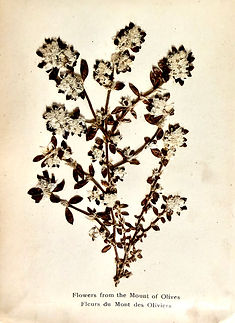
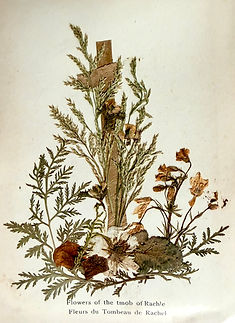
“Flowers from the Holy Land” is a turn-of-the-century Jerusalem botanical souvenir album for Holy Land pilgrims, with a beautifully bound olive wood cover, combining original photographs of the Holy Land with actual pressed flowers gathered from sacred sites, produced by Fr. Vester & Co. of the American Colony Stores in Jerusalem. Its delicate botanical presentation, preserved beneath the printed title Fleurs de Terre Sainte (“Flowers of the Holy Land”), captures the enduring appeal of Eretz Yisrael to travelers who sought to carry home a tangible remembrance of the biblical landscape. Among its evocative images is a specimen identified as “Flowers from the Mount of Olives,” linking the natural world of Jerusalem to one of the most revered and historically resonant places in the Holy Land. The album emerged from the remarkable story of the American Colony, a Christian community established in Jerusalem in 1881 by Anna and Horatio Spafford and later joined by Swedish immigrants. Drawn to Jerusalem by their religious convictions and expectations concerning the End of Days, the community gradually developed a distinctive presence in the city, engaging in charitable work, education, handicrafts, photography, and hospitality. Its members cultivated relationships with Jerusalem’s diverse communities and became known for their work documenting the city and surrounding region. As the Colony expanded, its commercial enterprises included the American Colony Stores near Jaffa Gate, where photographs and souvenirs were offered to the growing number of international visitors drawn to the Holy Land. The Mount of Olives, from which some of the album’s pressed flowers were gathered, holds a special place in the religious and historical imagination of Jerusalem. Rising east of the Old City across the Kidron Valley, it is associated in the Hebrew Bible with King David’s flight from Jerusalem and with the prophetic vision of the Lord standing upon the mountain in the end of days. It also became the site of the ancient Jewish cemetery that continues to overlook the Temple Mount, reflecting the profound Jewish tradition of burial in Jerusalem in anticipation of the messianic era and the resurrection of the dead. Across centuries, the mountain has drawn Jewish pilgrims, scholars, and worshippers, its slopes bearing witness to the enduring connection between the Jewish People and their ancestral capital. At the turn of the twentieth century, souvenirs such as this album offered visitors a way to preserve their encounters with a land whose significance extended far beyond its geography. The pressed flowers transformed the landscape itself into a keepsake, while the accompanying photographs connected the natural beauty of the region with the sacred places and historic streets of Jerusalem. Today, the album evokes an era when pilgrimage, photography, botanical collecting, and the emerging tourism trade intersected in the Holy City. It is a poignant material reminder of the timeless power of Eretz Yisrael to inspire devotion and wonder, and of Jerusalem’s extraordinary ability to connect the living landscape with the memory, faith, and aspirations of generations. 7x4.5in; 25 Pages; In Good Condition



HEBRON'S CAVE OF THE PATRIARCHS
BEZALEL STYLE HAND WOVEN EARLY CARPET
EARLY 20TH CENTURY, JERUSALEM, ERETZ YISRAEL
RESERVE: $1700 (estimate $2000-$2200)
This hand-woven Bezalel tapestry depicts the Cave of the Patriarchs in Hebron, one of the most sacred and historically significant sites in the Land of Israel. Created in Jerusalem during the early twentieth century, the textile combines traditional craftsmanship with the artistic stylistic vision of the Bezalel movement, which sought to establish a distinctive Jewish national art rooted in the history, landscapes, and biblical heritage of Eretz Yisrael. The Cave of the Patriarchs, known in Hebrew as Me’arat HaMachpelah, is traditionally identified as the burial place of Abraham and Sarah, Isaac and Rebecca, and Jacob and Leah, the patriarchs and matriarchs from whom the Jewish People trace their ancestry. The Book of Genesis recounts Abraham’s purchase of the Cave of Machpelah in Hebron as a burial place for Sarah, describing the transaction as a formal acquisition of land in Canaan. This biblical episode holds profound significance in Jewish tradition, connecting the beginnings of the Jewish people with a specific place in their ancestral Homeland. For millennia, Hebron has remained a destination of prayer, pilgrimage, and remembrance, its sacred associations extending across generations. The tapestry reflects the artistic ideals of the Bezalel School, founded in Jerusalem in 1906 by Boris Schatz to cultivate Jewish art and craftsmanship in the Land of Israel. Bezalel brought together European artistic influences and traditional Middle Eastern decorative forms, encouraging artisans to create works that expressed a renewed Jewish cultural identity. Its workshops explored a wide range of crafts, including metalwork, woodwork, textiles, and carpet weaving, incorporating biblical subjects and local landscapes into objects of artistic and cultural significance. The carpet-weaving tradition later continued through Marvadia, established in 1920 as a commercial continuation of Bezalel’s textile enterprise. The tapestry’s architectural composition, warm earthy colors, and decorative borders reflect this distinctive meeting of artistic traditions and national aspiration. The inscription beneath the central image identifies the scene as the Cave of the Patriarchs in Hebron and names Bezalel in Jerusalem, uniting the sacred place depicted with the artistic revival that produced the work. At a time when Jewish artists and craftspeople were helping shape the visual culture of a renewed Jewish presence in the Land of Israel, biblical sites became powerful subjects through which history, faith, and national identity could be expressed. This tapestry embodies that vision, transforming a revered landmark into a work of textile art that celebrates the deep roots of the Jewish People in Eretz Yisrael. 20.5 × 16.1 inches; In Good Condition

HOLOCAUST SURVIVORS OF BUCHENWALD ICONIC PHOTO
ALIYAH FROM CONCENTRATION CAMPS NEW YEARS CARD
1945, HAIFA, ERETZ YISRAEL
RESERVE: $1800 (estimate $2600-$3200)
This rare pre-statehood photographic New Year greeting card captures a profoundly moving moment in modern Jewish history: young Holocaust Survivors from Buchenwald raising a Jewish national flag as they make their way toward a new life in the Land of Israel. Photographed by Zoltan Kluger and published by Palphot in Mandatory Eretz Yisrael, the image unites the traditional Hebrew blessing L’Shanah Tovah, “For a Good Year,” with a powerful declaration of survival, national renewal, and hope after the catastrophe of the Holocaust. Sailing from Marseille, France, The RMS Mataroa arrived at the port of Haifa on July 15, 1945, carrying over 1,100 Holocaust Survivors, including 242 orphan children who had survived the Buchenwald concentration camp. Notably one of the child passengers was a young Yisrael Meir Lau (later the Chief Rabbi of Israel). Upon arrival, the British Mandatory authorities transferred many of the passengers to the Atlit Detention Camp before they were placed in kibbutzim and moshavim across the country. Buchenwald, established by Nazi Germany in 1937 near Weimar, became one of the largest concentration camps within the German Reich. American forces liberated the camp on April 11, 1945, revealing the horrific consequences of Nazi persecution and mass imprisonment. In the aftermath of liberation, Jewish Survivors faced the immense challenge of rebuilding lives shattered by persecution, the murder of their families, and the destruction of their communities. For many, the possibility of reaching Eretz Yisrael represented far more than finding refuge. It offered the prospect of living freely among fellow Jews and participating in the renewal of Jewish national life. The young men pictured here embody that extraordinary determination to survive and begin again. The flag raised above the survivors gives the photograph its enduring national significance. Its Star of David evokes the Zionist movement and the centuries-old Jewish connection to the Land of Israel, while the group’s determined expressions convey a sense of collective purpose. In the years immediately following the Holocaust, Jewish survivors became central to the struggle for a Jewish homeland, with many seeking to reach Mandatory Palestine despite British immigration restrictions. Their arrival helped shape the human story behind Israel’s establishment in 1948. Zoltan Kluger, one of the most important photographers working in pre-state Israel, documented the people, landscapes, and national aspirations of the emerging Jewish society. His photographs helped preserve the visual record of a generation determined to transform devastation into renewal. The Palphot greeting card adds another layer of meaning to this remarkable image. Its Hebrew inscription, L’Shanah Tovah, expresses the traditional Jewish wish for a good year, a blessing that takes on extraordinary emotional force when placed above survivors beginning their lives anew. Produced in Mandatory Palestine, the card transforms a photograph of historical significance into a message of hope, linking the Jewish New Year with survival, return, and the promise of a future in the ancestral homeland. The image stands as a testament to the resilience of the Jewish People: a generation that endured unimaginable suffering and nevertheless continued to raise its flag, rebuild its communities, and carry the dream of a renewed Jewish Homeland into reality. 2.5x3.5in; In Very Good Condition

EARLY ZIONIST TRAVEL POSTER
ISRAEL DEPARTMENT OF TOURISM
CIRCA 1950, TEL AVIV, ISRAEL
RESERVE: $4300 (estimate $5500-$6000)
This could be the State of Israel's first offical tourism poster created just after the War of Independence. It is a striking iconic design by artist Zvi Narkiss and celebrates the promise, beauty, and pioneering spirit of the young State of Israel. Issued around 1950 by the Department of Tourism in HaKirya, Tel Aviv, the colorful composition reimagines the biblical story of the spies who returned from the Land of Israel carrying an enormous cluster of grapes, transforming an ancient symbol of the Promised Land into a joyful invitation to discover the reborn Jewish Homeland. The poster draws directly upon the account in the Book of Numbers, when Moses sent the twelve spies. Returning from their mission, the scouts brought back grapes, pomegranates, and figs as evidence of the land’s extraordinary fertility. In one of the Bible’s most enduring images, the cluster of grapes was so immense that it had to be carried on a pole between two men. This scene became an emblem of the abundance of Eretz Yisrael and the Jewish People’s enduring connection to their ancestral Homeland. Narkiss gives the ancient narrative a distinctly modern Zionist interpretation, depicting youthful pioneers carrying a cluster of oversized grapes filled with miniature scenes of Israel’s landscapes, landmarks, and cultural achievements. Each grape becomes a window into the emerging state, illustrating the variety of experiences awaiting visitors to Israel. Among the recognizable scenes are the Habima Theatre, the Tower of David, agricultural orchards, a kibbutz, the Sea of Galilee, and the desert landscapes of the Negev. Together, these images present Israel as a country where biblical heritage meets contemporary nation-building, where ancient landscapes are renewed through agriculture, communal settlement, cultural institutions, and tourism. The young figures carrying the cluster evoke the pioneering generation whose labor and idealism helped build the state, while the grape motif links their achievements to the biblical promise of a fertile and flourishing Homeland. The multilingual inscription at the foot of the poster, identifying the State of Israel’s Department of Tourism in Hebrew’s national setting and in French and English, reflects the young country’s desire to welcome visitors from around the world. In the years immediately following independence in 1948, tourism offered a way to introduce international audiences to Israel’s historical treasures, revived Jewish national life, and extraordinary geographical diversity. Through its imaginative design and optimistic symbolism, this poster presents Israel as both an ancient homeland and a modern national achievement. It captures a formative moment when the imagery of the Bible was being reinterpreted through the visual language of Zionism, inviting the world to see the Land of Israel not only as the setting of sacred history, but as a living country being built by a new generation. 26.5x18.5in; In Good Condition with minor edge wear

JERUSALEM PANORAMA FROM THE MOUNT OF OLIVES
EARLY ENGRAVING OF TEMPLE MOUNT & MOUNT ZION
1837, GERMANY
RESERVE: $1200 (estimate $2000-$2200)
This nineteenth-century engraving, titled Prospect der Stadt Jerusalem vom Oelberge, or “View of the City of Jerusalem from the Mount of Olives,” presents a sweeping panorama of Jerusalem as seen from the east, across the Kidron Valley. Published in the German-speaking world around 1837 and associated with the cartographic tradition of Carsten Niebuhr, the view captures the ancient city before the great transformations of the modern era, preserving a vision of Jerusalem’s walls, densely clustered buildings, sacred landmarks, and surrounding hills. Jerusalem occupies a singular place in Jewish history, faith, and collective memory. For millennia, it has been the capital of ancient Jewish kingdoms, the location of the First and Second Temples, and the spiritual center toward which Jewish prayer is directed throughout the world. The Temple Mount, visible within the city’s monumental enclosure, evokes the site of the Temples that stood at the heart of Jewish religious life. Beyond the city walls, the Mount of Olives has its own profound significance in Jewish tradition, associated with ancient burial grounds, prophetic expectation, and the hope of redemption. The panorama brings these places into a single composition, allowing the viewer to contemplate the extraordinary concentration of sacred history within Jerusalem’s landscape. The engraving’s elevated perspective emphasizes the city’s compact, walled form, with tightly grouped houses, towers, and prominent religious structures rising above the surrounding terrain. The Kidron Valley, identified in the German caption as the Valley of Jehoshaphat, stretches across the foreground, while the label “Der Berg Zion” identifies Mount Zion to the left. Such panoramic views were important to nineteenth-century European geography and biblical scholarship, offering readers a visual understanding of places known through scripture, travel accounts, and historical study. The work reflects an era when European cartographers and illustrators sought to document the Holy Land with increasing geographical detail, combining observation with the enduring fascination Jerusalem held for audiences far beyond its walls. As a historical image, this panorama preserves a view of Jerusalem during the Ottoman period, more than a century before the establishment of the modern State of Israel. It depicts a city whose Jewish significance endured through centuries of changing empires and political circumstances, sustained by religious tradition, pilgrimage, and the longing of generations to return to Zion. The engraving’s German title and carefully ordered architectural detail also bear witness to the international interest in Jerusalem during the nineteenth century. Through its broad perspective, it offers a visual encounter with the city’s enduring landscape, connecting the Jerusalem of the past with the living center of Jewish history and the continuing bond between the Jewish People and their eternal capital. 11.5 × 6.5in; In Good Condition

'THE LIGHT OF CHRIST SHINES FOR ALL'
BYZANTINE OIL LAMP WITH GREEK INSCRIPTION
4TH CENTURY, ERETZ YISRAEL
RESERVE: $800 (estimate $1300-$2000)
Blessed is he who comes in the name of the Lord. From the house of the Lord we bless you. The Lord is God, and he has made his light shine on us. - Psalm 118:26-27 This fourth-century Byzantine oil lamp, made in the Holy Land, bears a remarkable Greek inscription proclaiming, “The Light of Christ Shines for All.” Created during the formative centuries of Christianity, when pilgrims journeyed to the holy sites, This mold-made ceramic vessel unites the practical function of an everyday object with a message of faith and spiritual illumination. Its inscription transforms a simple source of light into a declaration of faith. The Greek words φῶς Χριστοῦ φαίνει πᾶσιν express a central theme of scripture: light as a symbol of divine presence, revelation, and redemption. In the ancient world, oil lamps were indispensable household objects, yet they also carried symbolic significance in religious settings, where light evoked prayer, sacred presence, and the hope of salvation. During the Byzantine period, Christian symbols and inscriptions increasingly appeared on objects used in daily life, bringing expressions of religious devotion into homes, churches, and places of pilgrimage. The lamp’s design reflects the craftsmanship of ceramic workshops in the eastern Mediterranean. Its ring base provided stability, while the raised rim surrounding the filling hole helped contain the oil used to sustain the flame. The nozzle held the wick, and traces of burning preserve a physical reminder of the lamp’s original purpose. Above the nozzle, a stylized palm tree or Tree of Life motif introduces another layer of symbolism. In biblical and Christian traditions, the palm can evoke righteousness, victory, and eternal life, while the Tree of Life recalls the promise of life in the presence of God. Together with the inscription, the decoration gives the lamp a coherent spiritual message, joining the visible flame with the enduring promise of divine light. Produced in the Holy Land during the fourth century CE, this lamp belongs to an era when Christianity was becoming increasingly established throughout the Roman Empire and pilgrimage to sacred places was developing into an important expression of faith. Its Greek inscription reflects the language widely used across the eastern Mediterranean, while its imagery speaks to religious ideas that crossed regional and cultural boundaries. Nearly seventeen centuries later, the words remain compelling in their simplicity: light is not confined to a single place or people, but shines for all. Through its inscription, craftsmanship, and evidence of use, this ancient lamp offers a tangible connection to the spiritual world of Byzantine Christianity and the enduring significance of the Holy Land in Christian history. 3.5x2.5in; In Good Condition

PASSOVER HAGADAH PRINTED FOR
HOLOCAUST SURVIVORS ON ALIYAH
1948, MUNICH, GERMANY
RESERVE: $2300 (estimate $3000-$3600)
This rare Passover Haggadah, printed in Munich in 1948 by the American Jewish Joint Distribution Committee, was prepared for Holocaust Survivors displaced from their homes in Europe, offering the traditional message of the Festival of Freedom at a moment when the Jewish People stood on the threshold of a new chapter in their history. Its striking illustrated cover depicts Moses standing above a procession of Jewish refugees, gesturing toward the Land of Israel, with a map identifying Haifa, Tel Aviv, and Jerusalem. The Hebrew dedication, “To the Survivors of the Diaspora, with the blessings of the Festival of Freedom,” transforms this modest publication into a powerful expression of solidarity, renewal, and hope. The Passover Haggadah recounts the Exodus from Egypt, the liberation of the Israelites from slavery, and their journey toward the Promised Land. For generations, Jewish families have gathered at the Seder to retell this foundational story, declaring that freedom is not merely a distant historical event but a responsibility to be remembered and experienced anew. For Holocaust survivors in the aftermath of the Second World War, the Haggadah’s themes carried an extraordinary immediacy. Many had lost parents, spouses, children, and entire communities to Nazi persecution, and countless survivors were living in displaced persons camps while searching for relatives, rebuilding their lives, and determining where they might find a secure future. The image of Moses leading a people out of bondage offered a deeply resonant biblical parallel to their own struggle to emerge from catastrophe and reclaim their lives. The American Jewish Joint Distribution Committee, widely known as the JDC or the Joint, played a major role in assisting Jewish survivors in postwar Europe. It provided food, clothing, medical care, education, religious materials, and support for displaced persons as they sought to rebuild Jewish communal life. Printing this Haggadah in Munich, a city in the American occupation zone of Germany, brought the Passover message directly to survivors still living far from the homes and communities they had lost. Its cover places the biblical Exodus alongside the contemporary journey toward Eretz Yisrael, naming cities that represented both the ancient Jewish homeland and the emerging reality of a renewed Jewish national life. The image was especially poignant in 1948, as the United Nations partition plan, the end of the British Mandate, and the establishment of the State of Israel transformed the political landscape of the region. Israel declared independence on May 14, 1948, just weeks after Passover that year. This Haggadah thus brings together two defining moments of Jewish memory: the ancient liberation from Egypt and the modern struggle of Holocaust survivors to rebuild their lives and find a future. Its message does not erase the immense suffering that preceded it; rather, it gives voice to the determination to continue Jewish life despite that suffering. The figure of Moses points toward the land, while the procession of refugees embodies a people moving forward after devastation. Through the work of the JDC, a centuries-old ritual of freedom reached survivors at one of the most consequential moments in modern Jewish history. Printed in Munich in 1948, this rare Haggadah preserves a moving testament to Jewish resilience, the continuity of tradition, and the enduring hope of return to the Land of Israel. 32 Pages; In Good and Passover seder worn condition with the requisite wine stains from years of loved usage.

SECOND TEMPLE ERA STONE PURITY VESSEL
CARVED LIMESTONE FOR JEWISH RITUAL
CIRCA 1ST CENTURY CE, ERETZ YISRAEL
RESERVE: $4400 (estimate $6000-$7000)
This carved limestone vessel from the Second Temple period offers a tangible connection to the daily religious life of ancient Judea. Dating to approximately the first century CE, it belongs to a distinctive tradition of stone vessel production associated with Jewish communities in the Land of Israel, whose practices of ritual purity shaped both domestic routines and religious observance. Its simple, rounded form reflects the craftsmanship of ancient stoneworkers and the importance of vessels in a society deeply attentive to the sacred character of everyday life. The significance of stone vessels in this period is closely connected to the Jewish laws of taharah, or ritual purity, described in the Torah and developed through Jewish religious practice. Unlike pottery vessels, which could become ritually impure under biblical law, stone vessels were understood in Jewish tradition to be resistant to certain forms of ritual impurity. During the late Second Temple period, limestone vessels became especially common in Judea, with archaeological discoveries revealing their use in homes and settlements throughout the region. Their presence reflects the care with which many Jewish communities observed the requirements of ritual purity in daily life. The first century CE was a moment of extraordinary religious and historical importance for the Jewish people. Jerusalem stood at the center of Jewish spiritual life, with the Second Temple serving as the focal point of pilgrimage, sacrifice, and national worship. Jewish communities throughout Judea maintained religious practices that connected household life with the holiness of the Temple and the commandments of the Torah. Stone vessels formed part of this material culture, providing practical objects that also reflected religious commitments. Their widespread archaeological presence offers an intimate glimpse into the customs and beliefs of the people who lived in the Land of Israel during the final generations before the Roman destruction of Jerusalem and the Second Temple in 70 CE. This limestone vessel preserves a direct material connection to that ancient Jewish world. Its unadorned form speaks to a tradition in which the significance of an object could lie not in elaborate decoration but in its role within a life shaped by sacred law and inherited custom. Nearly two thousand years later, such vessels help illuminate the relationship between Jewish religious practice and the physical landscape of ancient Judea. As a remnant of the Second Temple era, this object evokes the homes, communities, and traditions of the Jewish people in their ancestral homeland during one of the most consequential periods in Jewish history. 5x4in; In Good but restored condition from cracking

HAND-COLORED MAP OF JUDEA WITH
TERRITORIES OF THE TWELVE TRIBES
1787, FRANCE
RESERVE: $2150 (estimate $3000-$3600)
This hand-colored copperplate engraving, titled Judaea seu Duodecim Tribus Israelis, or “Judea, or the Twelve Tribes of Israel,” was created in 1787 by the French cartographer Rigobert Bonne. Dividing the biblical Land of Israel into the territories traditionally associated with the twelve tribes, the map transforms the geography of Scripture into a carefully delineated landscape of mountains, rivers, ancient cities, and tribal boundaries. Its delicate coloring distinguishes the territories, while its Latin title reflects the enduring place of biblical geography in European scholarship and cartography. The division of the Land of Israel among the twelve tribes is central to the biblical account of Jewish nationhood. Following the Exodus from Egypt and the Israelites’ forty years of wandering in the wilderness, Joshua led the people into Canaan, where the land was apportioned among the tribes according to the biblical narrative. Each territory became associated with particular cities, landscapes, and historical events, establishing a geographical framework that would shape Israelite history throughout the biblical period. From Judah in the south to the territories of the northern tribes, the map evokes the ancestral homeland in which the Israelites established their communities and developed the religious, cultural, and political traditions that became foundational to Jewish civilization. Bonne’s map extends beyond the western bank of the Jordan River to depict the regions east of the river, including territories associated with the ancient kingdoms of Ammon, Moab, and Edom. The Mediterranean coastline, the Dead Sea, the Jordan Valley, and the mountain ranges of the interior provide geographical context for the biblical landscape. Cities such as Jerusalem, Hebron, Jericho, and other locations familiar from the Hebrew Bible anchor the composition in the places where the narratives of the patriarchs, the conquest of Canaan, the Israelite kingdoms, and the prophets unfolded. By bringing these locations together in a single image, the map makes the geography of biblical history accessible to readers living more than two millennia after the events it seeks to represent. Rigobert Bonne was a prominent French cartographer of the eighteenth century whose work contributed to the development of systematic European mapmaking. During this period, maps of biblical lands served religious scholars, historians, travelers, and readers seeking to understand the geographical settings of sacred texts. This engraving reflects that intellectual tradition while preserving a visual record of how the Land of Israel was understood and represented in the European imagination. More than a geographical document, it presents the territories of the twelve tribes as a coherent ancestral landscape, connecting the biblical account of Jewish nationhood with the enduring historical and spiritual relationship between the Jewish People and Eretz Yisrael. 14x9.5in; In Good Condition

"THEY CAME TO THE ESHKOL VALLEY & CUT A CLUSTER OF GRAPES" NUMBERS 13:23
HAMMERED PLATTER OF THE SPIES
MID-20TH CENTURY, IRAN
RESERVE: $1150 (estimate $1800-$2100)
This beautifully hammered Persian tinned-copper platter, created in the early to mid-twentieth century, depicts the biblical spies carrying the enormous cluster of grapes brought back from the Valley of Eshkol. Encircling the central relief is an inscription quoting Numbers 13:23, recalling the moment when the explorers sent by Moses gathered the fruit of Israel as evidence of the land’s extraordinary abundance. Combining traditional Persian metalworking with one of the most enduring images in Jewish biblical history, the platter brings together artistic craftsmanship, sacred text, and the ancient Jewish connection to Eretz Yisrael. The biblical episode unfolds when Moses sends twelve representatives of the tribes of Israel to explore the Land, examining its inhabitants, cities, soil, and produce. After forty days, the scouts return carrying grapes, pomegranates, and figs. The Torah describes the cluster of grapes as so immense that it had to be carried on a pole between two men, creating an unforgettable image of the fertility of the Promised Land. The verse engraved on this platter preserves that moment: “And they came unto the Valley of Eshkol, and cut down from thence a branch with one cluster of grapes.” The Hebrew name Eshkol itself means “cluster,” linking the place forever with the abundant fruit described in the biblical narrative. The relief at the center of the platter translates the scriptural account into a striking visual composition, with two figures supporting a great cluster of grapes between them. The surrounding Hebrew inscription frames the scene as both an illustration and a celebration of the biblical text. Persian Jewish communities maintained rich traditions of craftsmanship and religious artistic expression, creating objects that brought Jewish stories and symbols into everyday life. This platter reflects that cultural encounter, joining the visual language of Persian metalwork with a narrative central to Jewish collective memory. Its hammered surface and carefully worked details give physical form to a story transmitted through generations of Torah study, ritual, and family tradition. The image of the grape-bearing spies has endured for centuries as a symbol of the richness of Eretz Yisrael and the Jewish people’s enduring bond with their ancestral homeland. In modern Israel, the motif remains familiar in tourism and national imagery, linking the biblical promise of abundance with the landscapes and agricultural life of the present. This Persian platter preserves that powerful connection in an object shaped by Jewish artistic heritage beyond the borders of the Land of Israel itself. Its inscription and central relief celebrate not only the fertility of the Promised Land, but also the remarkable continuity of Jewish tradition across generations and throughout the Diaspora. 8in Diameter; In Very Good Condition

FEAST OF THE TABERNACLES SUKKOT ANTIQUE DIE CUT
ZECHARIAH 14: A DAY OF THE LORD IS COMING WHEN ALL NATIONS WILL GATHER IN JERUSALEM AT THE END OF DAYS
CIRCA 1900, GERMANY
RESERVE: $180 (estimate $250-$350)

'The Lord will be king over the whole earth. On that day there will be one Lord, and his name the only name...the survivors from all the nations that have attacked Jerusalem will go up year after year to worship the King, the Lord Almighty, and to celebrate the Festival of Tabernacles.'- Zechariah14 This elaborately beautiful antique die-cut chromo-lithograph embossed illustration depicts a Jewish family gathered around the festive Shabbat table in a decorated sukkah for Sukkot, the Feast of Tabernacles. Framed by lush greenery, flowers, and a canopy of foliage, the scene celebrates the warmth of Jewish family life and the enduring traditions of the biblical harvest festival. Beyond its charming presentation, the image evokes one of the most remarkable prophetic visions in the Hebrew Bible: the day when all nations will recognize Jerusalem’s spiritual significance and gather there to celebrate the Feast of Tabernacles. Sukkot commemorates the forty years during which the Israelites journeyed through the wilderness after the Exodus from Egypt, dwelling in temporary shelters under the protection of Divine providence. It is also one of the Torah’s three pilgrimage festivals, when the people of Israel were commanded to rejoice before God and, in the days of the Jerusalem Temple, to make pilgrimage to the sacred city. The sukkah itself recalls the fragile dwellings of the wilderness and the Divine protection that sustained the Israelites on their journey toward the Promised Land. The festival’s themes of gratitude, hospitality, harvest, and dependence upon God have made it a central celebration of Jewish religious life for thousands of years. The prophetic significance of Sukkot reaches a remarkable culmination in Zechariah 14, which envisions a future in which the nations of the world will ascend to Jerusalem year after year to worship the King and celebrate the Feast of Tabernacles. The chapter describes a dramatic confrontation over Jerusalem, Divine intervention, and the transformation of the city’s place in the world. Its concluding verses declare that even the nations that once stood apart will be expected to observe Sukkot, presenting the festival as a universal expression of recognition and reverence for God. This vision gives the holiday a significance extending beyond the Jewish People alone, portraying Jerusalem as the spiritual center of a future age of Divine sovereignty and universal acknowledgment. The image of a family celebrating Sukkot therefore carries meaning beyond the domestic scene it portrays. The intimate joy of the holiday becomes connected to the larger biblical hope for Jerusalem and the ultimate gathering of humanity in peace and worship. The festival’s concluding observance, Shemini Atzeret, the Eighth Day of Assembly, adds another dimension to its spiritual symbolism, marking a distinct sacred gathering immediately after the seven days of Sukkot. Through its richly ornamented frame and depiction of Jewish life, this antique illustration preserves the beauty of a living tradition while evoking the extraordinary prophetic vision in which the celebration of Sukkot extends from Jewish homes to the nations of the world gathered in Jerusalem.
ANGEL METATRON TERRACOTTA TILE
BYZANTINE-ROMAN ERA WITH HALO
CIRCA 6TH CENTURY, CARTHAGE
RESERVE: $5000 (estimate $7000-$9000)
This Byzantine-era terracotta tile, attributed to sixth-century Carthage in North Africa, features a mold-made face surrounded by a radiant halo or sunburst, rendered in low relief. Its central visage is framed by a circle of impressed pellets resembling rays of light, creating a striking image of celestial presence. The tile evokes the religious imagination of late antiquity, when artisans employed radiant halos and stylized human faces to express ideas of sanctity, heavenly authority, and the supernatural realm. The figure has been identified as the angel Metatron, one of the most prominent and enigmatic beings in Jewish mystical tradition, Kabbalah, and rabbinic literature. Although Metatron is not mentioned by name in the Hebrew Bible, he occupies an extraordinary position in later Jewish mystical writings. Often known as Sar ha-Panim, the “Prince of the Presence,” he is portrayed as a high-ranking celestial figure who stands close to the Divine throne and serves as a heavenly minister and spokesman. His other roles include that of the heavenly scribe, recording human deeds in celestial books, and a teacher who imparts Torah to children in the heavenly realm. One of the most remarkable traditions concerning Metatron appears in Sefer Hekhalot, also known as the Third Book of Enoch. In this mystical work, the biblical patriarch Enoch, described in Genesis as having “walked with God,” is taken into heaven and transformed into the exalted angel Metatron. The text depicts his transformation into a radiant celestial being of immense stature and extraordinary light, entrusted with responsibilities within the heavenly court. This association connects Metatron with ancient Jewish reflections on spiritual ascent, divine judgment, and the mysteries of the heavenly world. The tile’s face framed by a sunburst offers a compelling visual parallel to these descriptions of celestial radiance, although its identification as Metatron remains a proposed interpretation rather than an established archaeological fact. Attributed to Byzantine-era Carthage, the tile belongs to the wider artistic world of late antiquity, when North Africa was an important center of Roman and Byzantine culture. Mold-made terracotta objects allowed artisans to reproduce decorative designs, while the low-relief modeling and repeated impressed details gave surfaces texture and depth. Radiant halos and sunburst motifs appeared in the art of the ancient Mediterranean as visual expressions of sanctity, authority, and supernatural presence. The tile therefore offers a fascinating point of departure for exploring the ways ancient communities imagined the celestial realm, and how visual symbolism could communicate ideas about beings believed to stand between the human and divine worlds. Metatron’s enduring place in Jewish mysticism reflects the extraordinary richness of Jewish traditions concerning angels, heavenly realms, and the mysteries of creation. From the biblical account of Enoch to the elaborate cosmologies of later mystical literature, his story explores the possibility of transformation beyond ordinary human existence and the relationship between earthly life and divine presence. Whether or not this terracotta image was intended to represent Metatron, its radiant face invites reflection on the spiritual imagination of the ancient Mediterranean and the many ways sacred figures were represented through art. Preserved across the centuries, the tile offers a tangible connection to a world in which religious symbolism, artistic expression, and the search for heavenly understanding were deeply intertwined. 7.34in Square; In Good Condition

BETHLEHEM NATIVITY SITE MINIATURE PAINTING
ANTIQUE BEVELED GLASS ORMOLU CASKET BOX
LATE 19TH CENTURY, FRANCE
RESERVE: $1100 (estimate $2000-$2600)
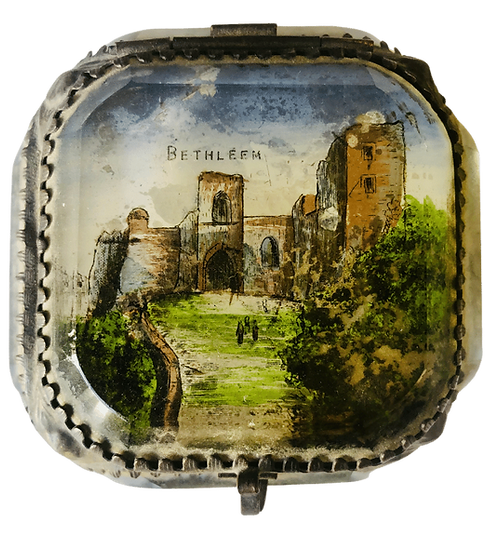
"But as for you, Bethlehem Ephrathah, Too little to be among the clans of Judah; From you One shall come forth for Me who is to be Ruler in Israel, His goings forth are from long ago, From ancient days" - Micah 5:2 This exquisite Victorian-era casket box features a delicate miniature painting of Bethlehem, identified by the inscription “Bethléem” above its historic architecture. Set beneath beveled glass and framed by ornate gilt-metal fittings, the painted scene captures the romantic fascination with the Holy Land that flourished in nineteenth-century Europe. Combining French decorative craftsmanship with imagery of one of Christianity’s most revered biblical sites, the box reflects the era’s enduring desire to preserve the memory of sacred places through finely made objects. Bethlehem holds a central place in biblical history and religious tradition. Located south of Jerusalem in the Judean hills, the town is known in the Hebrew Bible as the birthplace of King David, Israel’s celebrated king and the ancestor of the Davidic dynasty. The Book of Samuel recounts how David was anointed by the prophet Samuel in Bethlehem, establishing the town’s enduring significance in Jewish history. During the Victorian period, European interest in the Holy Land grew through pilgrimage, travel writing, archaeological exploration, and the circulation of illustrated souvenirs. Miniature paintings of Jerusalem, Bethlehem, and other biblical locations allowed travelers to preserve memories of sacred landscapes, while those who had never visited the region could acquire tangible reminders of places known through scripture. French craftsmen were renowned for decorative boxes and caskets that combined glass, gilt metal, and carefully finished interiors, transforming practical containers into objects of beauty and sentiment. This example’s architectural scene, with its fortified-looking buildings, greenery, and tiny figures, reflects the picturesque visual language through which nineteenth-century artists and travelers often represented the historic towns of the Holy Land. Designed to hold jewelry or other treasured keepsakes, the casket brings together the intimacy of a personal object and the wider significance of a sacred landscape. Its beveled-glass panels, ornate metalwork, and silk-lined interior reflect the Victorian taste for richly decorated objects that preserved both memories and meaningful associations. The miniature view of Bethlehem offers a window into the nineteenth-century fascination with the biblical world, connecting European craftsmanship with a town whose significance reaches back through the histories of ancient Israel. It is a charming expression of the enduring power of the Holy Land to inspire art, devotion, pilgrimage, and remembrance. 3.25 x 2.5in; Brass, Glass, & Silk, In Good Condition

'AND THE LORD SAVED DAVID WHEREVER HE WENT'
WWI ENGRAVED TRENCH ART BRASS ARTILLERY SHELL
1916, MILWAUKEE, WISCONSIN
RESERVE: $3360 (estimate $4500-$6000)
This engraved brass artillery shell casing was manufactured in 1916 during the First World War by the Federal Pressed Steel Company of Milwaukee Wisconsin. It was later transformed into a work of trench art, bearing beautiful Islamic motifs and a stirring biblical inscription: “And the Lord saved David wherever he went.” Drawn from the account of King David’s victories in the Hebrew Bible, the verse turns an object associated with modern warfare into a meditation on divine providence, courage, and the enduring legacy of Israel’s ancient monarchy. Its elaborate Hebrew lettering and intricate ornamental engravings reflect the tradition of soldiers repurposing spent artillery casings into commemorative objects during the long and devastating conflict. The inscription appears in 2 Samuel 8:14, following the biblical account of David’s military campaigns and the establishment of his authority over Edom: “And the Lord preserved David wherever he went.” A parallel passage appears in 1 Chronicles 18:13. These words present David not simply as a victorious warrior, but as a king whose achievements were understood within the framework of his covenantal relationship with God. In Jewish tradition, David occupies a unique place as the king who established Jerusalem as the political and spiritual capital of ancient Israel and whose dynasty became central to the biblical vision of future redemption. The verse engraved on this casing therefore evokes both the historical power of David’s kingdom and the spiritual legacy associated with his name. The use of Hebrew scripture on a wartime object creates a striking connection between the ancient Kingdom of Israel and the upheavals of the modern world. During the First World War, soldiers and military personnel frequently transformed spent artillery casings and other battlefield materials into decorative objects, a practice now widely known as trench art. These pieces often incorporated elaborate engraving, geometric ornament, inscriptions, and commemorative designs, turning the industrial products of warfare into personal expressions of memory, identity, and craftsmanship. Here, the flowing Hebrew inscription is accompanied by intricate arabesques and interlaced motifs that give the brass surface the appearance of a ceremonial vessel. The biblical verse offers a message of preservation and victory amid a conflict that brought unprecedented destruction across Europe. The casing thus brings together several layers of history: the military technology of the First World War, the ingenuity of trench-art craftsmanship, and the enduring words of the Hebrew Bible. Nearly three thousand years separate the biblical world of King David from the battlefields of 1916, yet the inscription preserves a verse that has continued to resonate across generations of Jewish history. Its transformation from an instrument of war into an engraved object bearing sacred text is especially compelling, reflecting the capacity of inherited tradition to provide meaning even amid violence and uncertainty. Through its Hebrew dedication and finely worked ornament, this unusual artifact links the legacy of ancient Israel with the lived experience of the modern age. 8.5 Height x 3in Diameter; In Very Good Condition

SIX-DAY WAR IDF CENTRAL COMMAND COMBAT PAGE
'THE WESTERN WALL & TEMPLE MOUNT IS IN OUR HANDS'
JUNE 8TH 1967, JERUSALEM, ISRAEL
RESERVE: $1400 (estimate $2000-$2200)
This historic battlefield bulletin, issued by the Israel Defense Forces’ Central Command on June 8, 1967, captures the extraordinary moment when Jerusalem’s Old City and the Western Wall came under Israeli control during the Six-Day War. Printed for internal distribution to IDF soldiers just one day after Israeli forces reached the Western Wall, the two-sided publication combines an official proclamation by Major General Uzi Narkiss, a contemporary battle report, a map of the Old City, and photographs documenting the first moments at the sacred site. Its headline declares: “Today We Have Entered Your Gates, Jerusalem, City of David and Solomon, in the Hands of the Armies of Israel.” The bulletin records the events of June 7, 1967, when Israeli paratroopers entered the Old City through the Lions’ Gate after intense fighting across Jerusalem. The city had been divided since the 1948 Arab-Israeli War, and the Old City, including the Western Wall, had remained under Jordanian control for nineteen years. The advance through the Old City brought Israeli soldiers to the ancient stones of the Western Wall, a remnant of the retaining wall surrounding the Second Temple complex and one of Judaism’s most sacred places. The bulletin’s map identifies the gates of the Old City, the Temple Mount, and the Jewish Quarter, grounding the emotional narrative in the actual geography of the battle and the historic landscape of Jerusalem. One of the most moving passages describes the soldiers standing before the Western Wall, many exhausted and grieving fallen comrades. The report recounts tears, the singing of Hatikvah, the arrival of Chief Military Rabbi Shlomo Goren carrying a Torah scroll, and the sounding of the shofar. General Uzi Narkiss’s proclamation honors the troops and declares that the day would remain forever in the hearts of the Jewish people. Another article, signed by journalist Didi Menusi, reflects on the significance of the moment, describing it as a victory not only of military planning and organization, but of the heart and the historic aspirations of a people. The reverse features photographs of officers saluting the Wall, soldiers standing in prayer, and Rabbi Goren embracing Narkiss, creating a visual record of the powerful convergence of military events, national memory, and religious emotion. For the Jewish People, Jerusalem is inseparable from the history of the ancient kingdoms of Israel and Judah, the First and Second Temples, and generations of prayer directed toward Zion. The Western Wall has remained a focal point of Jewish longing and pilgrimage through centuries of exile and changing political rule. This bulletin preserves the immediate voice of June 1967, when the events of the battlefield were being recorded as they unfolded and the significance of the moment was still fresh. As an official military publication produced within a day of the breakthrough, it offers a contemporary documentary record of a turning point in modern Israeli history, capturing the words, images, and emotions surrounding the return of Israeli soldiers to one of the most consequential sites in Jewish historical and spiritual memory. 9.5x13.5in; In Good Condition


RACHEL'S TOMB VINTAGE PILGRIM'S SHELL
HAND-CARVED IN MOTHER OF PEARL
MID-20TH CENTURY, BETHLEHEM, ISRAEL
RESERVE: $900 (estimate $1400-$2000)
This hand-carved mother-of-pearl pilgrim’s abalone shell depicts Rachel’s Tomb, the traditional burial place of the biblical matriarch Rachel, near Bethlehem. Created in Bethlehem in the mid-twentieth century, the iridescent shell combines the natural beauty of mother-of-pearl with intricate craftsmanship and a representation of one of the most revered sites in Jewish tradition. The Hebrew inscription identifying the tomb and the delicately carved architectural image transform this devotional souvenir into a tangible expression of the enduring connection between the Jewish People and the sacred landscapes of Eretz Yisrael. Rachel holds a uniquely tender place in the biblical story of the Jewish people. In Genesis, she is the beloved wife of Jacob and the mother of Joseph and Benjamin, whose descendants became central to the history of the Israelite tribes. The Torah recounts her death during the journey to Efrat, identified with Bethlehem, and describes Jacob erecting a memorial over her grave. Her burial place became a site of remembrance and prayer, associated with maternal devotion, sacrifice, and the enduring bonds between generations. In the biblical imagination, Rachel’s story extends beyond her own lifetime, becoming intertwined with the fate and hopes of her descendants. The spiritual significance of Rachel is further expressed in Jeremiah 31:15, which portrays Rachel weeping for her children, refusing to be comforted because they are gone. Jewish tradition interprets this poignant passage as an image of a mother grieving for her scattered descendants, linking Rachel to the suffering of the Jewish People in exile and to the hope of their eventual return. The prophet’s words continue with a promise of consolation and restoration, declaring that her children will return from the land of the enemy. Rachel’s Tomb has consequently become a destination of pilgrimage for generations of Jews, who have come to pray for family, children, healing, and the welfare of the Jewish People. Its significance lies not only in its association with the matriarch’s burial, but also in the profound emotional connection between Rachel and the generations that followed her. Bethlehem’s artisans developed a distinctive tradition of carving mother-of-pearl into religious souvenirs for pilgrims visiting the Holy Land. The material’s luminous, changing colors lend the shell a remarkable visual depth, while the carved tomb creates a miniature architectural portrait of a sacred place. Such objects carried memories of pilgrimage across continents, allowing travelers to preserve a tangible connection to the sites associated with biblical history. This shell unites the artistry of Bethlehem with the enduring story of Rachel, whose memory has remained a source of comfort and hope throughout Jewish history. Through its delicate craftsmanship and sacred subject, it reflects the powerful continuity of tradition and the lasting spiritual significance of the Land of Israel. 7x5in; In Good Condition

TEMPLE MOUNT ALTAR FEAST OF THE TABERNACLES
EARLY ENGRAVING OF FINAL SUKKOT CELEBRATIONS
1683, AMSTERDAM, NETHERLANDS
RESERVE: $3200 (estimate $4000-$5400)
This finely detailed etching by Dutch artist Jan Luyken (1649–1712), created around 1683, depicts a mass celebration on the Temple Mount. Specifically the artwork shows Hosanna Rabba, the great celebration associated with the seventh and final day of Sukkot, the Jewish Feast of Tabernacles. Published in connection with Petrus Cunaeus’s influential work on the ancient Hebrew commonwealth, the engraving presents a ceremonial gathering in a monumental courtyard inspired by descriptions of the Temple in Jerusalem. Its richly populated composition, elaborate architecture, ceremonial processions, and carefully rendered ritual activity reflect the intense European fascination with biblical history and the religious customs of the Jewish People during the seventeenth century. Hoshana Rabbah, literally “the Great Hoshana,” is the culminating day of the seven-day Sukkot festival. In Jewish tradition, the day is marked by extended prayers for salvation and blessing, including the procession around the synagogue with the Four Species and the custom of beating willow branches, known as aravot. These observances preserve themes of supplication, Divine protection, and hope for the coming year. Sukkot itself commemorates the Israelites’ journey through the wilderness after the Exodus from Egypt and celebrates the harvest, while its ancient Temple observances included distinctive ceremonies involving water, palm branches, and rejoicing in Jerusalem. The festival’s rich ritual life made it a subject of particular interest to European scholars seeking to understand the practices of biblical Israel. Various artists and writers frequently interpreted Jewish festivals through this theological framework, presenting their rituals as settings for events in the Bible. Luyken’s image belongs to this broader tradition of biblical illustration, combining the visual grandeur of an imagined Temple courtyard with the ceremonial atmosphere of a major religious gathering. Petrus Cunaeus’s De republica Hebraeorum, widely known in Dutch as De republyk der Hebreen, explored the political institutions and laws of the ancient Hebrew commonwealth and became an important work in early modern European discussions of biblical government. Illustrations such as Luyken’s helped bring the ancient world to life for readers, blending scholarly interest with the artistic imagination of the period. This etching preserves a fascinating chapter in the European reception of Jewish history and ritual, reflecting both the enduring influence of the Hebrew Bible and the efforts of early modern scholars and artists to reconstruct the ceremonial world of ancient Jerusalem. 12x6.5in; In Good Condition

EARLY HAND-CRAFTED FLAG
STATE OF ISRAEL
MID-20TH CENTURY, ISRAEL
RESERVE: $360 (estimate $600-$800)
We love seeing these retired old flags honored in style when framed prominently on the wall. Nothing compares to the pride one feels when knowing that the star and stripes of Israel’s blue and white flag had a long life fluttering in the breeze. Few symbols carry as much weight and meaning as the iconic blue and white flag of the State of Israel. More than a national emblem, it represents the enduring unity of the Jewish People, our faith, and our mission as a light unto the nations. This hand-crafted linen flag, sewn during the earliest days of Israel’s modern statehood, is a poignant tribute to the sacrifices and triumphs of the Zionist pioneers who transformed an ancient dream into a living reality. With its simple yet profound design, the Star of David flanked by two blue stripes symbolizing the traditional tallit, Israel’s flag has become a powerful representation of the Jewish journey. It embodies the painful past, resilient present, and hopeful future of the Jewish People, uniting those at home and abroad in shared heritage and purpose. This flag, lovingly sewn by hand, likely waved proudly in the years surrounding Israel’s founding, a time when the sacrifices of Israel’s founding Zionists forged the path to independence. It stood as a beacon of hope for generations, weathering the winds of a newly established homeland and symbolizing the collective resolve of a people who overcame insurmountable odds to achieve self-determination. Whether displayed prominently in a home, office, or institution, this historic flag serves as both a striking artifact and an enduring reminder of the ideals upon which the State of Israel was founded. This extraordinary piece invites us to honor the legacy of Israel’s creation and celebrate the unity and perseverance that continue to define the Jewish People. A timeless addition to any collection of Zionist history or Judaica, it stands as a testament to the enduring spirit of a nation and its People. 52x43in; In Good Condition with minor wear from fluttering in the wind, overseeing the rebirth of the Jewish People in Land of Israel.


